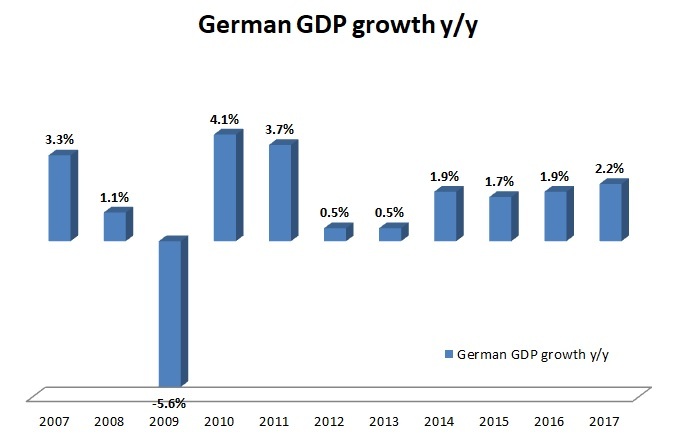
German GDP rises 2.2% in 2017


One might say it is not a big deal for the German GDP to rise 2.2% over the year in 2017. But those who dare to think so must be as arrogant as Hitler as the German economic growth was estimated at around 1.5% a year ago.
The good news is that the German economy continues to expand at full strength also without the proper government as Angela Merkel is holding talks with various political parties for the fourth month in a row.
Although it is rather unusual for the Statistical authorities to release the full year GDP estimate without showing the details of the fourth quarter, for the market analysts and commentators this is a cheerful piece of news. Especially with the German economy driven by a broad variety of factors.
The economic growth in Germany is also driving the other economies of the Eurozone higher releasing the pressure on European governments to save. Unlike Germany, most of the Eurozone member states struggle to keep balanced finances and most of them exceed the Maastricht debt-to-GDP criteria.
While GDP is rising at the highest growth rate in Germany since 2011, the momentum is expected to prolong into 2018. The top European research institutes released their forecast for the first half of 2018 saying the GDP growth rate in the Eurozone is expected to remain at the pace from late 2017.
German GDP growth supported by all components
German domestic demand was the main driver of German GDP growth in 2017. While household final consumption rose 2.0% from the previous year, the government final consumption was up 1.4%. Among the other segments of domestic demand, it was the gross fixed capital formation that rose above the average of 3.0%, increasing by 3.5% in 2017.
Gross fixed capital formation is a nasty statistical term, so let’s talk about investment instead, as it sounds more informal.
Investment in construction industry rose 2.6% in 2017 while investment in machinery and equipment increased 3.5% in 2017. The research and development investment also rose 3.5% in 2017.
While inventories as the smallest part of GDP rose 0.2%, the export performance of German economy improved with exports rising 4.7% in 2017, contributing to overall GDP growth by 0.2% after discounting imports.
German GDP growth 2007-2017
Author
Mario Blascak, PhD
Independent Analyst
Dr. Mário Blaščák worked in professional finance and banking for 15 years before moving to journalism. While working for Austrian and German banks, he specialized in covering markets and macroeconomics.

















