Georgia: Parliamentary elections could heighten instability and pressure social-political risks

Georgia’s coming elections highlight its balancing act between managing ties with the West and a complex relationship with Russia. Competing visions for the nation’s future, challenging geopolitics and sanctions risks threaten political and economic stability.
After Ukraine, Georgia is the most geopolitically at-risk of the 40 sovereigns rated publicly by Scope Group. This is reflected in the BB long-term credit ratings Scope has assigned to Georgia, which include an extraordinary one-notch downward adjustment for geopolitical risk.
This one-notch adjustment considers the geographical border with Russia, tensions around the separatist regions of South Ossetia and Abkhazia, and the spectre of an escalation in the conflict given the changing aspirations of the Russian government. Such risks have risen following Russia’s full-scale war in Ukraine. Only if the war ends poorly for Russia do such dangers for Georgia ease.
Georgia’s political situation looks precarious ahead of the elections
As Georgia approaches its parliamentary elections on 26 October, the political landscape remains precarious. The elections follow large-scale demonstrations during and after the passing by June of a Russian-inspired “foreign agents law”, which enforced stricter controls on international and specifically pro-western civic organisations ahead of the elections.
This year’s elections are decisive given Geogia’s transition to a fully parliamentary system. The presidency, until this year directly elected and currently held by the pro-European politician Salomé Zourabichvili, will late this year be chosen by an electoral college composed of members of the next parliament alongside local and regional authorities. If parliament remains under the ruling Georgian Dream (GD) party, the presidency may change hands – doubling the stakes for the pro-EU majority of the electorate.
Opinion polls suggest that GD has been losing voter support. Many polls place the party with around 30%-40% of nationwide support, which does not necessarily guarantee re-election after 12 years in power. But given recent history and the slippage of democratic norms around elections, it may be hard for many to imagine the party losing this election and handing over power to the opposition. Reports of Russian interference elevate uncertainty.
GD itself has announced that if elected with a so-called constitutional majority of a minimum 113 of the 150 seats in parliament, it plans to ban the “collective National Movement” – the main pro-Western opposition groups – from further political participation.
Consolidation of power could accelerate unpredictable regime changes
Although securing such a parliamentary super-majority may on the surface appear difficult to obtain based on latest polls, the threat to abolish political rivals worsens the polarised political climate and places the opposition and pro-western core of Georgian civil society in an existential contest this weekend.
Growing tensions in Georgia may have parallels with the experience of Ukraine during the early 2010s of a nation having a Russian-leaning government facing a problem of democratic legitimacy seeking to sustain close ties with Moscow while most voters want to move nearer the orbit of the European Union and the US.
Georgia’s governance deteriorates in historical parallels with Ukraine
World Bank Governance indicators range from -2.5 (weak) to +2.5 (strong).
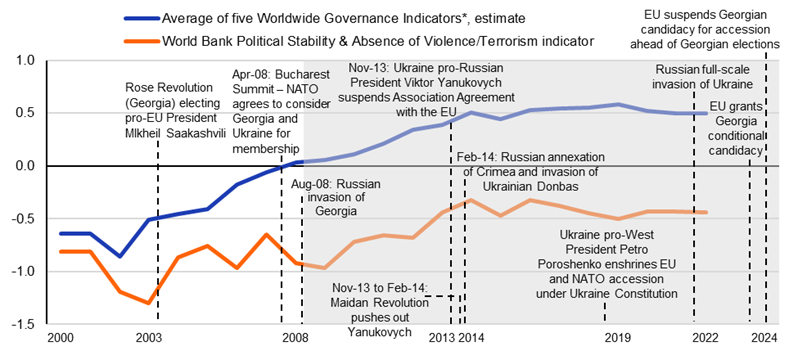
*Average of the following five World Bank Worldwide Governance Indicators: Control of Corruption, Voice and Accountability, Rule of Law, Government Effectiveness, and Regulatory Quality. X-axis is centred at the mid-point of each calendar year. Source: World Bank, Scope Ratings.
Georgia’s drifts towards Russia threaten institutional integrity
The pro-Russian drift exposes Georgia to institutional degradation alongside a risk of escalation of western sanctions given the context of Russia’s war in Ukraine and the intensified western sanctions regime against Moscow.
The US recently suspended USD 95m of aid for Georgia and has contemplated curbs on long-standing defence co-operation. The EU suspended accession negotiations of Georgia alongside EUR 30m in payments this year under the European Peace Facility. Recognising the drift of Georgia, the final declaration of this year’s NATO summit did not reference Georgia’s prospects of membership for the first time since 2008.
At this stage, sanctions on Georgia remain highly targeted and restricted in scope in the hope they encourage Georgia to resume a former role as a beacon of democratic transition among the post-Soviet republics rather than push Georgia further into Russia’s embrace.
Sanctions risks exacerbate economic vulnerabilities
Nevertheless, further drift towards Russia might necessarily present meaningful risk for Georgia’s economy. The International Monetary Fund already suspended a Stand-by Arrangement, representing a USD 280m insurance policy against economic risks after Georgia’s failure last year to observe specific US sanctions. Official reserves remain below their peaks, standing at USD 4.7bn, around 105% coverage of short-term external debt, in September this year after the crisis around the foreign-agents law earlier this year.
Geopolitical risk remains elevated
In the context of current geopolitics, it might be sensible in the long run for Georgia to promise to join the EU while seeking to ensure relations with Russia do not fray in the near term. Georgian authorities need to consider the legacy of three wars against Russia including the military defeat of 2008 when the country received limited military support from the US and allies during the Russian invasion. Commitments by GD to re-integrate the breakaway regions of Abkhazia and South Ossetia, however unrealistic, require the government to co-operate closely with Russia.
US elections might prove consequential: whereas a Kamala Harris presidency may mean more of the same drift for Georgia, a re-election of Donald Trump holds uncertain consequences for Georgia given his promises of ending the war in Ukraine by withholding US budgetary support for Ukraine to achieve lasting peace.
Author

Dennis Shen
Scope Ratings
Dennis Shen is Chair of the Macroeconomic Council and Lead Global Economist of Scope Ratings, the European rating agency, based in Berlin, Germany.