|

GDX Elliott Wave View: Found Buyers in Blue Box and Rallied

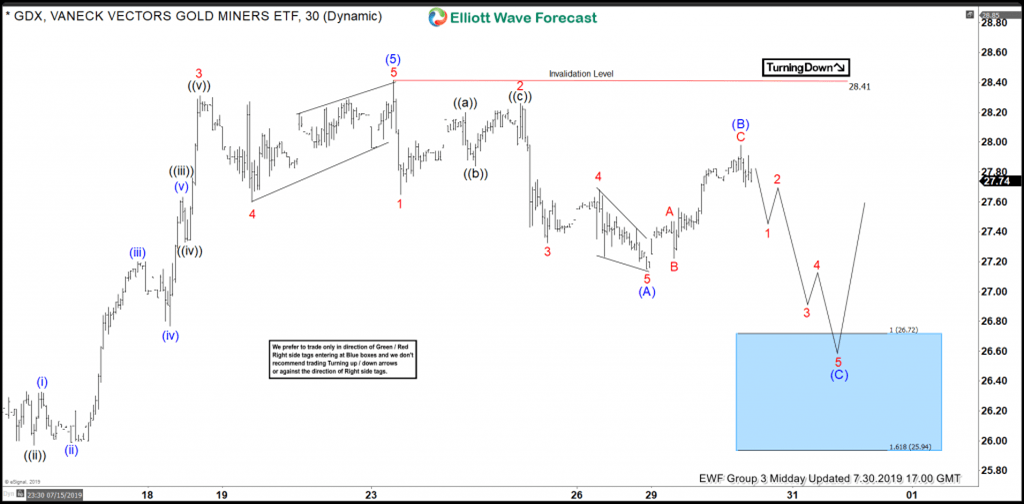
Hello fellow traders. Today, I want to share some Elliott Wave charts of the GDX which we presented to our members in the past. You see the 1-hour updated chart presented to our clients on the 07/30/19. showing that GDX ended the cycle from 05/13/19 low at the peak of 07/23/19 at 28.41.

Below from there, we advised members that the pullback should extend lower into the blue box. Below 28.41 level, we said to our clients it should see the equal legs from 07/23 peak towards the areas of the 100 – 1.618 Fibonacci extension of the blue wave (A)-(B) which came around 26.72-25.94. Therefore, we expected buyers to appear in the sequences of 3, 7 or 11 swings. And that was the first area for buyers to appear to take prices to new highs.

GDX 07.30.2019 1 Hour Chart Elliott Wave Analysis
gdx

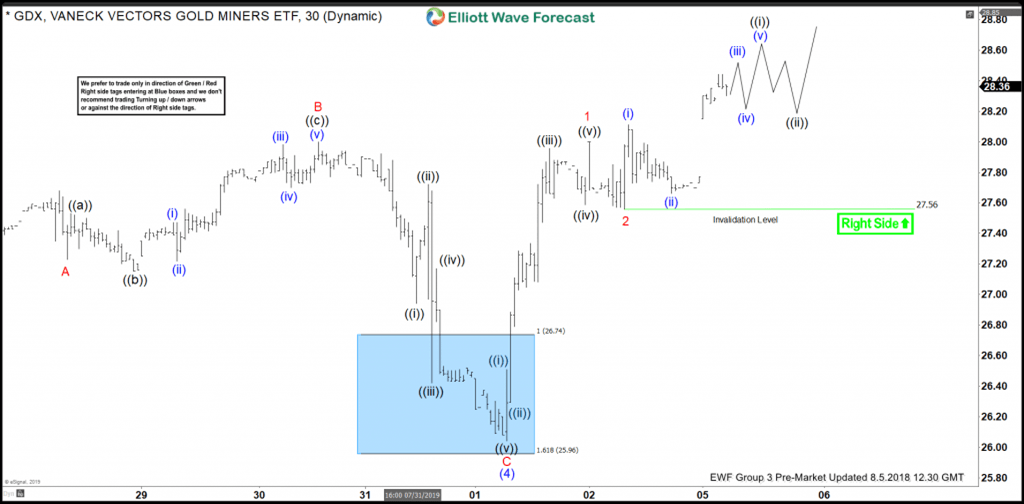
In the last Elliott Wave chart, you can see that GDX reacted nicely higher and continued the rally. Later on it made even a new high. Due to the right side up tag, we expected GDX to be supported overall.  Any trades from that area have been risk-free, which means the stop-loss was moved to breakeven, targeting higher levels.  Do please keep in mind that the 1-hour chart which I presented might have changed already. The blue boxes you see in our charts are our so-called High-Frequency boxes. Where the market ideally shows us a reaction either lower or higher. These areas are used be traded in the direction of the right side.
If you are interested in how to trade our blue box areas and want to understand how Elliott Wave works. Then I recommend you to get a shot on our 14 days free trial below. We present a lot of trading setups in our 3 Live Trading Rooms.
 

GDX 07.30.2019 1 Hour Chart Elliott Wave Analysis
gdx

Author

Elliott Wave Forecast Team

Elliott Wave Forecast Team

ElliottWave-Forecast.com

More from Elliott Wave Forecast Team
Share:

Editor's Picks

AUD/USD keeps the red near 0.6950 after weak Aussie jobs data

AUD/USD holds losses near 0.6950 on disappointing Australian jobs data, extending the previous day's retracement slide from the monthly high and hitting a fresh weekly low during Thursday’s Asian session. Meanwhile, declining US bond yields drag the US Dollar away from the April 2025 high, touched after Wednesday's hot US CPI, helping limit losses for the currency pair.

USD/JPY slides back below 158.00 as USD reverses post-CPI gains

USD/JPY extends the previous day's pullback from a three-week high, attracting follow-through selling and sliding below 158.00 during Thursday's Asian session. Traders remain on high alert amid speculation that authorities will step in to prop up the Japanese Yen. The US Dollar, meanwhile, reverses Wednesday's hot CPI-led gains to April 2025 highs as US bond yields retreat on China bond-buying talk, further pressuring the pair.

Gold pares intraday gains, trades below $4,150 as Fed hike bets cap upside

Gold struggles to capitalize on its strong Asian session move up on Thursday and currently trades below $4,150. The commodity, however, retains an intraday bullish bias, snapping a three-day losing streak to a one-week low, touched on Wednesday, amid a broadly weaker US Dollar (USD). 

Zcash declines as US inflation surprise offsets fresh ETF inflows
Zcash (ZEC) is trading in the red on Friday, extending its previous day’s roughly 6% losses as the broader cryptocurrency market falls on rising US inflation. The US Consumer Price Index (CPI) print came in higher than expected, at an annual increase of 3.7% versus the expected 3.6%, raising concerns about inflation and rate hikes.
China seems routing US Treasury holdings through Canada

According to a Bloomberg report, China seems to be moving United States securities to non-US custodian banks in other countries, masking its role in financing US deficits.

Has Bitcoin really escaped the macro forces it was built to fight?
Over 17 years ago, Satoshi Nakamoto designed Bitcoin (BTC) on the back of a global financial crisis as an alternative to the global monetary system outside the control of central banks, governments and traditional intermediaries. This raises a key question: has Bitcoin really become independent of the macroeconomic forces it was built to challenge?
















