GBPUSD Weekly Forecast: Pound Sterling eyes acceptance above 1.1800
- GBPUSD reaches two-month highs amid extended US Dollar weakness.
- The United States Consumer Price Index jacked up 50 bps Federal Reserve rate hike bets.
- GBPUSD is on the lookout for a meaningful upside above 1.1800 ahead of United Kingdom inflation.


GBPUSD swung from a two-week low to a two-month top in a matter of a few days, having climbed toward 1.1800 ahead of the weekend. The pair benefited from the US Dollar weakness, which extended on narrowing gap between monetary policies from the United States (US) and the United Kingdom (UK). The focus now shifts toward the UK Consumer Price Index (CPI) data due in the week ahead, with the US CPI data out of the way.
GBPUSD hit a two-month high. What happened last week?
GBPUSD settled the week roughly 400 pips higher, having snapped the previous weekly decline. The extended recovery in the Pound Sterling came mainly on the back of the renewed weakness in the US Dollar and the continuation of the risk rally on global markets. The US Dollar lost over 2.0% on a weekly basis, as investors ramped up bets of a smaller interest rate increase from the US Federal Reserve (Fed) in December. Markets wagered roughly an 81% probability of a 50 bps December Fed rate hike vs. odds of about 55% at the start of the week.
What seemed like a confirmation of a slowdown in the pace of the Federal Reserve tightening cycle was on account of softer-than-expected Consumer Price Index (CPI) data from the United States on Thursday. Investors awaited the critical US inflation data for the entire week, which emerged as the biggest market move in a relatively light week, in terms of the top-tier economic data from both sides of the Atlantic. Consumer inflation in the United States rose 7.7% YoY, down from 8.2% in September and clearly below the 8.0% consensus forecast. The CPI accelerated by only 0.4% on the month, down from 0.6% in September and core figures rose 0.3%, rather than the 0.5% expected.
Following soft US CPI data, the divergence between the Federal Reserve and the Bank of England (BoE) monetary policies somewhat narrowed, lending support to the uptrend in the Cable. The commentary from several Federal Reserve officials throughout the week also suggested the central bank pivoting toward smaller rate hikes amid softening wages and consumer inflation. Meanwhile, among other Bank of England policymakers on the rostrum, the central bank’s Chief Economist Huw Pill said that “the BoE will do what is needed to get inflation back to 2% on a sustainable basis.”
The US Midterm Elections also failed to have any significant impact on the US Dollar’s trading direction. It wasn’t a clean sweep for the Republicans as Democrats fared better than expectations. Republicans are almost certain to take control of the House of Representatives, although with far narrower margins than many predicted. On the other hand, Democrats are likely to retain their Senate majority.
Friday’s less-than-expected UK Q3 Gross Domestic Product (GDP) contraction powered the GBPUSD rally. The UK economy shrank 0.2% QoQ in the three months to September when compared with a 0.2% growth booked in Q2 and -0.5% expectations. On the monthly basis, the UK GDP came in at -0.6% vs. -0.4% expected and -0.3% previous.
Week ahead: Eyes on inflation data from United Kingdom
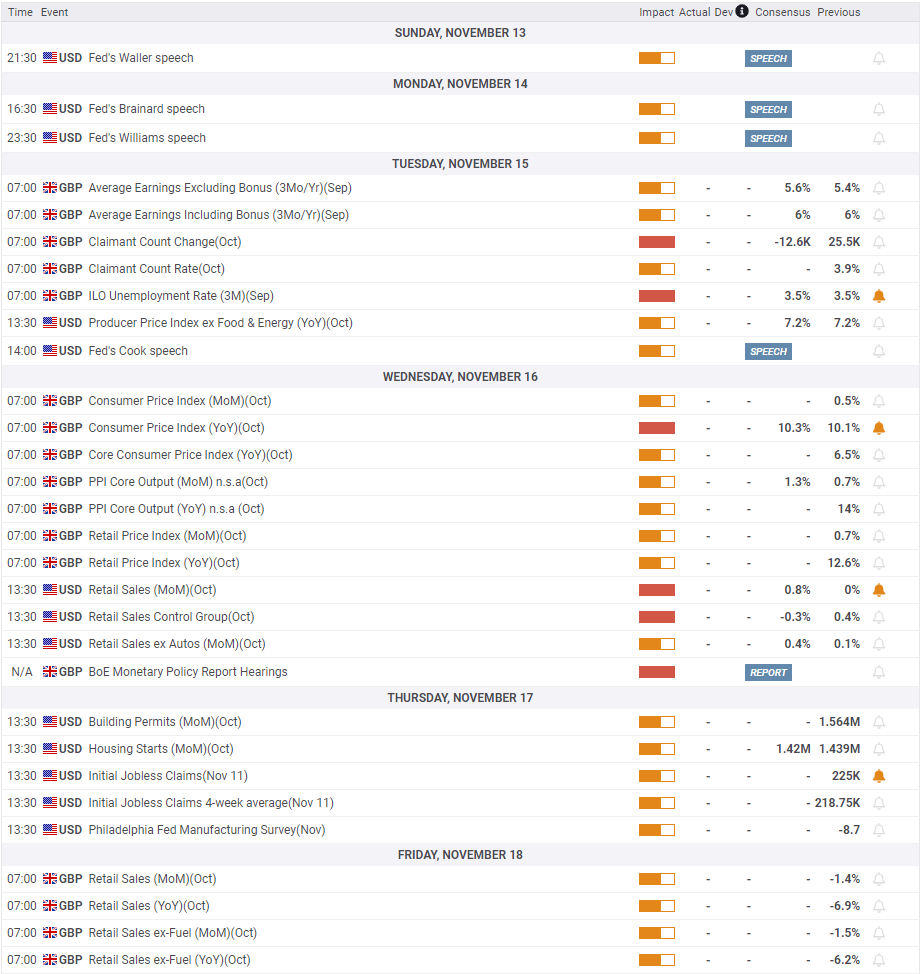
A data-dry spell from the United Kingdom will end in the upcoming week, with the high-tier Consumer Price Index and Employment data due on the cards. However, the main event risk will be UK Prime Minister Rishi Sunak’s fiscal statement, which has been upgraded to the Autumn Budget on Thursday, November 17.
The week will kick off with the Bank of England Monetary Policy Report (MPR) hearings on Monday, with Governor Andrew Bailey and other Monetary Policy Committee (MPC) members testifying before the Parliament's Treasury Committee. Their testimony could have some bearing on GBPUSD, in absence of any economic releases from the United States at the start of the week.
Tuesday is a relatively busy calendar, with the Chinese activity data expected to have a significant impact on risk sentiment, eventually influencing the risk-sensitive Pound Sterling. Next, the labor market report from the United Kingdom will drop in at 07:00 GMT, followed by the United States Producer Price Index (PPI) and region manufacturing data at 13:30 GMT.
The Consumer Price Index data from Britain will hog the limelight on Wednesday while the Retail Sales report from the United States will be also closely examined for fresh signs of strength in the American economy. The US Industrial Production will be also published about an hour later.
Thursday will see the usual US weekly Jobless Claims on the calendar along with the Building Permits, Housing Starts and the Philly Fed Manufacturing Index. The United Kingdom will report the Retail Sales data on Friday while the Existing Homes Sales will be the only notable release from the North American trading on the final day of the week.
GBPUSD technical outlook
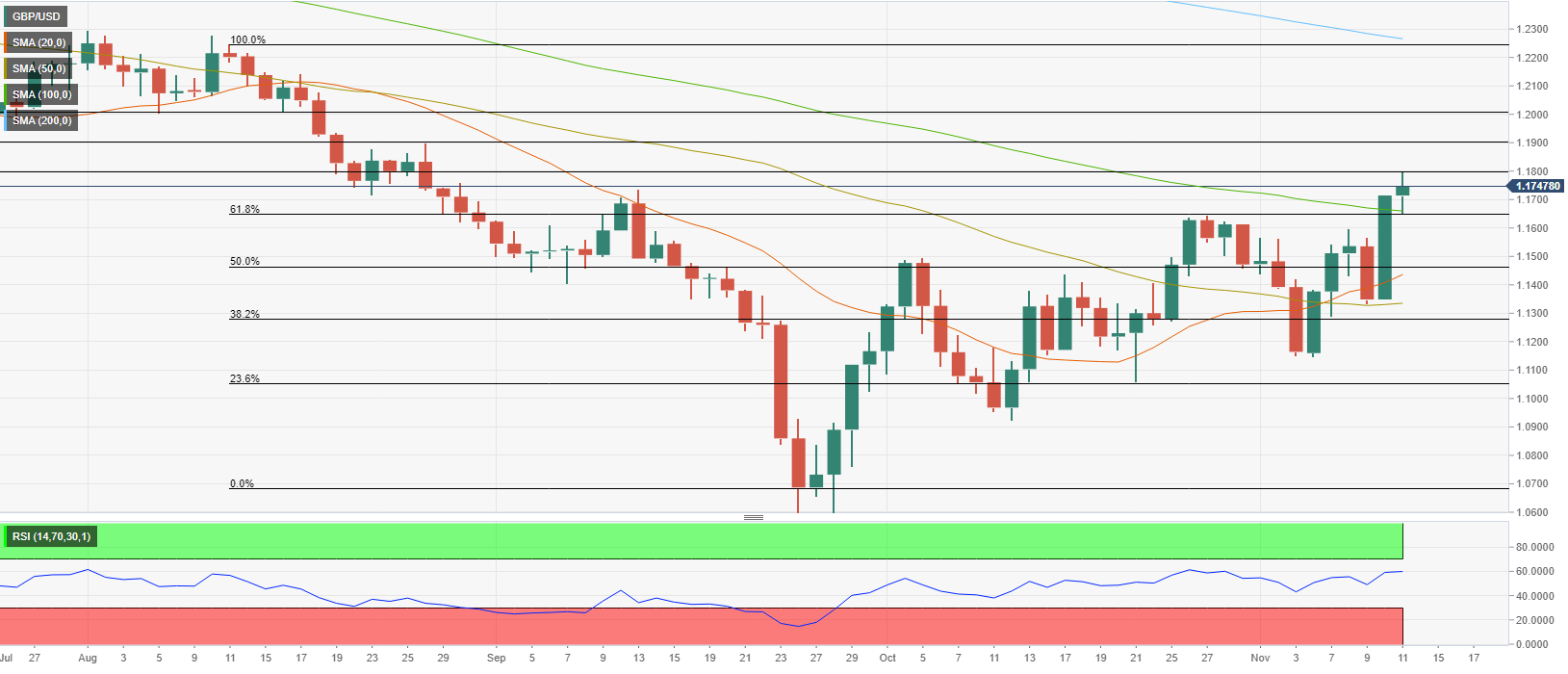
GBPUSD seems to have met resistance at around 1.1800 and it needs to flip that level into support in order to extend its rally. Meanwhile, the Relative Strength Index (RSI) indicator on the daily chart holds above 50 and the pair closed the last two trading days above the 100-day Simple Moving Average, pointing to a significant bullish shift in the short-term outlook.
Above 1.1800, GBPUSD could target 1.1900 (static level, psychological level) and 1.2000 (psychological level, static level) next. On the downside, 1.1650 (100-day SMA, Fibonacci 61.8% retracement of the latest downtrend) aligns as key support. With a daily close below that level, sellers could action and cause the pair to slide toward 1.1500 (psychological level, Fibonacci 50% retracement, 20-day SMA) and 1.1350 (50-day SMA).
GBPUSD forecast poll
Despite GBPUSD's impressive jump this week, experts remain sceptical about the Pound Sterling's potential to continue to rise. The FXStreet Forecast's poll points to an overwhelmingly bearish bias in the one-month and one-quarter looks with average targets for both time periods sitting near 1.1200.

Premium
You have reached your limit of 3 free articles for this month.
Start your subscription and get access to all our original articles.
Author
Dhwani Mehta
FXStreet
Residing in Mumbai (India), Dhwani is a Senior Analyst and Manager of the Asian session at FXStreet. She has over 10 years of experience in analyzing and covering the global financial markets, with specialization in Forex and commodities markets.

















