GBP/USD Weekly Forecast: Russia-Ukraine war and a busy week to keep sellers alive
- GBP/USD bulls give into bearish pressures amid Russia-Ukraine war.
- 1.3500/1.3530 will be a tough nut to crack for GBP bulls ahead of US NFP, Powell.
- Broader market sentiment will continue to lead the way amidst the Russia-Ukraine crisis.

GBP/USD had a rough week indeed, as bulls finally gave up their three-week-long hold amid a geopolitical storm in Ukraine. Hawkish Bank of England (BOE) expectations led by hotter UK inflation had underpinned the pound in the first three weeks of February but sellers returned towards the month end, as Russia waged war against its neighbor. The focus now shifts towards next week’s key event risks in the shape of US Nonfarm Payrolls and Fed Chair Jerome Powell’s testimony, while Russia-Ukraine tensions will continue to play out as the dominant overarching theme.
GBP/USD in the rear: Russia-Ukraine crisis pounded the pound
The pound yielded to bearish pressure finally after GBP/USD ran into powerful resistance near the mid-1.3650s in the previous week. After a brief pullback on Monday, in response to a broad US dollar rebound and stronger UK Preliminary Markit Manufacturing and Services PMI reports, sellers fought back for control and cable was thrashed to the weakest level in two months at 1.3271.
The UK/US calendar was relatively light this week, and as a consequence the market’s attention solely remained on geopolitical tensions surrounding Russia, Ukraine and the West. All through the early part of the week, the US kept warning about a potential Russian invasion of Ukraine, which kept markets on the tenterhooks. Although they remained somewhat hopeful ahead of the planned meeting between the US Secretary of State Antony Blinken and his Russian counterpart Sergey Lavrov on Thursday. Markets also looked forward to the G7 meeting to discuss the Ukraine issue.
Sentiment, however, turned sour mid-week after Blinken abandoned his meeting with Russia’s Lavrov amid Moscow’s persistent attempts to invade Ukraine, despite the sanctions imposed by the West. That said, the high-beta currency pair, GBP/USD, felt the pull of gravity and finally surrendered the 1.3600 level. The US dollar started to gain upside momentum thereafter, as demand for safe-havens accelerated on looming Russian invasion risks. The fateful event finally occurred on Thursday after Russia’s President Vladimir Putin authorized a special military operation, forcing residents to flee for their lives. The risk-averse market profile smashed cable by roughly three big figures lower.
However, an overextension in the pair’s sell-off triggered a swift comeback after US President Joe Biden announced that they would sanction Sberbank, Russia’s largest lender, and four other financial institutions that represent an estimated $1 trillion in assets, as well as a broad swath of Russian elites and their family members. Investors breathed a sigh of relief on Friday on hopes of a ceasefire and as markets reassessed Western sanctions. The recovery in risk sentiment helped the major extend the rebound towards 1.3500. The focus on Friday remained the US President Biden’s meeting with heads of state/government from NATO countries. Meanwhile, American top-tier economic releases, including the PCE inflation and Durable Goods, played second fiddle to Russia-Ukraine developments.
GBP/USD: Week ahead
As March kicks off, attention could turn back towards the market’s pricing of Fed rate hikes alongside the ongoing Russia-Ukraine conflict, as the Brexit issues take a back seat.
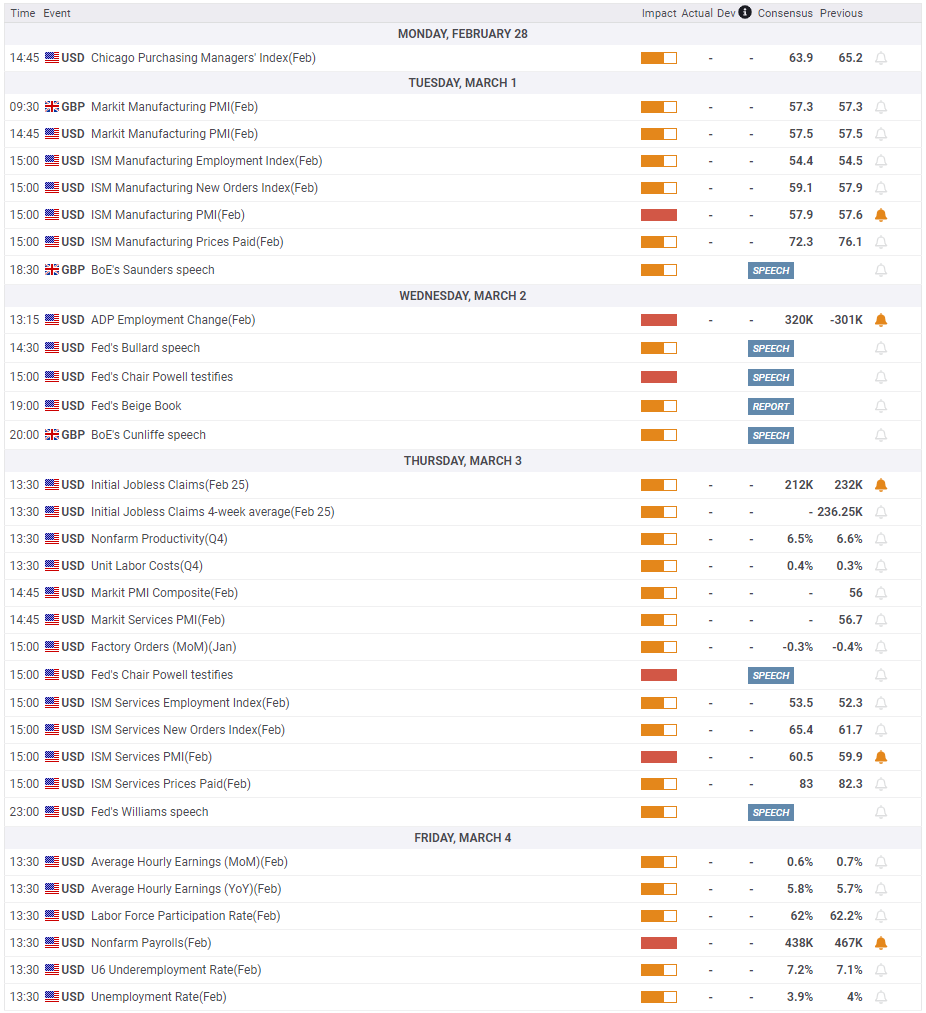
Month-end flows could also come into play on the first trading day of the week, as the data docket remains light on both sides of the Atlantic. Tuesday will see the releases of the final Manufacturing PMI from the UK and the US ISM Manufacturing PMI.
The economic calendar will pick up on Wednesday, with the US ADP employment and a speech from the St. Louis Fed President James Bullard dropping in ahead of Fed Chair Jerome Powell’s testimony on the Semi-Annual Monetary Policy Report before the House Financial Services Committee.
The spot will also take cues from BOE-speak, US Jobless Claims and ISM Services PMI on Thursday. Meanwhile, round two of Powell’s testimony – this time before the Senate Banking Committee – will be closely followed as well.
The NFP February report will be published on Friday, with the US economy having added 467K jobs in January. The US labor market report is unlikely to impact the March Fed rate hike expectations, although could hint at potential aggressive tightening this year.
Despite a relatively busy week ahead, the broader market sentiment will continue to lead the way amidst the Russia-Ukraine crisis. Further, investors will also pay attention to the oil price action for fresh trading opportunities in the GBP/USD pair.
GBP/USD: Technical analysis
The technical outlook suggests that GBP/USD is not out of the woods yet with the Relative Strength Index (RSI) indicator staying below 40 on the daily chart. Additionally, the pair is trading below the 100-day SMA, after breaking below it for the first time since early February.
In order to convince bulls, GBP/USD needs to reclaim 1.3500 (psychological level, 100-day SMA) and 1.3530 (former support, static level). With a daily close above that resistance area, the pair could extend its rebound to 1.3600 (psychological level, static level).
On the downside, near-term support seems to have formed at 1.3350 (static level). In case that level turns into resistance, the next bearish targets could be seen at 1.3300 (psychological level), 1.3270 (Thursday low) and 1.3200 (psychological level, static level).

GBP/USD: Sentiment poll
FXStreet forecast poll shows that experts don't expect the bearish pressure to ramp up next week and the one-week average target aligns at 1.3400, near GBP/USD's weekly closing level. There is a slight bullish tilt in the one-month and one-quarter outlooks.

Author

Dhwani Mehta
FXStreet
Residing in Mumbai (India), Dhwani is a Senior Analyst and Manager of the Asian session at FXStreet. She has over 10 years of experience in analyzing and covering the global financial markets, with specialization in Forex and commodities markets.