GBP/USD Weekly Forecast: Pound Sterling remains exposed to downside risks
- GBP/USD sustained the previous week’s correction from three-week highs.
- United Kingdom jobs and inflation data to inject volatility around the Pound Sterling.
- Death Cross and Bear Pennant confirmation points to further GBP/USD declines.

After witnessing good two-way trading a week ago, the Pound Sterling extended its losing momentum against the United States Dollar (USD), sending GBP/USD briefly below the 1.2100 threshold. Based on the technical outlook, risks remain skewed to the downside for GBP/USD in the week ahead.
GBP/USD: What happened last week?
Simmering Gaza-Israel geopolitical tensions and the US bond market rout remained the main highlights in the past week, impacting the broader market sentiment and the US Dollar valuations. Thus, the GBP/USD pair remained at the mercy of the US Dollar dynamics and risk trend, which was primarily a global flight to safety.
Tensions between Gaza and Israel remained high at the start of the week on Monday, after Israel called on Friday the evacuation of more than 1 million civilians in Gaza City to the south within 24 hours. However, investors witnessed a positive turnaround in risk sentiment amid China’s stimulus hopes and expectations that diplomacy efforts from the US and its allies could help de-escalate Middle East tensions. US President Joe Biden was set to travel to Israel on Wednesday.
On Tuesday, the US Dollar regained some footing, as risk-off flows seeped back on persistent concerns surrounding the Chinese property market. Risks of Country Garden's entire offshore debt being in default heightened if Tuesday’s payment was not made. A lack of encouraging news from a seven-hour-long meeting between Israeli President Benjamin Netanyahu and US Secretary of State Antony Blinken revived risk aversion across the financial markets. Further, investors traded with caution ahead of key earnings reports for the third quarter from the United States.
Additionally, the upbeat US Retail Sales report temporarily offered some support to the US Dollar on Tuesday. US Retail Sales, unadjusted for inflation, rose 0.7% after upwardly revised increases in the prior two months, according to the Commerce Department. Against this back drop, the GBP/USD failed to resist above the 1.2200 level and reversed toward the 1.2100 level.
With all eyes on the Gaza-Israel geopolitical development, GBP/USD traders paid little heed to the partial UK employment data. Wage inflation in the United Kingdom (UK), as measured by the change in the Average Earnings Excluding Bonus, rose 7.8% 3M YoY in August, as against a 7.9% increase registered in July.
The bearish momentum in the pair extended into Wednesday, as the US Dollar built on its previous rebound amid rife Middle East tensions and a relentless rise in the US Treasury bond yields.
United Nations (UN) Secretary-General António Guterres called for an immediate humanitarian ceasefire after early Wednesday’s deadly Israeli strike at a Gaza hospital, which killed at least 500 people, including women and children. A UN-run school housing refugees was also struck.
Markets shrugged off upbeat Chinese Gross Domestic Product (GDP) and activity data, in the face of lingering concerns over a potential default by Country Garden on its $11 billion in offshore debt.
Meanwhile, the recent Fed commentaries backed the central bank’s view of higher interest rates for longer, offering additional legs to the ongoing uptrend in the US Treasury bond yields, in turn, aiding the US Dollar rebound.
New York Fed President John Williams said on Wednesday, interest rates will need to stay high for a while to get inflation back to the central bank's 2% target. Fed Governor Christopher Waller said that he would like the central bank to wait on any further interest rate hikes while it evaluates the direction of the US economy and inflation. In a separate speech, Fed Governor Michelle W. Bowman agreed that inflation has come down but it is still too high.
US President Joe Biden’s arrival in Israel and his early comments further added to the geopolitical tensions and the US Dollar’s strength. President Biden said that “the US will make sure Israel has what it needs to defend itself."
On Friday, however, the US Dollar failed to sustain the recovery due to Fed Chair Jerome Powell’s comments and improving risk sentiment. Powell suggested that rising US Treasury bond yields are not indicative of further Fed rate hikes or higher inflation. "It's really happening in term premiums," Powell said, meaning the compensation investors demand for holding bonds for a longer time. He added, "financial conditions have tightened significantly" with the rise of long-term bond yields.
Following Powell’s speech, the US Treasury bond yields extended their rally, with the benchmark 10-year US Treasury bond yields briefly touching the 5.0% level for the first time since 2007. The US Treasury bond yields lent support to the US Dollar while benefiting from renewed Gaza-Israel tensions, which hit risk appetite once again. The Israel Defense Forces (IDF) had been given the ‘green light’ to enter Gaza whenever it deems necessary, potentially paving the way to a ground invasion of Gaza, a member of the Israeli security cabinet told ABC News on Thursday. Strong US Jobless Claims report also helped keep the US Dollar afloat, keeping GBP/USD’s upswing capped below 1.2200.
Geopolitics continued to dominate the risk trend on Friday, as reports hit the wires that drones and rockets have reportedly attacked Iraq's Ain Al-Asad airbase that houses US forces. Surging Oil prices on Middle East strife also weigh on the sentiment, in turn, on the higher-yielding Pound Sterling.
Disappointing UK Retail Sales data for September and dovish comments from the Bank of England (BoE) Governor Andrew Bailey weighed further on the pair. UK Retail Sales tumbled 0.9% in September, compared with a 0.1% fall expected, as consumers refrained from spending due to unusually warm weather. Meanwhile, Bailey said that he “expects a 'marked fall' in inflation next month,” in his interview with Belfast Telegraph on Friday.
It’s the PMIs week ahead
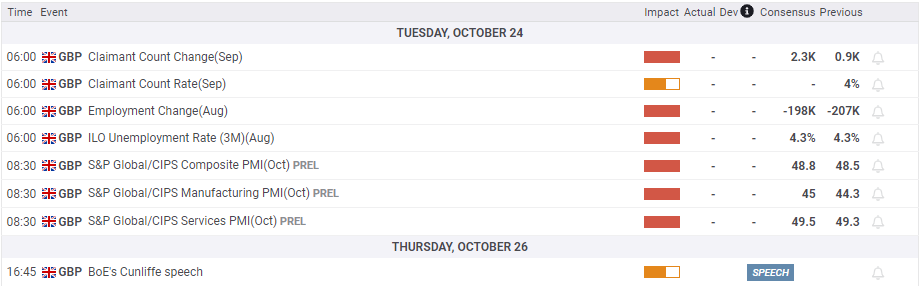
With the Middle East conflict still dominating risk sentiment, the global business PMI reports on Tuesday will put the focus back on the fundamentals amid concerns over a ‘soft-landing’.
Monday, however, remains data-empty on both sides of the Atlantic. The Fed remains in its ‘blackout period’ ahead of the November 1 policy meeting.
Ahead of the UK and Eurozone preliminary Manufacturing and Services PMI data, the British docket will feature the partial employment data, which is unlikely to have a significant impact on the Pound Sterling. Later that day, the US calendar will also feature the S&P Global preliminary PMI.
On Wednesday, the only data of note will be the New Home Sales data from the United States. Moving on, GBP/USD traders will brace for an action-packed Thursday, with the European Central Bank (ECB) policy announcements and the preliminary estimate of the third quarter US GDP.
The ECB interest rate decision could likely have a EUR/GBP cross-driven rub-off effect on the Pound Sterling, eventually impacting the GBP/USD pair. Meanwhile, the US GDP report could provide fresh insights into the health of the economy, having a strong bearing on the Fed’s path forward on interest rates, as well as, on the US Dollar valuations.
Traders will also pay attention to the US weekly Jobless Claims, Durable Goods and Pending Home Sales data in American trading on Thursday.
The US Personal Consumption Expenditure (PCE) Price Index and the Core print (the Fed’s preferred inflation measure) will offer some trading incentives on Friday.

GBP/USD: Technical outlook
Pound Sterling buyers faced a double-whammy in the past week on the technical front as the GBP/USD pair confirmed a Death Cross, as well as, a Bear Pennant formation on the daily chart.
The previous week’s bullish wedge-driven upward momentum appeared temporary, as the 50-day Simple Moving Average (SMA) pierced through the 200-day SMA from above and fuelled a fresh downswing in the pair.
Further, the Bear Pennant confirmed on October 12 added credence to the downside bias, with the seven-month low of 1.2037 pegged as the next relevant support.
If the selling momentum gathers steam in the week ahead, Pound Sterling sellers could target the 1.1900 round level on a sustained move below the aforementioned multi-month low of 1.2037.
Deeper declines could put the focus back on the March low of 1.1803.
On the upside, a daily closing above the 21-day SMA of 1.2233 is needed to ditch the ongoing bearish consolidative mode. If Pound Sterling buyers manage to find a strong foothold above the latter, a fresh run toward the 1.2335 static resistance cannot be ruled out.
The desecending 50-day SMA at 1.2408 could then come into play, above which the immediate resistance is seen at the horizontal 200-day SMA at 1.2443.

GBP/USD: Forecast poll
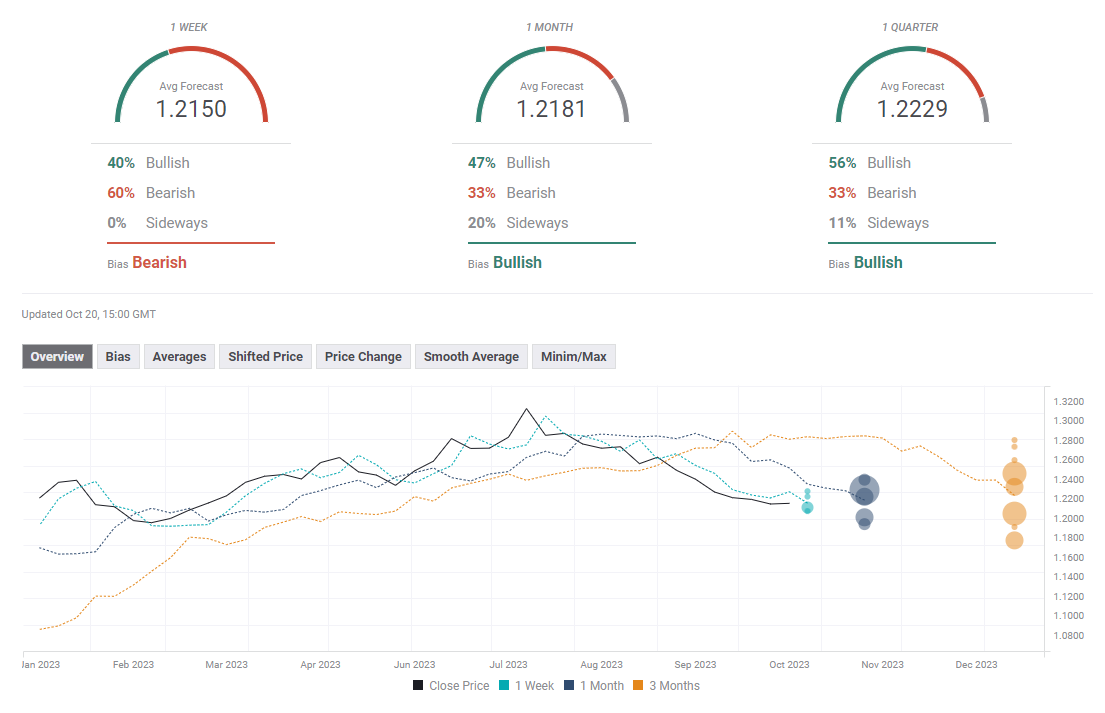
FXStreet Forecast Poll paints a mixed picture for GBP/USD with the one-week and one-month average targets aligning at 1.2150 and 1.2181, respectively.
Author

Dhwani Mehta
FXStreet
Residing in Mumbai (India), Dhwani is a Senior Analyst and Manager of the Asian session at FXStreet. She has over 10 years of experience in analyzing and covering the global financial markets, with specialization in Forex and commodities markets.