GBP/USD Weekly Forecast: Pound Sterling downside risks remain intact ahead of UK inflation data
- The Pound Sterling sellers refused to give up as the US Dollar remained in command.
- GBP/USD eyes UK and US economic data for some relief.
- Technically, downside risks remain intact for the Pound Sterling on a daily bearish RSI.

The Pound Sterling (GBP) booked the seventh straight weekly loss against the US Dollar (USD), with the GBP/USD pair falling as low as 1.2630 during the week.
Pound Sterling gave in to the US Dollar's dominance
The USD rode the Trump trades optimism wave higher following US President-elect Donald Trump’s victory, clinching the highest level in a year against its major currency rivals. Markets build on the narrative that Trump’s tax cuts and trade tariff policies will likely rekindle inflationary pressures, calling for higher interest rates and eventually supporting the Greenback, US stocks and US Treasury bond yields.
The buying interest around the USD remained unabated, slamming the GBP/USD pair to the lowest level since July at 1.2630. The Greenback received an added boost from fading expectations that the US Federal Reserve (Fed) will continue its easing trajectory after the US election outcome.
Fed Chair Jerome Powell echoed his colleagues’ caution on inflation and that the Fed could remain patient with its policy approach. Powell said in his speech on Thursday that there was no need to rush rate cuts with the economy still growing and the job market solid, despite inflation still above the 2.0% target, tempering expectations for a rate cut next month, per Reuters.
The sticky US Consumer Price Index (CPI) and hot Producer Price Index (PPI) data for October also backed the hawkish shift in the Fed's policy stance. US CPI rose 2.6% annually in October, coming in higher than the 2.4% growth in September while meeting the forecast. The annual core CPI inflation steadied at 3.3% in the same period vs. 3.3% expected.
Meanwhile, the annual headline factory-gate inflation rose to 2.4% in October after increasing 1.9% in September, indicating that disinflation is losing momentum. Markets now price in a less than 60% chance of a 25 basis points (Fed) rate reduction next month, the CME Group’s Fed Watch Tool showed, down from 82.5% in the prior session.
The bullish undertone in the Greenback hindered the Pound Sterling from capitalizing on prudent remarks from the Bank of England (BoE) policymakers concerning the bank’s path forward on interest rates. BoE Chief Economist, Huw Pill, said that the latest “labor data shows pay growth still at high levels,” adding that “further rate cuts is likely to be a gradual process.”
Meanwhile, his colleague Catherine Mann, the hawkish dissenter, noted that “central banks must ensure these inflation pressures do not get embedded. I do not think high interest rates are bad for high productivity.”
Heading into the weekend, Pound Sterling sellers took a breather as they awaited the US Retail Sales report for October for further incentives in trading the GBP/USD pair.
The US Dollar gained some pips following upbeat data, as Retail Sales rose by 0.4% MoM in October, better than the 0.3% anticipated by market players. Additionally, the September reading was upwardly revised from 0.4% to 0.8%.
The week ahead: UK inflation data and global PMIs eyed
After a busy second half of the last week, the early part of this week seems to be quiet data-wise from both sides of the Atlantic until the release of the UK CPI inflation report on Wednesday.
In the meantime, the appearances by the BoE and Fed policymakers and mid-tier US housing data will keep traders entertained.
Wednesday’s UK CPI data will hold the key to influencing the market expectations of future rate cuts by the BoE as policymakers assess the impact of the Autumn Budget on the economy and inflation prospects.
BoE official Dave Ramsden is due to speak about monetary policy at the University of Leeds later on Wednesday.
Central bankers’ speeches will dominate on Thursday amid the weekly US Jobless Claims data release.
S&P Global preliminary Purchasing Managers' Index (PMI) data from the UK and the US will wrap a relatively data-quiet week.
GBP/USD: Technical Outlook
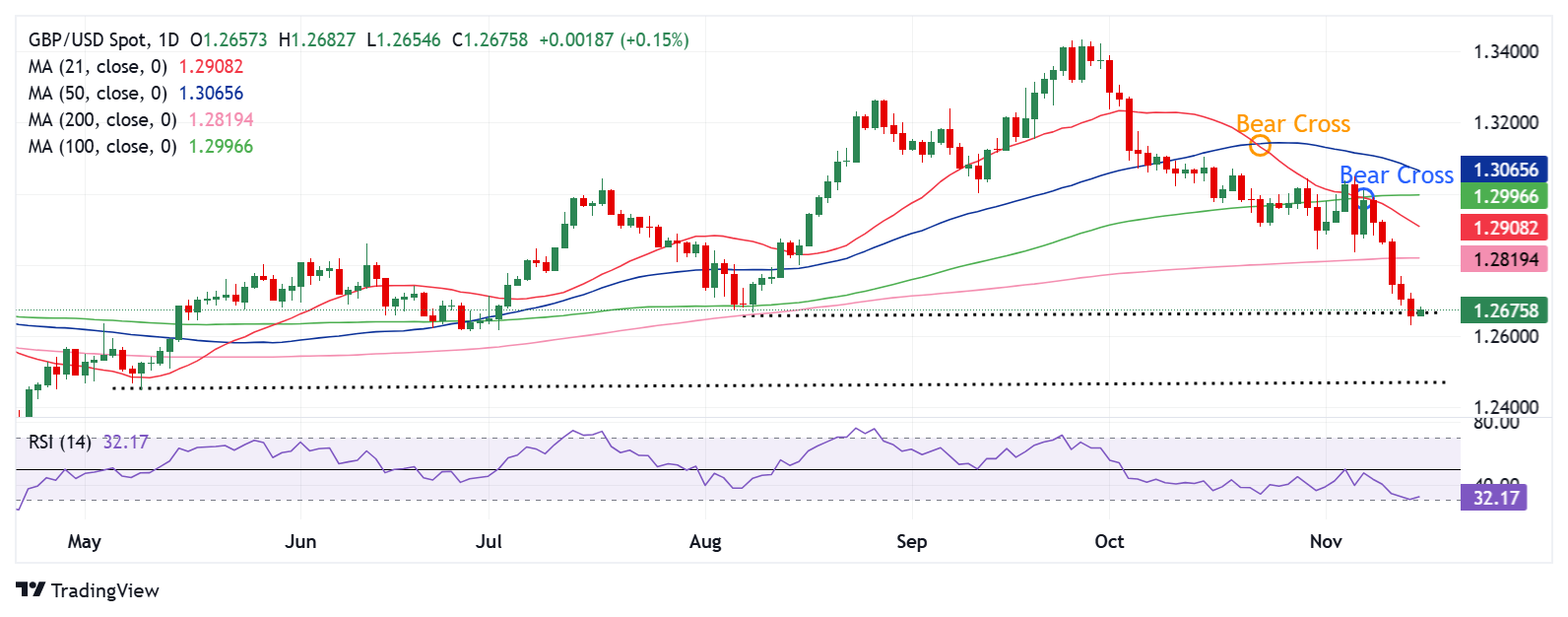
The daily technical setup for the GBP/USD pair suggests that sellers will continue jumping on any recovery attempts as the 14-day Relative Strength Index (RSI) remains in negative territory.
With the previous week’s dual Bear Crosses in play, the downside risks remain intact for the pair.
The Pound Sterling needs a weekly candlestick closing below the August 8 low of 1.2665 to stretch the downside momentum.
If the selling pressure intensifies, sellers could attack the 1.2550 psychological barrier. On a failure to defend that level, the May 9 low of 1.2446 will be challenged.
However, the pair could see a brief upside correction before the next leg down kicks in.
Recapturing the 200-day Simple Moving Average (SMA) at 1.2819 is critical to initiating any meaningful recovery in the near term.
The next topside barrier aligns at the 21-day SMA at 1.2908.
Inflation FAQs
Inflation measures the rise in the price of a representative basket of goods and services. Headline inflation is usually expressed as a percentage change on a month-on-month (MoM) and year-on-year (YoY) basis. Core inflation excludes more volatile elements such as food and fuel which can fluctuate because of geopolitical and seasonal factors. Core inflation is the figure economists focus on and is the level targeted by central banks, which are mandated to keep inflation at a manageable level, usually around 2%.
The Consumer Price Index (CPI) measures the change in prices of a basket of goods and services over a period of time. It is usually expressed as a percentage change on a month-on-month (MoM) and year-on-year (YoY) basis. Core CPI is the figure targeted by central banks as it excludes volatile food and fuel inputs. When Core CPI rises above 2% it usually results in higher interest rates and vice versa when it falls below 2%. Since higher interest rates are positive for a currency, higher inflation usually results in a stronger currency. The opposite is true when inflation falls.
Although it may seem counter-intuitive, high inflation in a country pushes up the value of its currency and vice versa for lower inflation. This is because the central bank will normally raise interest rates to combat the higher inflation, which attract more global capital inflows from investors looking for a lucrative place to park their money.
Formerly, Gold was the asset investors turned to in times of high inflation because it preserved its value, and whilst investors will often still buy Gold for its safe-haven properties in times of extreme market turmoil, this is not the case most of the time. This is because when inflation is high, central banks will put up interest rates to combat it. Higher interest rates are negative for Gold because they increase the opportunity-cost of holding Gold vis-a-vis an interest-bearing asset or placing the money in a cash deposit account. On the flipside, lower inflation tends to be positive for Gold as it brings interest rates down, making the bright metal a more viable investment alternative.
Economic Indicator
Consumer Price Index (YoY)
The United Kingdom (UK) Consumer Price Index (CPI), released by the Office for National Statistics on a monthly basis, is a measure of consumer price inflation – the rate at which the prices of goods and services bought by households rise or fall – produced to international standards. It is the inflation measure used in the government’s target. The YoY reading compares prices in the reference month to a year earlier. Generally, a high reading is seen as bullish for the Pound Sterling (GBP), while a low reading is seen as bearish.
Read more.Next release: Wed Nov 20, 2024 07:00
Frequency: Monthly
Consensus: -
Previous: 1.7%
Source: Office for National Statistics
The Bank of England is tasked with keeping inflation, as measured by the headline Consumer Price Index (CPI) at around 2%, giving the monthly release its importance. An increase in inflation implies a quicker and sooner increase of interest rates or the reduction of bond-buying by the BOE, which means squeezing the supply of pounds. Conversely, a drop in the pace of price rises indicates looser monetary policy. A higher-than-expected result tends to be GBP bullish.
Author

Dhwani Mehta
FXStreet
Residing in Mumbai (India), Dhwani is a Senior Analyst and Manager of the Asian session at FXStreet. She has over 10 years of experience in analyzing and covering the global financial markets, with specialization in Forex and commodities markets.
















