GBP/USD Weekly Forecast: Pound bears set to return in a critical week ahead
- GBP/USD faltered its recovery following UK PM Truss’ speech, US dollar rebounded.
- The focus shifts to the FOMC minutes and top-tier US and UK data.
- The pair breached a key daily trendline and is poised for more pain ahead.

GBP/USD lost its recovery momentum after reaching the highest level in three weeks near 1.1500, in the face of the US dollar upswing and UK political tensions. Cable settled the week modestly flat following a volatile previous week. Market participants now look forward to the Fed minutes and the first-tier UK and US economic releases amid a holiday-shortened week.
What happened last week?
GBP/USD extended its previous turnaround at the start of the week, as pound bulls found an additional boost after UK PM Liz Truss and Kwasi Kwarteng confirmed on Monday that the government will not go ahead with a plan to scrap a 45% rate of income tax. The UK government tax policy U-turn lifted the overall market sentiment, allowing the safe-haven US dollar to extend its correction from two-decade highs. Further, easing US PCE Price Inflation and ISM Manufacturing Prices Paid gauge combined with a sharp drop in the JOLTS Job Openings weighed down on aggressive Fed tightening bets, which kept the sentiment around the dollar and the Treasury yields undermined. The probability of a 75 bps Fed rate hike in November dropped to 50% after the PMI survey.
Against this backdrop, the pair rallied further to test the highest level in three weeks close to the 1.1500 level but sellers were quick to wrest back control, as risk-aversion returned on Wednesday at full steam amid escalating geopolitical tensions between Russia and the West over the Ukraine war. Russia's ambassador to the US said that the danger of a direct clash between Russia and the West had escalated following the White House's decision to send more military aid to Ukraine. Reports also hit the wires that Russian President Vladimir Putin was preparing to announce a change in the status of the "special operation". The flight to safety environment rekindled demand for the safe-haven dollar while knocking GBP/USD off the cliff to below 1.1200 levels.
Further, UK PM Truss’s speech on Wednesday at the Conservative party conference failed to inspire GBP bulls. Truss urged the Conservative party to stick together and help transform the economy and the country, as investors continued to fret over the Kingdom’s fiscal standing following the previous week’s brutal gilt sell-off. The corrective decline from multi-week highs picked up pace on Thursday following the mixed releases of the US ADP jobs and ISM Services PMI and hawkish Fed commentary, which once again added to the renewed upside in the dollar. The Wall Street pullback also aided the greenback’s rebound. Fed policymakers continued to push their hawkish message that inflation continues to remain too high and they won’t be deterred from raising rates by volatility in financial markets.
Risk-flows extended into Friday’s trading, as investors refrained from placing any directional bets on the major ahead of the all-important US Nonfarm Payrolls (NFP) data.
The US Bureau of Labor Statistics reported that Nonfarm Payrolls rose by 263,000 in September, compared to analysts' estimate of 250,000. Additionally, the Unemployment Rate declined to 3.5% from 3.7% in August with the Labor Force Participation rate edging lower to 62.3% from 62.4%. The initial reaction to the upbeat jobs report allowed the dollar to preserve its strength ahead of the weekend and caused GBP/USD to end the day in negative territory at around 1.1100.
A busy week ahead
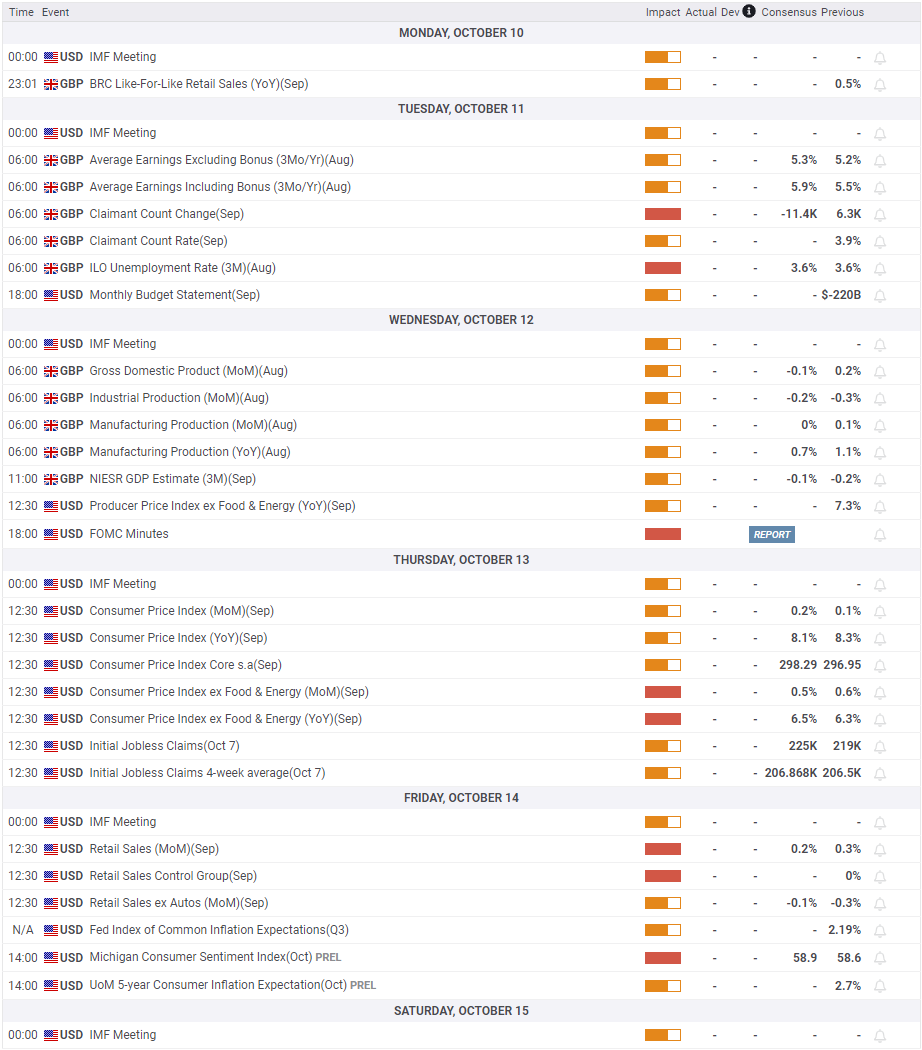
The retreat in the cable pair could likely extend in the week ahead, with investors seeking safety in the dollar amidst rife geopolitical tensions. Also, they will look out for the US Consumer Price Index (CPI) data to determine the size of the Fed’s next rate hike.
That said, it’s a holiday-shortened week, with American traders away on Monday in observance of Columbus Day. Although Fed Vice Chair Lael Brainard is due to speak at the National Association for Business Economics Annual Meeting, in Chicago.
The UK labor market report will be published on Tuesday, followed by speeches from Cleveland Fed President Loretta Mester and BOE Deputy Governor Jon Cunliffe. The UK central bank Governor Andrew Bailey is scheduled to speak early Wednesday. The BOE commentary will set the tone for the GBP/USD pair heading into the UK monthly GDP and industrial data. The central bank’s Financial Policy Committee (FPC) meeting minutes and statements will drop in later in the day. However, traders will be focussed on the US Producer Price Index (PPI) release and the Fed September meeting’s minutes that will conclude an eventful midweek’s trading.
Although the reaction to the Fed minutes could be limited, as investors await the US inflation reading on Thursday for fresh direction in the dollar, eventually impacting cable. The US Jobless Claims will be also closely followed. The US inflation data will be critical to gauge whether the Fed will hike rates by 75 bps in November. At the moment, markets are pricing a more than 80% probability of a super-sized Fed rate hike next month.
Friday will also be data-heavy, with the US Retail Sales measure and Preliminary UoM Consumer Sentiment due on the cards. Apart from macro data, looming geopolitical tensions concerning Russia, and UK political risks will continue playing out.
GBP/USD: Technical analysis
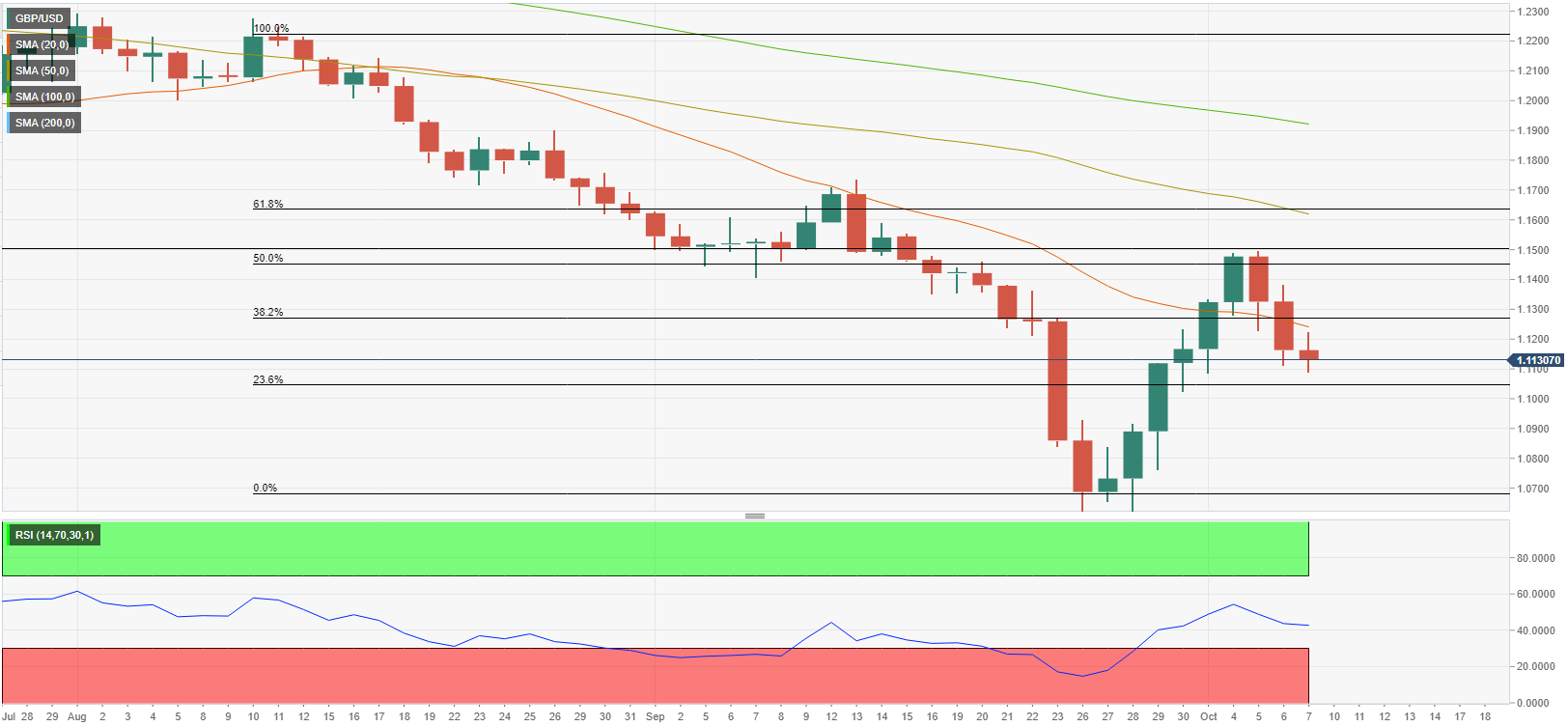
GBP/USD dropped below the 20-day SMA on Thursday and closed the second straight day below that level on Friday. Additionally, the Relative Strength Index (RSI) indicator on the daily chart declined below 50, confirming a bearish tilt in the near-term technical outlook.
On the downside, the pair faces key support at 1.1050 (Fibonacci 23.6% retracement level of the latest downtrend) ahead of 1.1000 (psychological level) and 1.0900 (static level, psychological level).
In case GBP/USD manages to rise above 1.1240 (20-day SMA) and starts using that level as support, it is likely to face next resistance at 1.1300 (Fibonacci 38.2% retracement). With a daily close above that hurdle, additional gains toward 1.1460 (Fibonacci 50% retracement) and 1.1500 (psychological level) could be witnessed.
GBP/USD: Forecast poll
There is a slight bearish tilt in GBP/USD's near-term outlook and the one-week average target of the FXStreet Forecast Poll stands at 1.1030. The one-month look paints a mixed picture.

Author

Dhwani Mehta
FXStreet
Residing in Mumbai (India), Dhwani is a Senior Analyst and Manager of the Asian session at FXStreet. She has over 10 years of experience in analyzing and covering the global financial markets, with specialization in Forex and commodities markets.