GBP/USD Weekly Forecast: GBP/USD looks to BoE for near-term direction
- GBP/USD kept an erratic performance in place throughout this week.
- Firm flash PMIs provided some colour to the British pound in past days.
- The BoE is largely expected to keep rates unchanged.

It was a fairly choppy week for the British pound, which prompted GBP/USD to maintain its consolidative fashion between 1.2600 and 1.2800.
Dollar dynamics ruled sentiment in the past week
Despite the ongoing choppiness, GBP/USD remained at the mercy of the developments gyrating around the Greenback, which has also been moving within a range-bound trade when gauged by the USD Index (DXY).
Among the bright spots supporting a constructive bias for the Pound Sterling (GBP) an auspicious reading emerged from advanced PMIs for the current month, which improved from the December’s prints in both the manufacturing and the services sectors.
Adding to the above, there were also positive surprises from the Public Sector finances results and Consumer Confidence tracked by GfK. Somewhat eclipsing that data emerged worsening figures from the Consortium of British Industry (CBI) Industrial Trends Orders and CBI Distributive Trades Survey.
The BoE and the Fed steal the show next week
With the BoJ and the ECB meetings already out of the way, investors’ attention will now shift to the upcoming FOMC and BoE events on January 31 and February 1, respectively.
The broad-based consensus among market participants sees both central banks refraining from any move on rates, in line with the decisions by the BoJ and the ECB to keep their policy rates on hold.
The Bank of England (BoE) is widely anticipated to maintain its 5.25% bank rate, although this time a unanimous vote looks more likely (than the usual 6-3 pattern) on February 1, aligning with both consensus and current market expectations. Investors are also seen closely watching the updated projections and the subsequent press conference.
Despite this anticipated decision, the likelihood of a dovish message from the bank appears less probable, leaning instead towards a more cautious stance particularly in light of the rebound in UK inflation witnessed during December.
GBP/USD daily chart
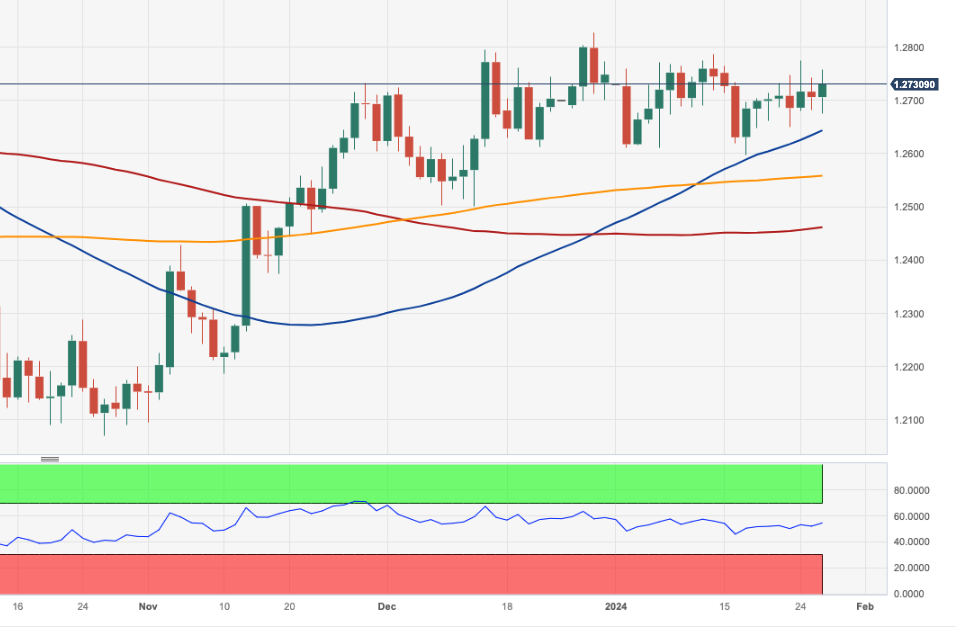
GBP/USD: Technical Outlook
The GBP/USD appears contained by the neighbourhood of 1.2600 for the time being. If sellers retake control, there is direct competition at the so-far 2024 low of 1.2596, set on January 17. If Cable falls below this level, a challenge of the 200-day Simple Moving Average (SMA) at 1.2554 may develop ahead of the December 2023 bottom of 1.2500 (noted on December 13). Further south comes the intermediate 100-day SMAs at 1.2455 prior to the November low of 1.2187, the October low of 1.2037 (October 3), the critical 1.2000 level, and, ultimately, the 2023 bottom of 1.1802, which was achieved on November 10.
If the bullish trend accelerates, the pair may revisit the December top of 1.2827. (observed on December 28). The breakout of the latter could pave the way for a move to the weekly peak of 1.2995 of July 27, 2023, the critical threshold of 1.3000 only a little higher.
The daily Relative Strength Index (RSI) improves to 56, and the MACD remains in the positive zone
Pound Sterling price this week
The table below shows the percentage change of Pound Sterling (GBP) against listed major currencies this week. Pound Sterling was the weakest against the Swiss Franc.
| USD | EUR | GBP | CAD | AUD | JPY | NZD | CHF | |
| USD | 0.28% | -0.25% | 0.15% | 0.07% | -0.06% | 0.23% | -0.60% | |
| EUR | -0.32% | -0.57% | -0.17% | -0.25% | -0.38% | -0.09% | -0.88% | |
| GBP | 0.24% | 0.53% | 0.39% | 0.32% | 0.19% | 0.48% | -0.35% | |
| CAD | -0.13% | 0.18% | -0.37% | -0.04% | -0.15% | 0.13% | -0.73% | |
| AUD | -0.08% | 0.18% | -0.33% | 0.07% | -0.14% | 0.16% | -0.66% | |
| JPY | 0.06% | 0.35% | -0.19% | 0.13% | 0.13% | 0.30% | -0.58% | |
| NZD | -0.29% | 0.01% | -0.55% | -0.13% | -0.23% | -0.29% | -0.90% | |
| CHF | 0.59% | 0.88% | 0.35% | 0.72% | 0.67% | 0.57% | 0.83% |
The heat map shows percentage changes of major currencies against each other. The base currency is picked from the left column, while the quote currency is picked from the top row. For example, if you pick the Euro from the left column and move along the horizontal line to the Japanese Yen, the percentage change displayed in the box will represent EUR (base)/JPY (quote).
Author

Pablo Piovano
FXStreet
Born and bred in Argentina, Pablo has been carrying on with his passion for FX markets and trading since his first college years.















