|

GBP/USD takes a negative turn

  • GBPUSD starts a new bearish wave but maintains broad uptrend.

  • Technical signals reflect appetite for more selling; eyes on 1.3100.

Chart

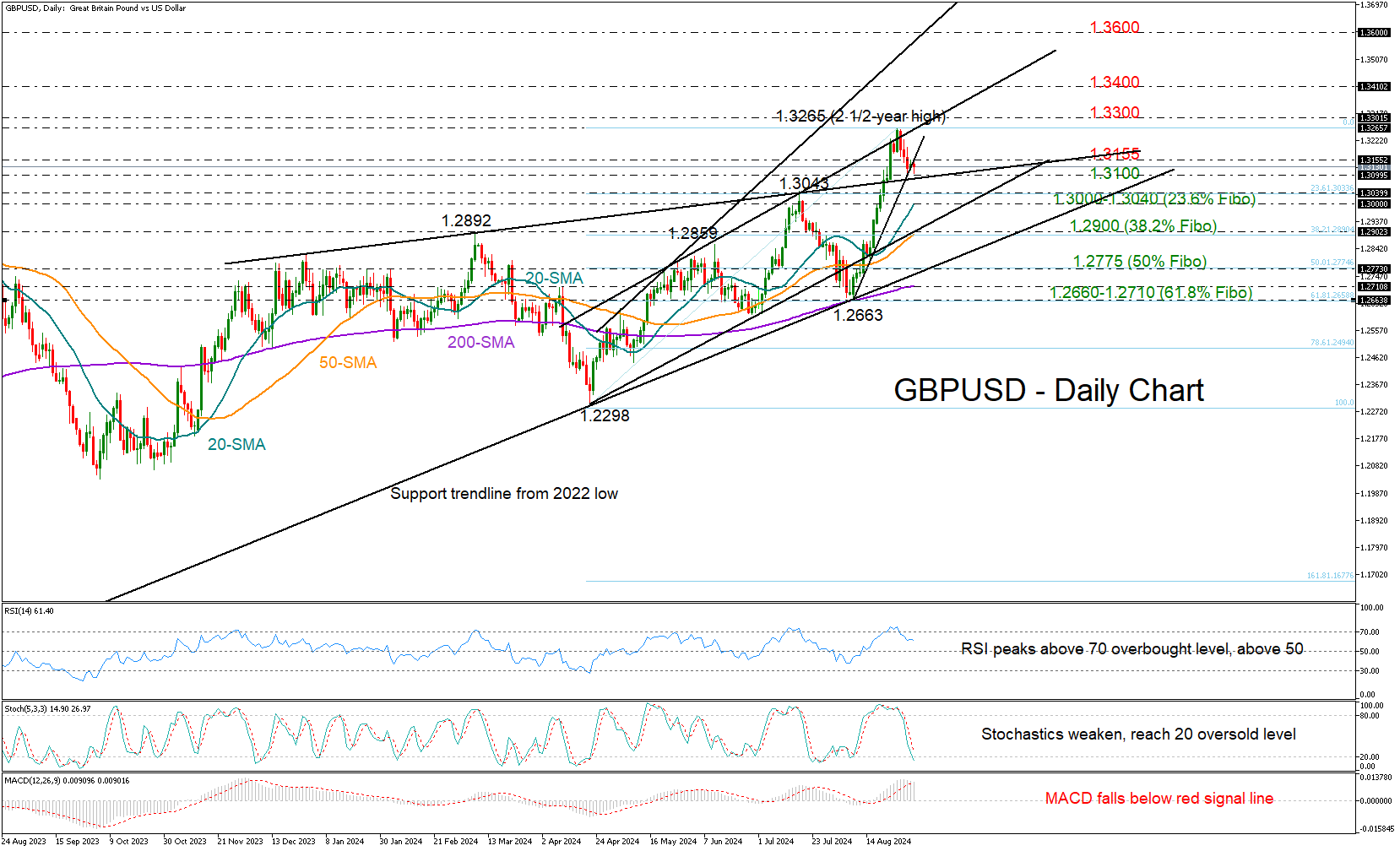
GBPUSD resumed its negative momentum during Tuesday’s early European trading hours, crossing below the steep support trendline, which had been curtailing the pullback from the two-and-a-half year high of 1.3265 over the past two trading days.

A decline below 1.3100 could motivate more selling towards the 23.6% Fibonacci retracement of the April-July upleg at 1.3040 and the 20-day simple moving average (SMA) at 1.3000. If the bears dominate there, the negative cycle could stretch towards the 38.2% Fibonacci mark of 1.2900 and the 50-day SMA. Another step lower could confirm a continuation towards the ascending trendline from 2022 seen around the 50% Fibonacci level and the 1.2775 level.

With the RSI and the stochastic oscillator changing direction to the downside and the MACD slipping below its red signal line, it is probable that selling interest will remain intact for the time being. Nevertheless, the rising slope in the SMAs implies that the ongoing bearish wave might be a component of the larger bullish trend.

In the event the price returns above the broken support trendline at 1.3155, the bulls will stage another battle around the 1.3265 peak and the tough resistance line from April. The 1.3300 number will be closely watched as well, and if buyers claim that barrier, the rally could pick up steam towards the 1.3400 round level. Above that, there are no significant obstacles until the 1.3600 level.

In summary, GBPUSD might experience ongoing downward pressure in the next few sessions, especially if it closes below 1.3100. For a bullish continuation, the price must exceed the resistance trendline at 1.3265.

Author

Christina Parthenidou

Christina joined the XM investment research department in May 2017. She holds a master degree in Economics and Business from the Erasmus University Rotterdam with a specialization in International economics.


More from Christina Parthenidou
Share:

Markets move fast. We move first.

Orange Juice Newsletter brings you expert driven insights - not headlines. Every day on your inbox.

By subscribing you agree to our Terms and conditions.

Editor's Picks

EUR/USD flatlines below 1.1800 amid trading lull, awaits Fed Minutes

EUR/USD trades around a flatline below 1.1800 in European trading on Tuesday. The pair lacks any trading impetus as the US Dollar moves little amid market caution ahead of the Fed's December Meeting Minutes release, which could offer insights into the Federal Reserve’s 2026 outlook.

GBP/USD retakes 1.3500 despite the year-end grind

GBP/USD finds fresh demand and retakes 1.3500 on Tuesday as markets grind through the last trading week of the year. Despite the latest uptick, the pair is unlikely to see further progress due to the year-end holiday volumes.

Gold holds the bounce on Fed rate cut bets, safe-haven flows

Gold holds the rebound near $4,350 in the European trading hours on Tuesday. The precious metal recovers some lost ground after falling 4.5% in the previous session, which was Gold's largest single-day loss since October. Increased margin requirements on gold and silver futures by the Chicago Mercantile Exchange Group, one of the world’s largest trading floors for commodities, prompted widespread profit-taking and portfolio rebalancing.

Tron steadies as Justin Sun invests $18 million in Tron Inc.

Tron (TRX) trades above $0.2800 at press time on Monday, hovering below the 50-day Exponential Moving Average (EMA) at $0.2859.

Economic outlook 2026-2027 in advanced countries: Solidity test

After a year marked by global economic resilience and ending on a note of optimism, 2026 looks promising and could be a year of solid economic performance. In our baseline scenario, we expect most of the supportive factors at work in 2025 to continue to play a role in 2026.

Crypto market outlook for 2026

Year 2025 was volatile, as crypto often is.  Among positive catalysts were favourable regulatory changes in the U.S., rise of Digital Asset Treasuries (DAT), adoption of AI and tokenization of Real-World-Assets (RWA).