|

GBP/USD outlook: Near-term structure weakens after a double failure at 1.1500 barrier
GBP/USD

Cable remains in red for the second day, pressured by weaker risk sentiment and downbeat report from the BoE, which showed raised expectations for inflation in one year time to 9.5% from 8.4% estimation in August and expectations for 4.8% inflation in three years.

Inflation in UK eased to 9.9% in September from 10.1% in August, but still about five times above the central bank’s 2% target.

BoE remains on track for further rate hikes to in fight to bring red-hot inflation under control, though high borrowing cost would further hurt already weakened economic growth.

Overall negative near-term picture could be partially offset by better than expected UK PMI data which showed unexpected increase of activity in construction sector, sending the index to three-month high.

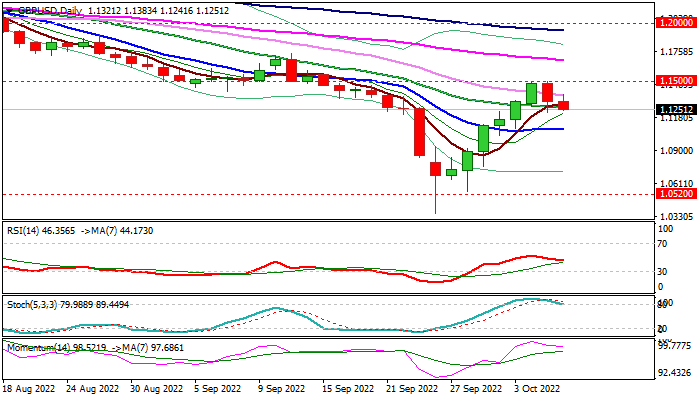
Daily studies show near-term structure weakening, following a pullback after repeated reject at round-figure 1.15 resistance, as negative momentum is rising and stochastic emerging from overbought territory. Fresh bears tested initial support at 1.1225 (Fibo 23.6% of 1.0348/1.1495 recovery leg), but need break here to further weaken near-term structure and open way for attack at key supports at 1.1082/1.1057 (10DMA/Fibo 38.2%) and psychological 1.10 level, to generate stronger reversal signal on break. Falling 30DMA offers immediate resistance at 1.1373, guarding the upper pivot at 1.1500, violation of which would bring bulls back to play.

Res: 1.1373; 1.1410; 1.1460; 1.1500.
Sup: 1.1225; 1.1082; 1.1057; 1.1000.
GBPUSD

Interested in GBP/USD technicals? Check out the key levels

    1. R3 1.1741
    2. R2 1.1618
    3. R1 1.1472
  1. PP 1.1349
    1. S1 1.1203
    2. S2 1.1081
    3. S3 1.0934

Author

Slobodan Drvenica

Slobodan Drvenica

Windsor Brokers

Industry veteran with over 22 years’ experience, Slobodan Drvenica joined Windsor Brokers in 1995 when he was an active trader for more than 10 years, managing the trading desk and own account departments.


More from Slobodan Drvenica
Share:

Markets move fast. We move first.

Orange Juice Newsletter brings you expert driven insights - not headlines. Every day on your inbox.

By subscribing you agree to our Terms and conditions.

Editor's Picks

EUR/USD falls toward 1.1700 on broad USD recovery

EUR/USD turns south and declines toward 1.1700 on Wednesday. The US Dollar gathers recovery momentum and forces the pair to stay on the back foor, as traders look to USD short-covering ahead of US inflation report on Thursday. However, the downside could be capped by hawkish ECB expectations. 

GBP/USD trades deep in red below 1.3350 after soft UK inflation data

GBP/USD stays under strong selling pressure midweek and trades below 1.3350. The UK annual headline and core CPI rose by 3.2% each, missing estimates of 3.5% and 3.4%, respectively, reaffirming dovish BoE expectations and smashing the Pound Sterling across the board ahead of Thurday's BoE policy announcements. 

Gold clings to moderate daily gains above $4,300

Following Tuesday's volatile action, Gold regains its traction on Wednesday and trades in positive territory above $4,300. While the buildup in the USD recovery momentum caps XAU/USD's upside, the cautious market stance helps the pair hold its ground.

Bitcoin risks deeper correction as ETF outflows mount, derivative traders stay on the sidelines

Bitcoin (BTC) remains under pressure, trading below $87,000 on Wednesday, nearing a key support level. A decisive daily close below this zone could open the door to a deeper correction.

Monetary policy: Three central banks, three decisions, the same caution

While the Fed eased its monetary policy on 10 December for the third consecutive FOMC meeting, without making any guarantees about future action, the BoE, the ECB and the BoJ are holding their respective meetings this week. 

AAVE slips below $186 as bearish signals outweigh the SEC investigation closure

Aave (AAVE) price continues its decline, trading below $186 at the time of writing on Wednesday after a rejection at the key resistance zone. Derivatives positioning and momentum indicators suggest that bearish forces still dominate in the near term.