GBP/USD is locked in a clear range as a second referendum gains traction — Confluence Detector

GBP/USD is trading marginally lower amid news that the UK Labour Party tabled a parliamentary motion that could open the door to a second EU Referendum, potentially averting Brexit.
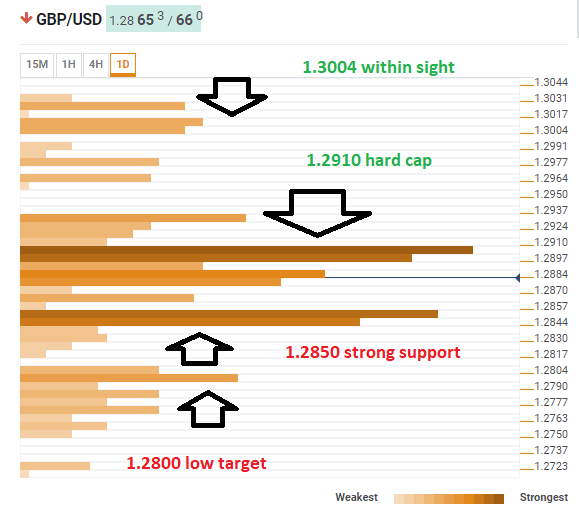
The Technical Confluences Indicator shows that cable faces resistance at 1.2910 which is the convergence of the Pivot Point one-month Resistance 1, the Bollinger Band 4h-Middle, the Simple Moving Average 5-one-day, the SMA 200-15m, the SMA 100-one-day, the Fibonacci 23.6% one-day, and more.
Breaking above this level will allow GBP/USD to run higher, opening the road to 1.3004 where we see the Pivot Point one-day R3, and last week's high.
Looking down, Sterling has significant support at 1.2850 where we see the confluence of the Pivot Point one-day Support 1, the SMA 10-one-day, last month's high and also the SMA 200-1h, and the Fibonacci 61.8% one-day.
Losing that line could send the pair down to 1.2800 where we see the convergence of the Fibonacci 61.8% one-week, the SMA 100-4h, and the Pivot Point one-day S2.
All in all, once GBP/USD decides where to break out to, it could run quite a bit.
This is how it looks on the tool:
Confluence Detector
The Confluence Detector finds exciting opportunities using Technical Confluences. The TC is a tool to locate and point out those price levels where there is a congestion of indicators, moving averages, Fibonacci levels, Pivot Points, etc. Knowing where these congestion points are located is very useful for the trader, and can be used as a basis for different strategies.
This tool assigns a certain amount of “weight” to each indicator, and this “weight” can influence adjacents price levels. This means that one price level without any indicator or moving average but under the influence of two “strongly weighted” levels accumulate more resistance than their neighbors. In these cases, the tool signals resistance in apparently empty areas.
Author

Yohay Elam
FXStreet
Yohay is in Forex since 2008 when he founded Forex Crunch, a blog crafted in his free time that turned into a fully-fledged currency website later sold to Finixio.
















