|

GBP/USD holds near September’s support zone after mixed jobs data

  • GBP/USD stays directionless near September’s base.

  • Technical signals cannot warrant an upside reversal.

GBPUSD

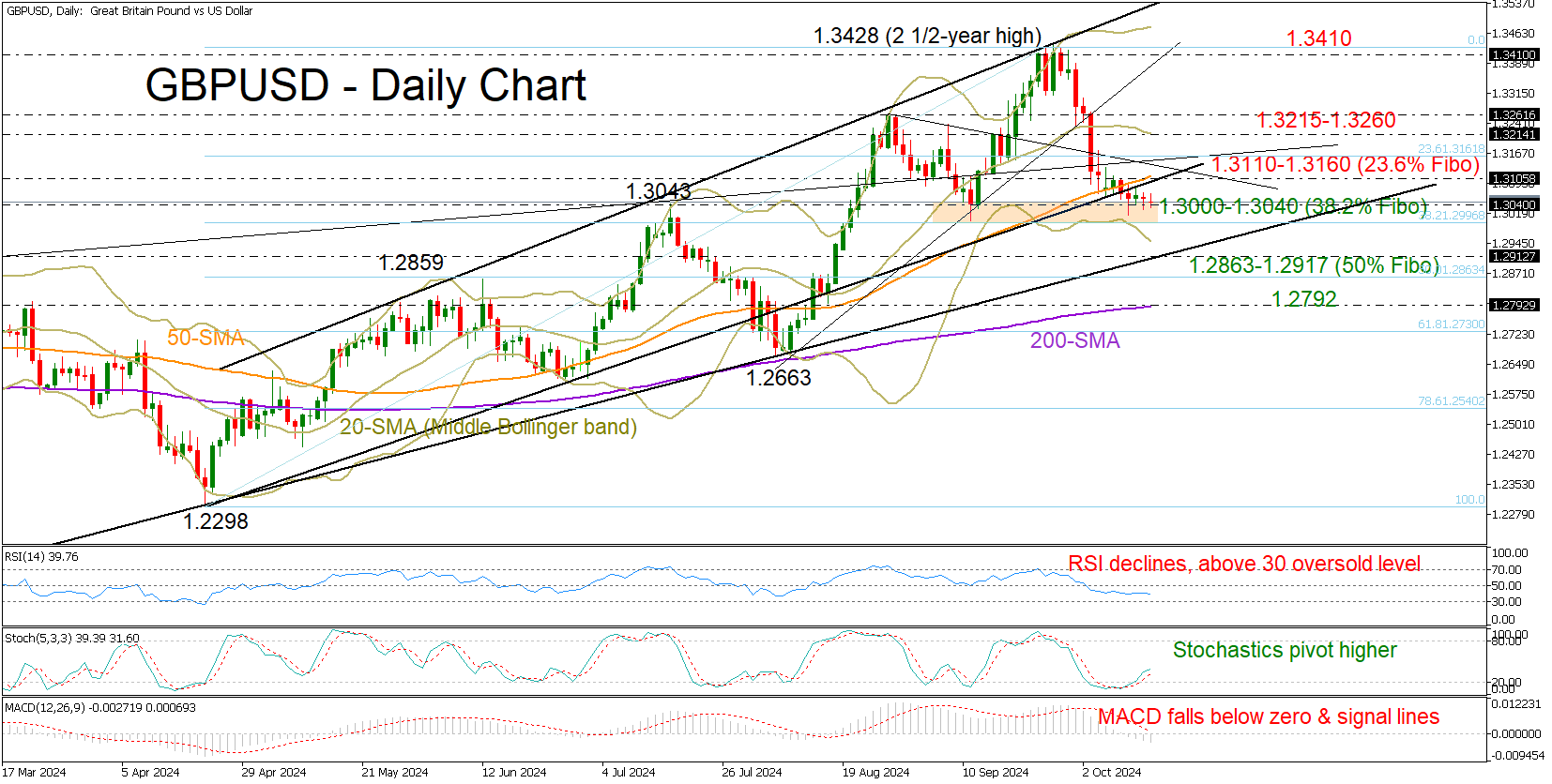
GBPUSD faced mild selling pressure but held its footing above September’s floor of 1.3000-1.3040 after the UK employment survey showed better-than-expected jobs data in August and an increase in the number of unemployed people in September.

The bears may have luck on their side as the technical indicators are not confirming oversold conditions yet. While the stochastic oscillator has dropped below 20, the RSI is still above its 30 oversold level. Likewise, the price itself has not touched the lower Bollinger band.

In the case the pair signals a bearish trend reversal below 1.3000-1.3040, it may seek shelter near the critical 2022 support trendline at 1.2917. Slightly lower, the 50% Fibonacci retracement of the April-September upleg at 1.2863 might encounter downside pressures too. If not, the decline may gain new legs towards the 200-day simple moving average (SMA), which successfully boosted the price back above the 1.3000 level in August.

The path could be rough if there’s an upside reversal. The bulls could initially experience congestion within the 1.3110-1.3160 zone. Then, the recovery could stall somewhere between 1.3215 and 1.3260. Breaking this range might be necessary for an advance back to the September ceiling of 1.3410.

Summing up, GBP/USD has not overcome downside risks despite approaching an important protective area. A step below 1.3000 could renew selling interest, whilst a bounce above 1.3260 could shift the bias back to positive.

Author

Christina Parthenidou

Christina joined the XM investment research department in May 2017. She holds a master degree in Economics and Business from the Erasmus University Rotterdam with a specialization in International economics.


More from Christina Parthenidou
Share:

Editor's Picks

AUD/USD falls to near 0.7100 after slipping below 50-day EMA

AUD/USD depreciates after registering minor gains in the previous day, trading around 0.7120 during the Asian hours. The technical analysis of the daily chart shows the pair consolidating sideways within a rectangle pattern, as neither bulls nor bears gain control. The AUD/USD pair is holding a slight bearish tone however as it sits beneath both the nine-day and 50-day EMAs.

Japanese Yen edges up but remains close to the 160.00 intervention threshold

The Japanese Yen edges up against the US Dollar on Friday, but the USD/JPY pair remains above 159.90 at the time of writing, unable to put a significant distance from the 160.00 level, considered the limit of tolerable JPY weakness for Japanese authorities.

Gold returns to the red, awaits US NFP

Gold price is looking to test the weekly lows, while in the red near $4,450 in the early European session on Friday. The precious metal remains vulnerable amid ongoing geopolitical turmoil. Traders will closely monitor the developments surrounding the US-Iran peace deal and the US May employment report later on Friday.


Arthur Hayes' “Holy Trinity” is dead: Exits Zcash after Orchard Pool exploit

Arthur Hayes has entirely dumped his “Holy Trinity” holdings by offloading his Zcash holdings on Friday. The privacy coin is down 13% so far on Friday, extending Thursday’s 26% decline after an Orchard Shielded Pool audit revealed a critical vulnerability that allowed the undetectable minting of fake coins. Hayes continues to hold Worldcoin ahead of the upcoming SpaceX Initial Public Offering, on the chance of a “high-beta proxy” rally.

Nonfarm Payrolls set to show stable labor market in May as markets digest Fed hawkish shift

The United States Bureau of Labor Statistics will release the Nonfarm Payrolls data for May on Friday at 12:30 GMT. Investors expect NFP to rise by 85K following the surprisingly strong 185K and 115K increases recorded in March and April, respectively.

The US economy defies the rules: 100 days into the Oil shock and the recession signal is still missing

More than three months after the start of the Iran war and the resulting disruption to global energy markets, the US economy continues to display remarkable resilience. The conflict has triggered a sharp rise in Oil prices, reignited inflationary pressures and fueled widespread concerns about a potential economic slowdown.