|

GBP/USD has two support levels

GBP/USD, EUR/GBP, GBP/NZD

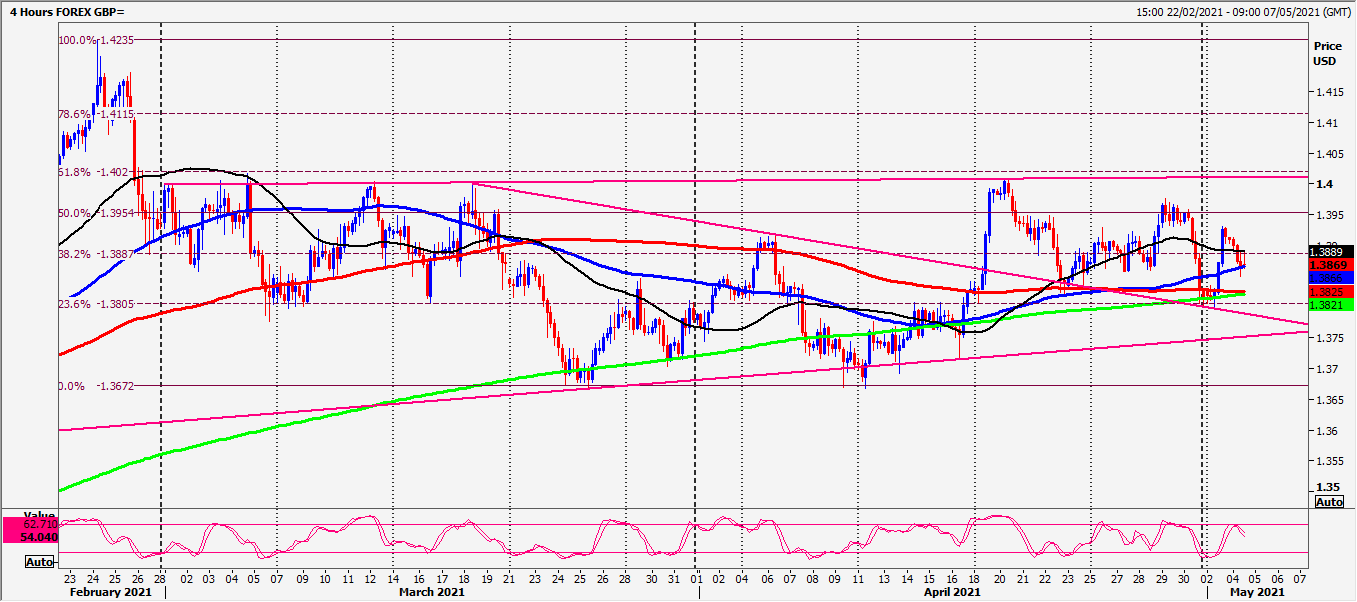
GBPUSD unexpectedly wiped out 5 days of gains as the pair collapsed 160 pips in the sideways trend on Friday then recovers most of the losses on Monday. This is an unpredictable erratic sideways trend.

EURGBP topped exactly here at first resistance at 8712/19 & bottomed exactly at first support at 8665/55 yesterday.

GBPNZD holding between 4 month ascending trend line & 200 day moving average resistance at 1.9330/40 & support at the 100 day moving average at 1.9190/80.

Daily analysis

GBPUSD has 2 support levels at 1.3815/05 (we bottomed exactly here yesterday) & at 1.3765/55.

Holding support at 1.3815/05 targets 1.3845/55 & 1.3890 perhaps as far as strong resistance at 1.3910/25. A break higher targets 1.3980/90.

EURGBP topped exactly at first resistance at 8712/19. A break higher targets 8750/60, perhaps as far as 8785/90.

The pair bottomed exactly at first support at 8665/55 but below 8645 can target 8630/20 before support at 8600/8590. Below 8585 can target 8565/60.

GBPNZD retests strong resistance at the 4 month ascending trend line & 200 day moving average 1.9330/40. If we continue higher look for strong resistance at 1.9410/20.

First support at the 100 day moving average at 1.9190/80. Longs need stops below 1.9165. A break lower to targets 1.9105/00.

Chart
GBPUSD

Author

Jason Sen

Jason Sen

DayTradeIdeas.co.uk

Jason Sen began his career in the options pits on the trading floor of LIFFE in 1987 at the age of 19, making markets on his own account. In 2001 when the trading floor closed he successfully made the transition to day trading on computer screens.


More from Jason Sen
Share:

Editor's Picks

GBP/USD stays below 1.3400 after soft UK CPI data

GBP/USD struggles to gain traction and stays below 1.3400 in the second half of the day on Wednesday. The UK annual Consumer Price Index (CPI) inflation cooled to 2.6% in June against the market forecast of 2.7%, making it difficult for the British Pound gather recovery momentum. Meanwhile, investors keep a close eye on headlines coming out of the Middle East.

EUR/USD stabilizes near 1.1400 as markets focus on geopolitics

EUR/USD trades in a narrow channel at around 1.1400 on Wednesday. In the absence of high-impact data releases, escalating geopolitical tensions in the Middle East caps the pair's upside. On Thursday, the European Central Bank (ECB) will announce monetary policy decisions.

Gold holds comfortably above $4,100, remains close to two-week high

Gold steadies above $4,100 during the Asian session on Thursday, stalling the previous day's modest pullback from over a two-week high amid a soft US Dollar. However, the recent spike in oil prices, bolstered by escalating US-Iran tensions, continues to fuel inflationary concerns and lift bets for a Fed rate hike in 2026. This remains supportive of elevated US Treasury bond yields, which favors USD bulls and could act as a headwind for the non-yielding bullion.

Australia unemployment rate set to steady at 4.4% in June, signaling strong job market

Australia will publish the June monthly employment report on Thursday at 01:30 GMT, and market participants expect a modest increase in job creation in the land Down Under. The Australian Bureau of Statistics is expected to announce that the country added 15K new jobs in the month, while the Unemployment Rate is forecast at 4.4%, unchanged from May.

Hyperliquid, Robinhood could lead crypto’s next bull market as DeFi and TradFi converge

The next crypto bull market could be driven by the growing convergence between blockchain-based financial infrastructure and traditional finance, according to Bitwise CIO Matt Hougan. In a report published late Tuesday, Hougan argued that crypto may be showing early signs of a market bottom, with Bitcoin gaining 9% since July 1 even as the NASDAQ 100 declined 6%.

US Dollar mid-year outlook: Exceptional currency, exceptional risks?
The US Dollar enters the second half of 2026 in a markedly different position from a year ago. The King currency has recovered, reflecting persistent US inflation, changing expectations for Fed policy, geopolitical tensions and renewed demand for defensive assets.