GBP/USD Forecast: Sterling crawls towards $1.4000 as US government shutdown looms

The GBP/USD is trading up 0.3% at around $1.3930 against the US Dollar after easily passing through and closing above the resistance line at $1.3850 on Thursday. The UK retail sales are expected to fall 0.6% over the month and core retail sales are seen falling 0.8% over the month in December, the data from the Office for National Statistics are to show later on Friday.
While monthly retail sales are expected to fall due to a strong rise in November, both total and core retail sales are seen accelerating when compared to a year ago. The story of GBP/USD is driven by the US Dollar weakness as the US Senate is struggling to strike the deal between Democrats and Republican averting the US government shutdown that looms from midnight January 19.
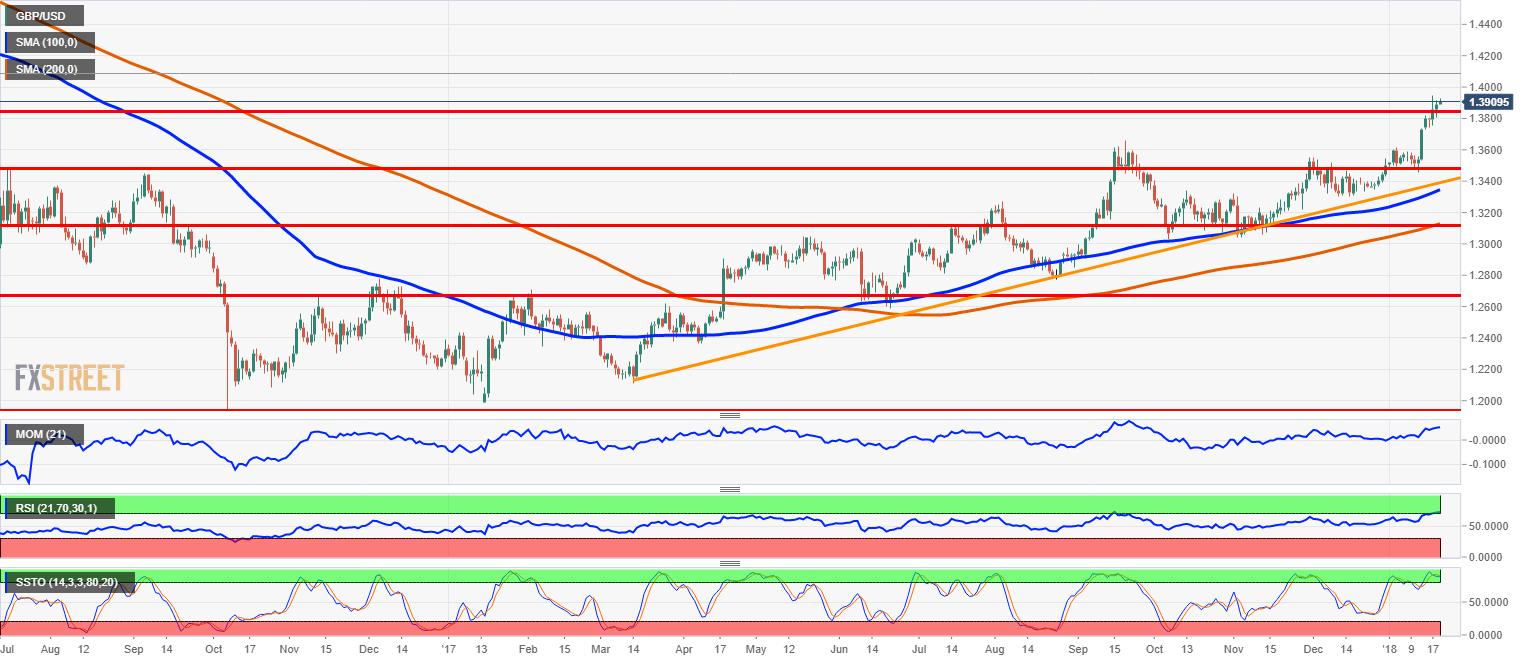
Technically the GBP/USD busted the resistance at $1.3850 representing 61.8% Fibonacci retracement line of post-Brexit slide lower. Although GBP/USD initially failed to close above that key resistance line on Wednesday, its ride higher continued over Thursday with no barrier between the current spot and the round big figure of $1.4000.
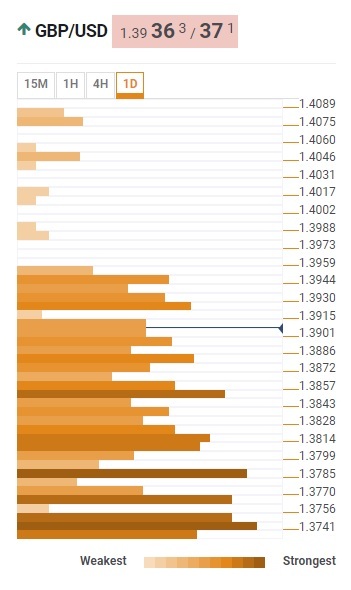
The FXStreet confluence indicator that analyses multi-factor coincidence of different technical barriers points to $1.3944 as a near-term resistance on a daily chart with no big barrier for GBP/USD until round big figure of $1.4000.
FXStreet confluence indicator for GBP/USD
With technical hurdle for GBP/USD already broken at $1.3850, the oscillators are painting picture of a corrective move sideways with both Slow Stochastics and the Relative Strength Index moving within the Overbought territory. The momentum indicator is pointing upwards on a daily chart indicating a rise in demand and further potential on the upside.
GBP/USD daily chart
Author
Mario Blascak, PhD
Independent Analyst
Dr. Mário Blaščák worked in professional finance and banking for 15 years before moving to journalism. While working for Austrian and German banks, he specialized in covering markets and macroeconomics.
More from Mario Blascak, PhD