GBP/USD Forecast: Sellers retain control as Pound Sterling fails to clear 1.2730
- GBP/USD retreated below 1.2700 in the European session on Thursday.
- 1.2730 aligns as key technical resistance for the pair.
- USD could struggle to gather strength in case market mood remains upbeat.


After falling toward 1.2600 on Wednesday, GBP/USD made a sharp U-turn and closed the day virtually unchanged above 1.2700. The pair, however, came under renewed bearish pressure in the European session on Thursday and broke below 1.2700.
Following the dismal UK PMI data, Pound Sterling came under selling pressure as investors reassessed the Bank of England's rate outlook. According to Reuters, markets are currently pricing in a less than 50% probability of the BoE peak rate reaching 6%. Highlighting dovish BoE bets, the rate-sensitive 2-year UK gilt yield fell nearly 4% on Wednesday and broke below 5%.
On the other hand, disappointing US PMI readings caused the USD to erase its daily gains in the American session on Wednesday, helping GBP/USD shake off the bearish pressure.
Meanwhile, strong gains seen in US technology stocks allowed risk flows to dominate the market action and allowed GBP/USD to keep its footing.
At the time of press, Nasdaq Futures were up 1%, while Dow Futures were down 0.2%. A bullish opening in Wall Street could make it difficult for the USD to gather further strength.
Pound Sterling price today
The table below shows the percentage change of Pound Sterling (GBP) against listed major currencies today. Pound Sterling was the weakest against the US Dollar.
| USD | EUR | GBP | CAD | AUD | JPY | NZD | CHF | |
| USD | 0.14% | 0.36% | 0.17% | 0.53% | 0.51% | 0.55% | 0.40% | |
| EUR | -0.15% | 0.21% | 0.00% | 0.39% | 0.37% | 0.40% | 0.23% | |
| GBP | -0.36% | -0.22% | -0.21% | 0.17% | 0.15% | 0.19% | 0.04% | |
| CAD | -0.16% | 0.02% | 0.23% | 0.40% | 0.36% | 0.41% | 0.24% | |
| AUD | -0.56% | -0.38% | -0.18% | -0.39% | -0.03% | 0.01% | -0.13% | |
| JPY | -0.52% | -0.36% | -0.14% | -0.37% | 0.03% | 0.02% | -0.11% | |
| NZD | -0.56% | -0.41% | -0.20% | -0.43% | -0.03% | -0.06% | -0.19% | |
| CHF | -0.38% | -0.24% | -0.02% | -0.24% | 0.17% | 0.13% | 0.18% |
The heat map shows percentage changes of major currencies against each other. The base currency is picked from the left column, while the quote currency is picked from the top row. For example, if you pick the Euro from the left column and move along the horizontal line to the Japanese Yen, the percentage change displayed in the box will represent EUR (base)/JPY (quote).
Market participants will also pay close attention to the US data. Durable Goods Orders in the US is forecast to decline 4% in July and the weekly Initial Jobless Claims is expected to tick higher to 240,000 from 239,000 in the previous week. In case the number of first time applications for unemployment benefits rise more than 250,000, the USD could weaken with the immediate reaction. Ahead of Federal Reserve Chairman Jerome Powell's speech at the Jackson Hole Symposium, however, investors could refrain from taking large positions.
GBP/USD Technical Analysis
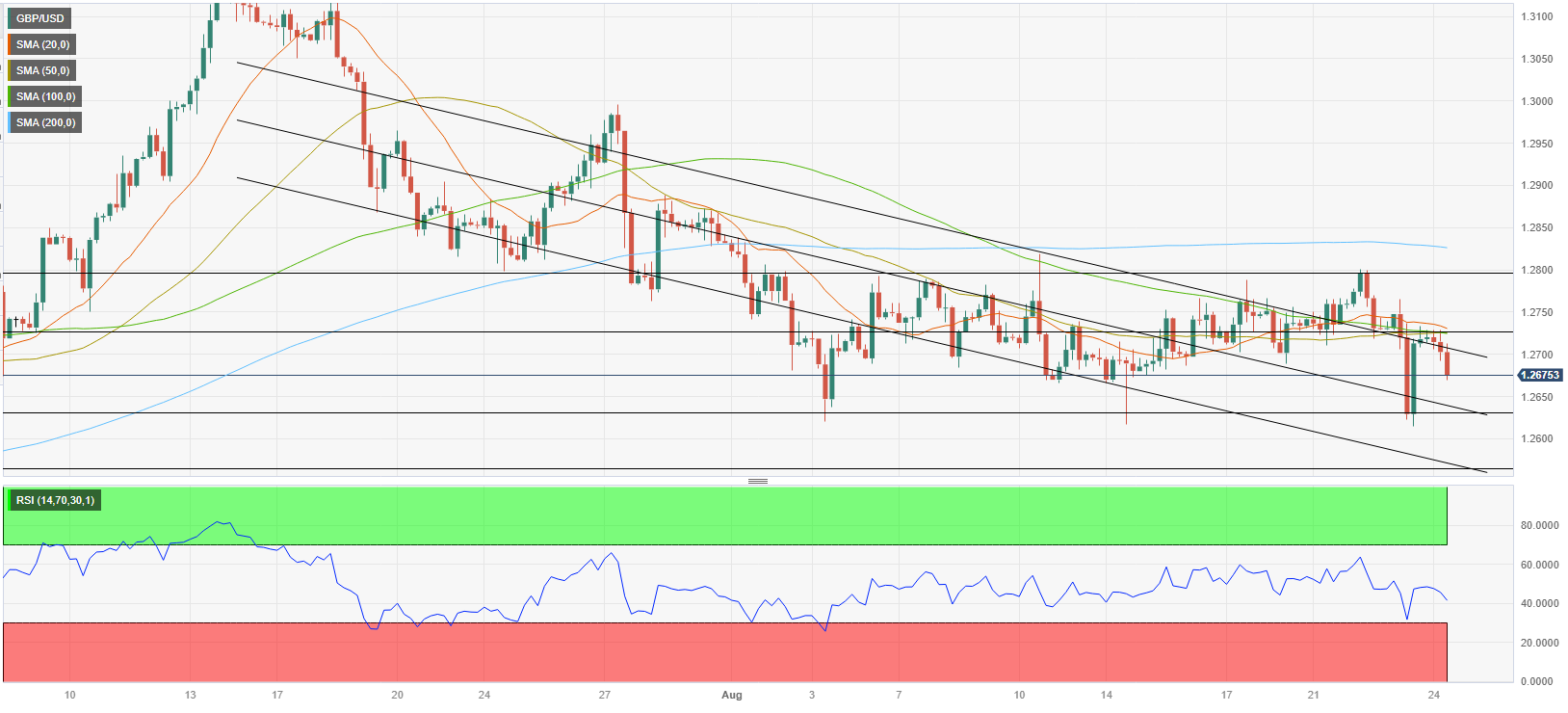
GBP/USD returned within the descending regression channel by falling below 1.2700 on Thursday. Meanwhile, the Relative Strength Index (RSI) indicator on the four-hour chart retreated to 40 after rising to 50 on Wednesday, highlighting buyers' hesitancy.
On the downside, 1.2650 (mid-point of the descending channel) aligns as next important support before 1.2600 (psychological level, static level) and 1.2560 (lower limit of the descending channel).
In case GBP/USD manages to reclaim 1.2700 and stabilize above that level, it could face stiff resistance at 1.2730, where the 20-, 50-, and 100-period Simple Moving Averages (SMA) are located. A four-hour close above 1.2730 could open the door for an extended rebound toward 1.2800 (psychological level, static level).
Premium
You have reached your limit of 3 free articles for this month.
Start your subscription and get access to all our original articles.
Author
Eren Sengezer
FXStreet
As an economist at heart, Eren Sengezer specializes in the assessment of the short-term and long-term impacts of macroeconomic data, central bank policies and political developments on financial assets.