GBP/USD Forecast: Pound Sterling could extend correction amid risk aversion
- GBP/USD has lost its traction after having tested 1.2500.
- 1.2450 aligns as key support area for the pair.
- GBP/USD could stay under bearish pressure if safe haven flows continue to dominate the action.

GBP/USD has turned south and declined toward 1.2450 after having climbed above 1.2500 for the first time in nearly two weeks during the Asian trading hours on Tuesday. The pair faces key support area at 1.2450 and additional losses could be witnessed if that level fails. In the absence of high-impact data releases, the pair could find it difficult to regather bullish momentum unless the risk mood starts to improve.
On Monday, the US Dollar (USD) came under selling pressure as US Treasury bond yields fell sharply. Although markets nearly fully price in a 25 basis points (bps) Federal Reserve (Fed) rate hike at next week's policy meeting, investors were reminded of the negative impact of the tight policy on financing conditions late Monday.
First Republic Bank reported that deposits in the first quarter declined by more than $100 billion, triggering a leg lower in the US T-bond yields.
In the second half of the day, the Conference Board will release the Consumer Confidence Index for April. The one-year inflation component of the survey, which stood at 6.2% in March, could impact the US Dollar's valuation in the short term. An unexpected decline in that data could hurt the USD while a reading close to 6.5% should help the currency stay resilient against its rivals.
Ahead of the first-quarter Gross Domestic Product (GDP) data from the US on Thursday, however, investors could refrain from taking large positions based on the consumer sentiment data.
Meanwhile, US stock index futures are down between 0.4% and 0.5% in the European trading hours. A negative opening in Wall Street followed by big losses in Wall Street's main indexes could help the USD hold its ground.
GBP/USD Technical Analysis
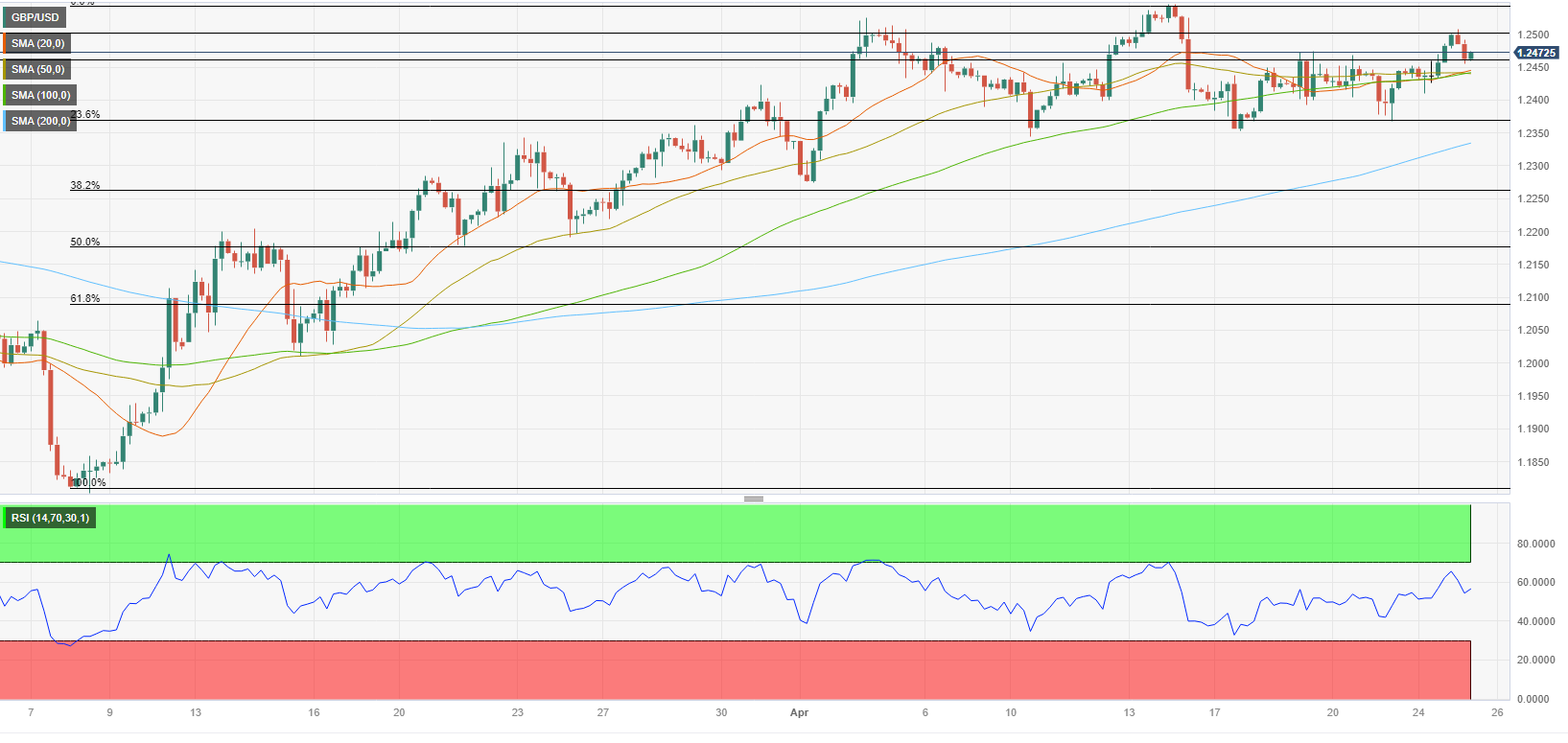
GBP/USD trades slightly above 1.2460/1.2450 support area, where the static level is reinforced by the 20-period, 50-period and 100-period Simple Moving Averages on the four-hour chart. With a four-hour close below that level, the pair could continue to push lower toward 1.2400 (psychological level, static level) and 1.2360 (Fibonacci 23.6% retracement of the latest uptrend).
On the other hand, 1.2500 (psychological level, static level) and 1.2550 (end-point of the uptrend) could be seen as next bullish targets as long as 1.2460/50 support area stays intact.
Premium
You have reached your limit of 3 free articles for this month.
Start your subscription and get access to all our original articles.
Author
Eren Sengezer
FXStreet
As an economist at heart, Eren Sengezer specializes in the assessment of the short-term and long-term impacts of macroeconomic data, central bank policies and political developments on financial assets.

















