GBP/USD Forecast: Politics to take center stage, as UK gets a new PM
- The pound continues to be pressured by UK political uncertainty and Brexit fears.
- Parliament reduces chances of a no-deal Brexit in October, light economic calendar for next week, UK politics to gather all the attention as new PM takes office.
- GBP/USD hit the lowest since April 2017 and then rebounded erasing weekly losses, boosted by a weaker US Dollar; trend still points to the downside.
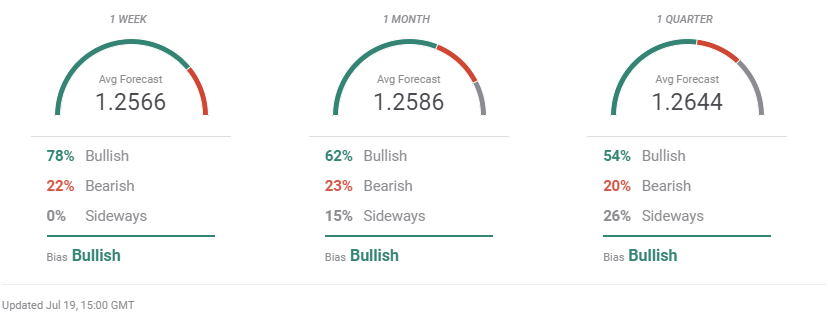
- The FX Poll is showing that experts are now bullish in the short to medium term.

What just happened: Saved by the US Dollar
The GBP/USD pair bottomed on Wednesday at 1.2381, the lowest level since April 2017. That same day started a recovery, having on Thursday the biggest daily gain in two months. The key driver was a decline of the US Dollar following comments from Fed’s officials reinforcing July rate cut expectations. Cable recovered the key 1.2500 area, but the trend still points to the downside.
The result of the winner of the Conservative Party's leadership contest is expected to be announced on July 23. The next day, Theresa May will resign as Prime Minister to the Queen. Boris Johnson is seen defeating Jeremy Hunt. On Thursday more than a dozen ministers signaled they will quit when Johnson becomes PM. Earlier that day, a vote in parliament made it harder for any government to prorogue parliament. Rising uncertainty continues to be the only sure thing in the UK. Meanwhile, government borrowing increased nearly twice as expected in June, with the largest deficit for June in four years.
Again, like what happened last week, the US Dollar came to rescue GBP/USD. Comments from Fed’s Williams, Clarida, and Bullard pushed the greenback sharply lower across the board by arguing for a rate cut. Those comments offset the latest round of US data that came in above expectations and impulsed some analysts to ask if a rate cut is really necessary.
GBP/USD bounced from levels not seen in two years, back above 1.2500. With politics taking center stage in the UK with a new PM, high volatility appears to be granted.
UK events: It's all about politics
The contest between Johnson and Hunt ends next week, and also the Premiership of Theresa May. What is known is that uncertainty still rules in the UK. Is not only about how Brexit will be, it is not clear if the next PM will be the one signing the documents for the withdraw. The possibility of a general election is high. The vote at the UK Parliament on Thursday signals that it won’t be easy for Johnson to gain support for his position. Even to form a cabinet appears to be difficult.
Johnson will attempt a renegotiation of May’s deal in Brussels, despite EU officials comments that the withdrawal agreement will not be renegotiated. If talks fail, Johnson could pursue a no-deal Brexit or a longer transition period. Under the no-deal scenario, the Parliament could force an election.
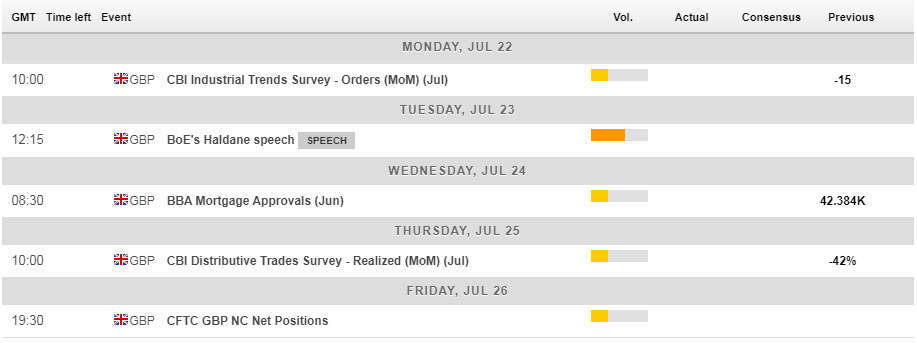
Economic data to be released next week shows no top-tier events. All clear for politics and Brexit to take center stage. Politics in the UK will be the critical event, next week and probably the next ones too.
Here are the events lined up in the UK on the forex calendar:
US events: GDP data and more, does it matter?
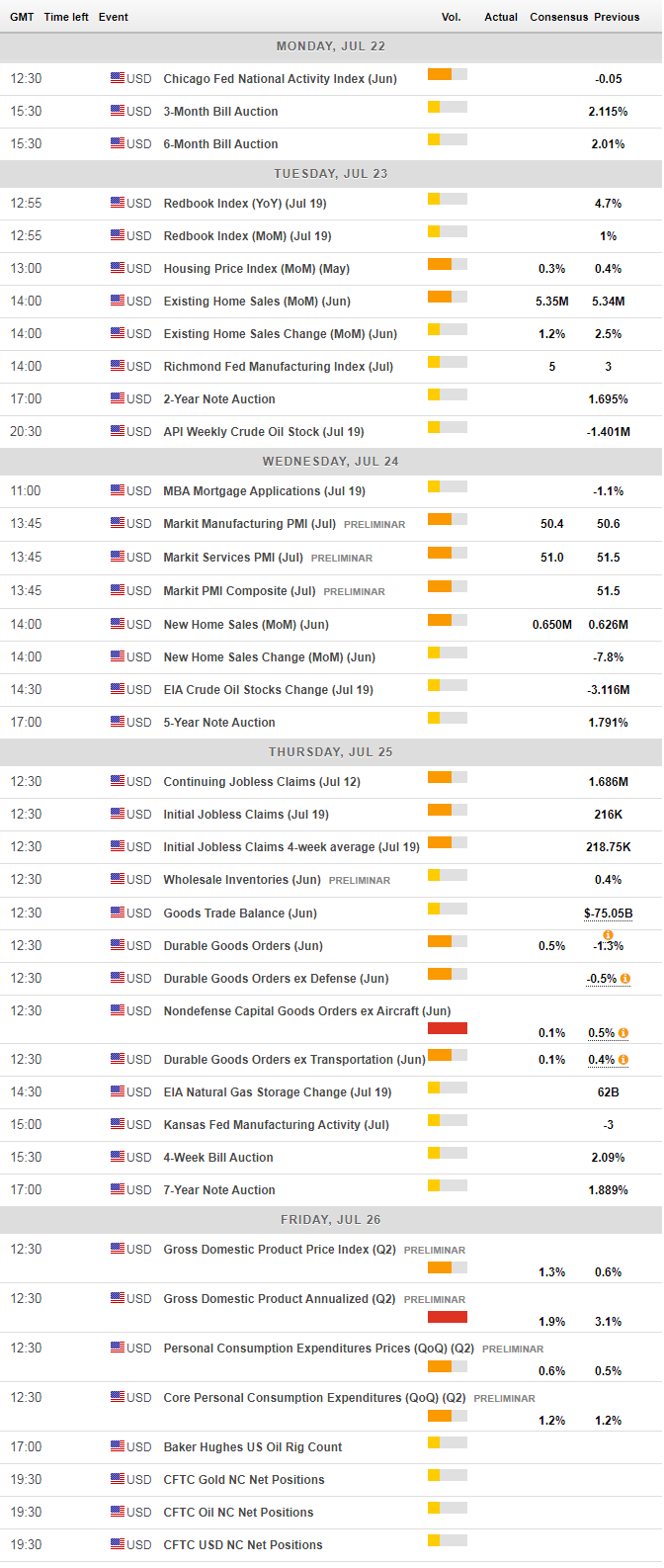
Economic data to be released next week in the US, includes the first take on 2Q GDP. Growth is likely to be lower than in recent quarters, slightly below 2%. Is that low enough for a rate cut from the Fed? Maybe not, but just like Fed’s Clarida said, the central bank should not delay rate cuts until the economy falters. The economy is in a good place, according to Clarida, but uncertainties have increased. So after all, is not all “data-dependent.” The next FOMC meeting will take place on July 30/31, and a 25bp rate cut is expected. Can next week economic's data change those expectations?
Several housing reports are due next week (price index, existing home sales, and new home sales), the preliminary Markit PMI and Durables Goods Orders. Those numbers will offer further information about the state of the economy. The Beige Book published on Wednesday suggested uncertainty goes on for US business.
Trade talks offered nothing new over the last days. Is it a fantasy to consider that US President Trump is waiting for the Fed to cut rates before reaching a deal with China? The lack of progress in trade talks has been replaced with rising tensions between the US and Iran, amid drones battle and Iran’s nuclear program.
Here are the scheduled events in the US:
GBP/USD Technical Analysis
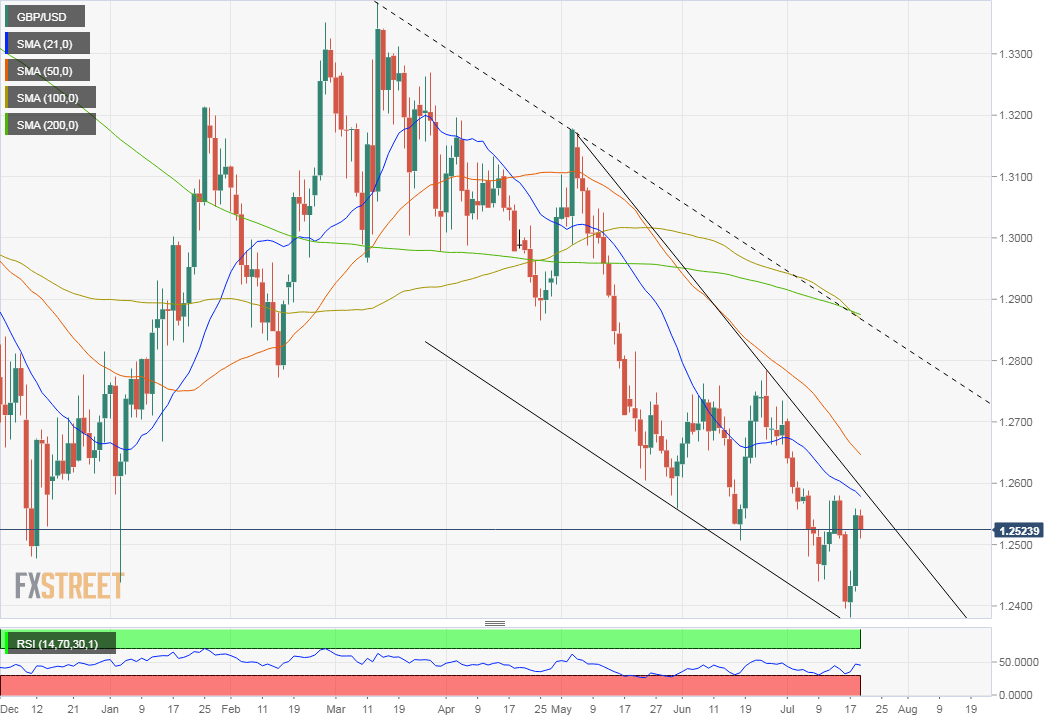
GBP/USD continues to trade within a narrowing downtrend wedge and moving with a bearish bias. The negative Momentum eased after the rebound back above 1.2500 following a rejection from under 1.2400. RSI move away from 30 and flattened. Price remains well below the 20, 50, 100 and 200-day moving averages.
A consolidation above 1.2600 would be a positive technical development for the Pound. It would have risen above the 20-day moving average, also on top of the 1.2580/1.2600 barrier, and above a short-term downtrend. The next resistance is 1.2660 followed by 1.2710.
A failure to hold on top of 1.2600 could reinforce the bearish bias. A slide back below 1.2480 will likely add pressure to the pair. Next comes the 1.2400 figure: a daily close below opens the doors for 1.2360, the April 2017 low.
GBP/USD sentiment poll
The FXStreet Poll shows that experts are bullish in the short and long terms. The targets are rising along with the time horizon. Experts forecast have widened when compared to last week, particularly in the 3-month horizon, mainly due to a move to the upside.
Author
Matías Salord
FXStreet
Matías started in financial markets in 2008, after graduating in Economics. He was trained in chart analysis and then became an educator. He also studied Journalism. He started writing analyses for specialized websites before joining FXStreet.