GBP/USD Forecast: No signs of life in Pound Sterling
- GBP/USD trades virtually unchanged slightly below 1.2450 on Friday.
- The pair remains on track to end the fourth straight week in positive territory.
- Nonfarm Payrolls in the US are expected to rise by 240K in March.

GBP/USD has gone into a consolidation phase a few pips below 1.2450 after having closed in negative territory for the second day in a row on Thursday. Thin trading volumes on Good Friday are likely to force the pair to remain directionless even after the March jobs report from the United States. On a weekly basis, GBP/USD looks to post gains for the fourth straight time.
Although Wall Street's main indexes managed to close marginally higher on Thursday, the US Dollar (USD) didn't have a difficult time staying resilient against its rivals, supported by the modest recovery seen in the US Treasury bond yields.
In the early American session, the US Bureau of Labor Statistics will release the labor market report for March. Nonfarm Payrolls (NFP) are forecast to rise by 240,000 and the Unemployment Rate is expected to stay unchanged at 3.6%. Moreover, Average Hourly Earnings growth is seen declining to 4.3% on a yearly basis from 4.6% in February.
Investors could start reassessing the US Federal Reserve's rate outlook and reconsider the possibility of another 25 basis points (bps) rate hike in case the NFP reading and the wage inflation come in stronger than expected. On the other hand, a weak growth in NFP could feed into the market expectation of the Fed leaving its policy rate unchanged at the next policy meeting. According to the CME Group FedWatch Tool, the probability of one more 25 bps rate increase currently stands at 52.7%.
Nevertheless, it will not be easy to figure out how the jobs report will influence the Fed's rate outlook amid the Easter holiday.
GBP/USD Technical Analysis
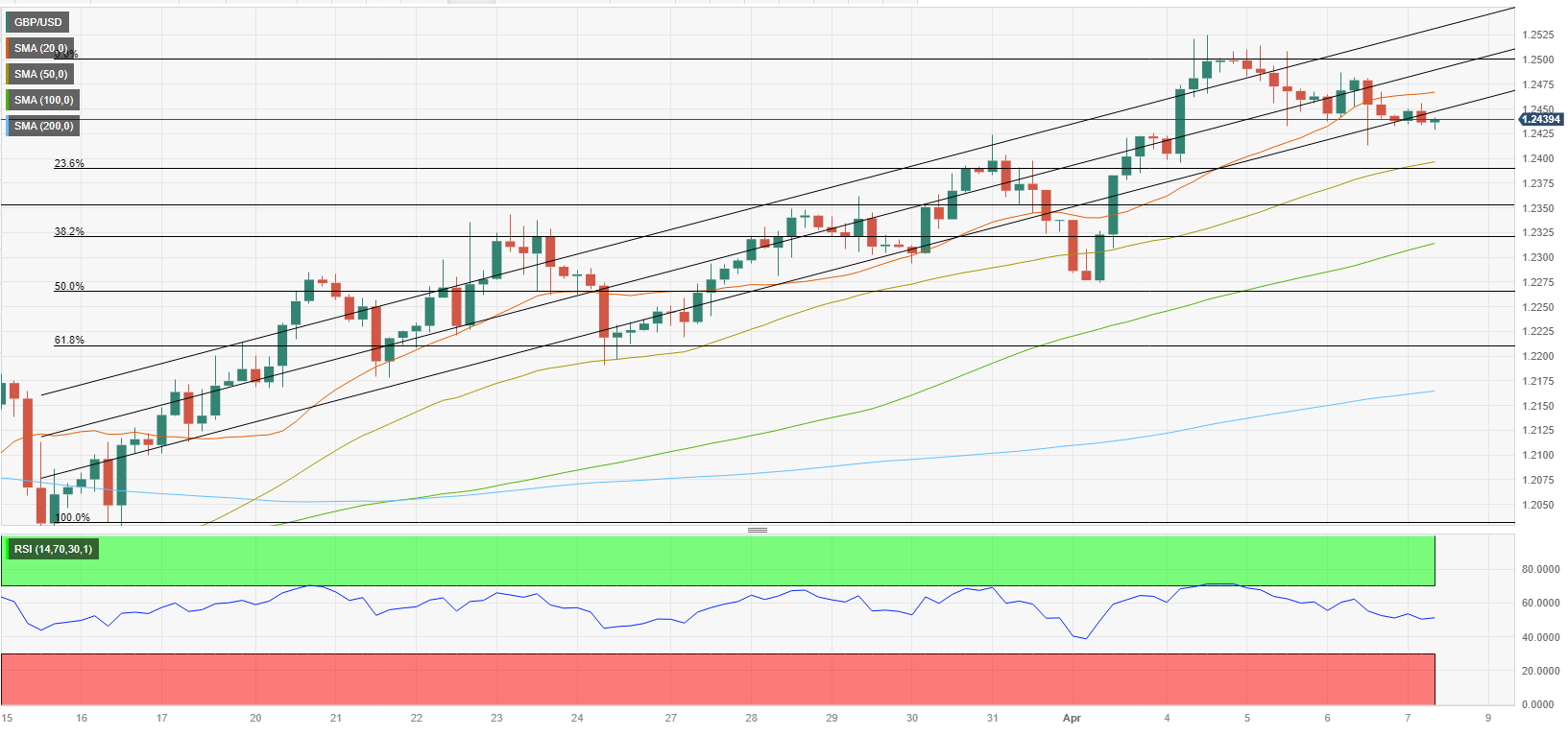
GBP/USD dropped below the 20-period Simple Moving Average (SMA) on Thursday and the last four four-hour candles closed below that level. Additionally, the pair stays slightly below the lower limit of the ascending regression channel, which currently aligns as immediate resistance at 1.2450.
In case 1.2450 stays intact, an extended downward correction toward 1.2400 (Fibonacci 23.6% retracement of the latest uptrend, 50-period SMA) and 1.2350 (static level) could be witnessed.
On the upside, 1.2470 (20-period SMA), 1.2500 (psychological level, end-point of uptrend) and 1.2525 (April 4 high) align as resistances.
Author

Eren Sengezer
FXStreet
As an economist at heart, Eren Sengezer specializes in the assessment of the short-term and long-term impacts of macroeconomic data, central bank policies and political developments on financial assets.

















