GBP/USD Forecast: Going nowhere in a hurry, UK/US PMIs eyed for some impetus
- The incoming UK election polls have been indicating a majority for Conservatives.
- A late pick up in the USD demand kept a lid on the overnight attempted positive move.
- Dip-buying interest below the 1.2900 handle helped limit any meaningful pullback.

The GBP/USD pair on Thursday initially edged higher and moved back closer to weekly tops, albeit failed to capitalize on the momentum. In a series of UK election polls, the latest Ipsos MORI's poll showed that the UK Prime Minister Boris Johnson's Conservative Party has gained three points to take its lead to 44% and turned out to be one of the key factors that provided a minor boost to the British pound. Meanwhile, the support for the Labour Party also rose four points to 28%, while support for the Liberal Democrats and Nigel Farage's Brexit Party dropped four points each to 16% ad 3% respectively.
Bulls resilient below 1.2900
However, a late pickup in the US dollar demand kept a lid on any strong follow-through, rather prompted some fresh selling at higher levels. Positive trade-related headlines led to a sharp pickup in the US Treasury bond yields, which eventually extended some support to the greenback. The push higher came after China was reported to have extended an invite to US trade negotiations for another round of face-to-face talks. This was followed by a report by the South China Morning Post (SCMP), indicating that tariffs on Chinese goods slated to go into effect on December 15 will likely be delayed even if the negotiating parties can't reach an agreement.
The pair ended with modest losses for the third straight session, albeit continued showing some resilience below the 1.2900 handle and edged higher during the Asian session on the last trading day of the week. Moving ahead, market participants now look forward to the first preliminary readings of the UK Manufacturing and Services PMI. Later during the North-American session, the flash version of the US Manufacturing PMI, followed by revised UoM Consumer Sentiment might further contribute towards producing some short-term trading opportunities on the last day of the week.
Short-term technical outlook
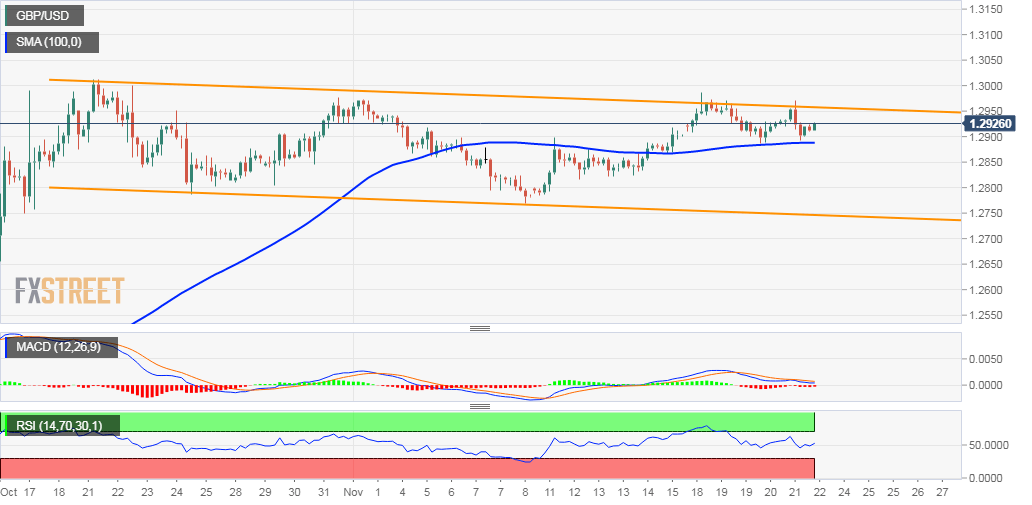
From a technical perspective, the pair's repeated failures to decisively break through a short-term descending trend-channel suggests persistent selling interest in the vicinity of the key 1.30 psychological mark. Hence, it will be prudent to wait for some strong follow-through buying beyond the mentioned handle before positioning for any further near-term appreciating move towards an intermediate resistance near the 1.3045-50 region. The momentum could further get extended towards the 1.3100 mark en-route May monthly swing highs – around the 1.3175 region.
On the flip side, bearish traders are likely to wait for a sustained breakthrough the 1.2900 mark, below which the pair is likely to accelerate the slide further towards mid-1.2800s. Failure to defend the mentioned support levels might now turn the pair vulnerable and accelerate the fall further towards testing the 1.2800 round-figure mark. The pair could then weaken further, albeit the downside is likely to find decent support and remain limited near the lower end of the descending trend-channel, currently near the 1.2750-40 region.
Author

Haresh Menghani
FXStreet
Haresh Menghani is a detail-oriented professional with 10+ years of extensive experience in analysing the global financial markets.
















