GBP/USD Forecast: bears struggle to push it through 1.3450 support

The British Pound broke down significantly on Tuesday, with a strong follow-through US Dollar upsurge dragging the GBP/USD pair to fresh YTD lows. The pair failed to gain any positive traction following the release of not so impressive UK employment details and dropped back below the key 1.3500 psychological mark, albeit managed to close just above the mentioned handle.
The greenback continued scaling higher and was further supported by the US economic data, which indicated that the economy is picking up pace after a slow start to the year. The 10-year Treasury bond yield shot above the psychologically important 3% level, hitting its highest level since 2011 on reviving hopes that the Fed might need to raise interest rates more aggressively, and was seen as one of the key factors driving the buck higher.
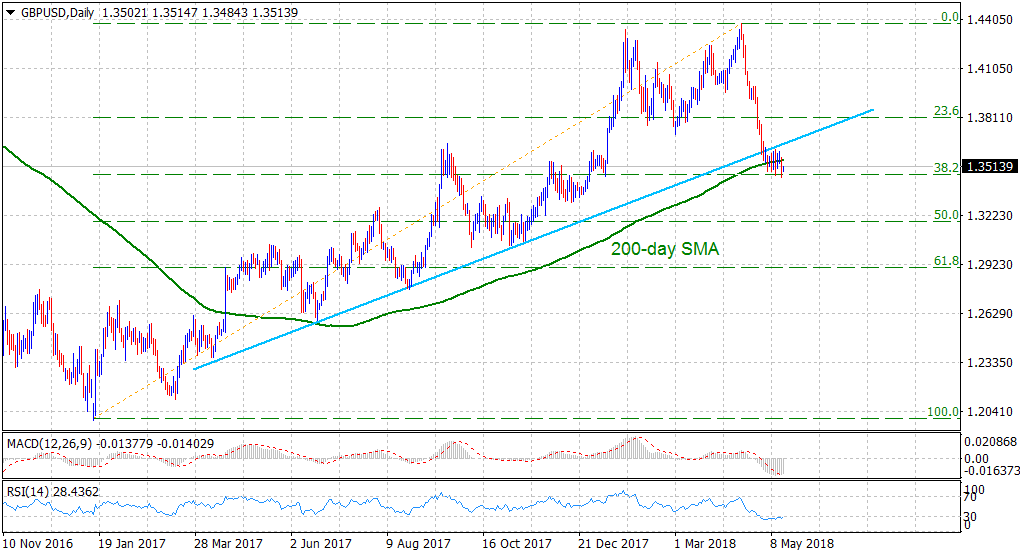
The downfall, however, lacked bearish conviction and the pair once again managed to find decent support near the 38.2% Fibonacci retracement level of the 1.1987-1.4377 up-move. In absence of any market moving economic releases from the UK, the USD price dynamics might continue to act as an exclusive driver of the pair's momentum through the European session. Later in the day, the US housing market data and a scheduled speech by Atlanta Fed President Raphael Bostic might provide some fresh impetus.
The negative signals provided by short-term technical indicators point to an extension of the pair's near-term bearish trajectory, which would be confirmed on acceptance below the immediate support near mid-1.3400s. A convincing breakthrough the mentioned support now seems to accelerate the fall towards the 1.3400 round figure mark before the pair eventually drops to test its next support near the 1.3330 area.
On the flip side, momentum back above the very important 200-day SMA, currently around mid-1.3500s, should continue to face stiff resistance near the 1.3600-1.3610 region, which if cleared might trigger a short-covering bounce towards a medium-term ascending trend-line support break-point near the 1.3640 area.
Author

Haresh Menghani
FXStreet
Haresh Menghani is a detail-oriented professional with 10+ years of extensive experience in analysing the global financial markets.

















