GBP/USD Forecast: Bearish potential intact, awaits US CPI before the next leg down
- A combination of factors prompted fresh selling around GBP/USD on the last day of the week.
- Reduced BoE rate hike bets, Brexit woes, weaker UK macro data weighed on the British pound.
- Hawkish Fed expectations, rising US bond yields underpinned the USD and exerted pressure.
- Bearish traders now await the release of the US consumer inflation before placing fresh bets.

The GBP/USD pair met with fresh supply on Friday and dropped back to the 1.3200 mark during the early European session, reversing the previous day's modest recovery gains. Expectations that the imposition of fresh COVID-19 restrictions in the UK could force the Bank of England to delay its decision to hike interest rates at its December policy meeting, along with persistent Brexit-related uncertainties, acted as a headwind for the British pound.
In the latest development, French President Emmanuel Macron accused the UK government of failing to keep its word on Brexit and fishing licences. Adding to this, Annick Girardin, France's sea minister warned on Thursday that it would call on the EU to go to litigation if the 53 licences awaiting UK approval are not granted by Friday evening. Apart from this, mostly disappointing UK macro data dump and modest US dollar strength exerted some pressure on the major.
The UK Office for National Statistics reported that economic growth decelerated to 0.1% in October from a 0.6% rise reported in the previous month, missing expectations for a 0.4% reading. Adding to this, total industrial output dropped 0.6% in October as against consensus estimates for a modest 0.1% increase. This, to a larger extent, overshadowed better-than-anticipated UK Trade balance data and did little to impress GBP bulls or lend any support to the pair.
On the other hand, the USD drew some support from a fresh leg up in the US Treasury bond yields, bolstered by hawkish Fed expectations. Investors seem convinced that the Fed will tighten its monetary policy sooner rather than later to contain stubbornly high inflation and have been pricing in the possibility of liftoff in May 2022. Hence, the market focus remains on the release of the US consumer inflation figures, due later during the early North American session.
The US CPI report would influence the Fed's decision to taper its bond purchases at a faster pace and its strategy on interest rate hikes. This, in turn, could drive US dollar demand heading into the FOMC monetary policy meeting on December 14-15 and provide some meaningful impetus to the GBP/USD pair.
Technical outlook
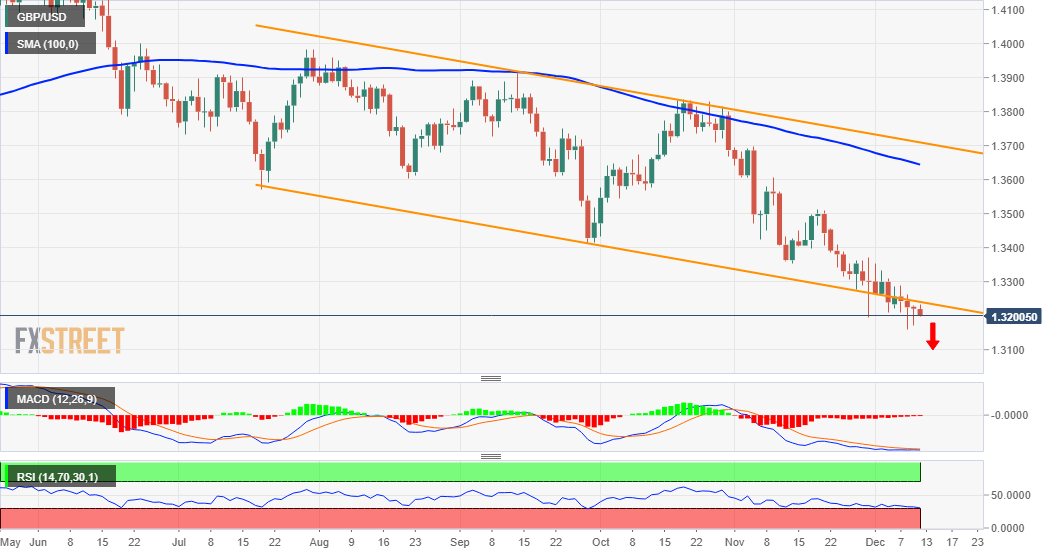
From a technical perspective, the pair’s inability to gain any traction or register any meaningful recovery supports prospects for an extension of the recent bearish trend. That said, RSI (14) on the daily chart is hovering just above the oversold territory and warrants some caution for aggressive bearish traders. Nevertheless, the stage still seems set for a test of the YTD low, around the 1.3160 region touched on Wednesday. The next relevant support is pegged near the 1.3125 region before the pair breaks below the 1.3100 mark and accelerates the decline towards the 1.3050-45 region.
On the flip side, the 1.3220-30 region now seems to have emerged as an immediate hurdle. The mentioned barrier coincides with a short-term descending trend-channel support breakpoint, which if cleared could trigger a short-covering move. However, any subsequent move up is likely to face stiff resistance and seen as a selling opportunity near the weekly swing high, just ahead of the 1.3300 mark. Sustained strength beyond there should allow the pair to move back towards the 1.3340-50 supply zone en-route the 1.3370 area and the 1.3400 round figure.
Author

Haresh Menghani
FXStreet
Haresh Menghani is a detail-oriented professional with 10+ years of extensive experience in analysing the global financial markets.