|

GBP/USD analysis: upward potential limited after White Paper release

GBP/USD Current price: 1.3218

  • UK White Paper on Brexit strategy disappointed Brexiteers, raises concerns within European Parliament.
  • GBP/USD posted a shy advance on dollar's weakness, poised to break lower.
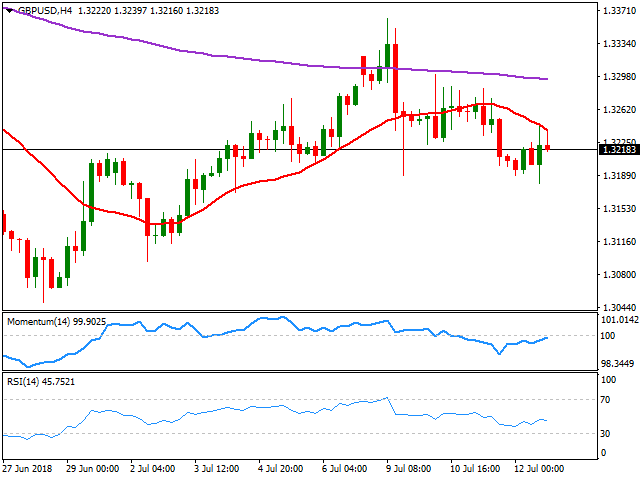
The GBP/USD pair posted a modest daily advance to settle in the 1.3220 price zone, after trading as low as 1.3179. The movements were purely driven by the greenback, despite the UK government finally published the White Paper that draws the kingdom's future relations with the EU. The document that still needs to be analyzed and validated by EU authorities,  triggered a negative Brexiteers' reaction, as Jacob Ress-Mogg said it was a "bad deal for Britain." The blueprint offers multiple intermediate solutions, as for example, the UK will continue to follow EU law but won't be directly affected by European Courts. Unlimited migration will come to an end, but EU citizens will be able to travel freely and work in the UK without a visa on a temporal basis. Regarding customs, the document proposed copying EU rules to maintain a "frictionless trade." Regarding the key Irish border issue, the situation remains complicated. After the release of the paper, the European Parliament threatened to veto the plan,  concerned that the temporary customs plan with no regulatory alignment would lead to border checks. Technically, the risk is leaned to the downside according to the 4 hours chart, as the pair met selling interest around a bearish 20 SMA a couple of times, currently at 1.3240, while technical indicators remain in negative territory, with the Momentum aiming modestly higher but the RSI losing upward strength and heading marginally lower at 45.

Support levels: 1.3180 1.3155 1.3110

Resistance levels: 1.3240 1.3285 1.3320  

View Live Chart for the GBP/USD

Author

Valeria Bednarik

Valeria Bednarik was born and lives in Buenos Aires, Argentina. Her passion for math and numbers pushed her into studying economics in her younger years.


More from Valeria Bednarik
Share:

Editor's Picks

AUD/USD eyes 0.7150 barrier nine-day EMA

AUD/USD inches higher after registering modest losses in the previous day, trading around 0.7130 during the Asian hours. The technical analysis of the daily chart indicates that the pair is moving sideways within the rectangle pattern, suggesting a consolidation as neither the bulls nor the bears have enough momentum to take control of the market.

USD/JPY trades below 160.00 intervention threshold; bullish bias intact

The USD/JPY pair attracts some sellers during the Asian session amid fears that authorities will step in again to prop up the Japanese Yen. Furthermore, the Israel-Lebanon truce prompts some profit-taking around the US Dollar and exerts downward pressure on the currency pair.

Gold extends rebound to $4,500 as US yields edge lower

Gold (XAU/USD) preserves its recovery momentum following Wednesday's slide and tests the $4,500 mark in the second half of the day on Thursday. While US-Iran uncertainty remains, easing tensions between Lebanon on Israel seems to be helping the market mood improve, causing the USD to lose strength alongside falling US T-bond yields and opening the door for a decisive rebound in XAU/USD.

Bitcoin’s massive storm is back: Why the sell-off is far from over

Bitcoin price action over the last few weeks has felt less like a normal, healthy correction and more like a slow grinding crash that continues to wreak havoc on holdings and trading accounts. And everything suggests that the dramatic crash isn’t over.

Nonfarm payrolls: Testing the limits of Fed policy patience

The upcoming nonfarm payrolls report for May will provide the final update on the US labor market before Kevin Warsh attends his first policy meeting as the new Fed Chair later this month.

Recession on paper: What really moves the Canadian Loonie now?

Statistics Canada handed the headline writers a gift and the analysts a headache. Real GDP shrank 0.1% on an annualized basis in the first quarter, and with the fourth quarter of 2025 revised down to a 1.0% contraction, that is two negative quarters in a row, the textbook definition of a technical recession and Canada's first since the pandemic.















