GBP/USD Analysis: Bulls could aim to test 1.3565-70 confluence despite COVID-19 woes
- GBP/USD witnessed two-way price moves on Thursday and ended nearly unchanged for the day.
- The intraday downtick turned out to be short-lived and was quickly bought into near mid-1.3400s.
- The worsening COVID-19 situation in the UK acted as a headwind and capped gains for the major.

The GBP/USD pair seesawed between tepid gains/minor losses and finally settled nearly unchanged on Thursday amid thin end-of-year trading volumes. The US dollar made a solid comeback and reversed the previous day's losses back closer to the monthly low. This was seen as a key factor that exerted some downward pressure on the major, though the early downtick turned out to be short-lived.
The optimism over signs that the Omicron variant might be less severe than feared and is unlikely to derail the economic recovery remained supportive of the underlying bullish sentiment. This was evident from an extension of the recent runup in the equity markets, which acted as a headwind for the safe-haven greenback. Adding to this, retreating US Treasury bond yields forced the buck to trim a part of its intraday gains. This, in turn, assisted the pair to attract fresh buying near mid-1.3400s and jump to the highest level since November 10.
Meanwhile, data released from the US showed that Initial Jobless Claims dropped more than anticipated, to 198k in the week ended December 24 – marking the lowest level since 1969. Separately, the Chicago PMI also surpassed expectations and rose to 63.1 for the current month from 61.8 in November. This, along with the Fed's hawkish outlook, indicating at least three rate hikes next year, acted as a tailwind for the greenback. Apart from this, the worsening COVID-19 situations in the United Kingdom kept a lid on any further gains for the major.
In fact, Britain reported a record 189,213 new COVID-19 cases on Thursday amid an alarming spread of the Omicron variant, which could force the government to impose additional restrictions. It is worth recalling that the UK Prime Minister Boris Johnson had said last week that ministers would keep the latest data under constant review to see if stricter measures are needed. This held back traders from placing aggressive bullish bets around the British pound, which failed to assist the pair to find acceptance above the key 1.3500 psychological mark.
The pair now seems to have entered a consolidation phase and was seen oscillating in a narrow trading band through the Asian session on Friday. In the absence of any major market-moving economic releases, either from the UK or the US, development surrounding the coronavirus saga will be looked upon for some trading impetus. Apart from this, the broader market risk sentiment will influence the USD demand and produce some short-term opportunities on the last day of the week/month/year.
Technical outlook
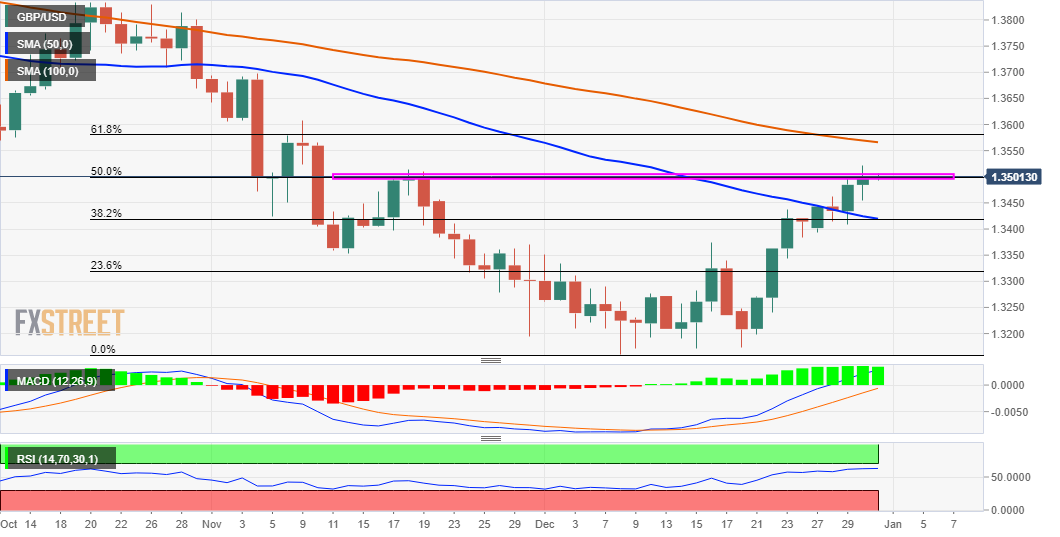
From a technical perspective, the recent strong recovery move from the YTD low paused near a hurdle marked by the 50% Fibonacci level of the 1.3834-1.3161 downfall. This coincides with the November 18-19 swing high and should act as a key pivotal point for short-term traders. Given the recent move beyond the 1.3375-80 horizontal resistance, a sustained breakthrough of the 38.2% Fibo. and the 50-day SMA confluence hurdle favours bullish traders. This along with positive oscillators support prospects for a further near-term appreciating move towards the 1.3565 region. This marks another confluence resistance comprising 61.8% Fibo. level and the 100-day SMA, which if cleared decisively would be seen as a fresh trigger for bullish traders.
On the flip side, the overnight swing low, around the 1.3455-50 region, now seems to protect the immediate downside. Any subsequent decline could be seen as a buying opportunity near the 38.2% Fibo. level/50-DMA confluence resistance breakpoint and remain limited near the 1.3400 mark. Failure to defend the said support levels, leading to a further slide below the 1.3385-75 region might shift the bias back in favour of bearish traders. The pair could then accelerate the fall towards testing the 23.6% Fibo. level, around the 1.3320 area.
Author

Haresh Menghani
FXStreet
Haresh Menghani is a detail-oriented professional with 10+ years of extensive experience in analysing the global financial markets.