|

GBP/NZD breaks below the key support of 1.9850

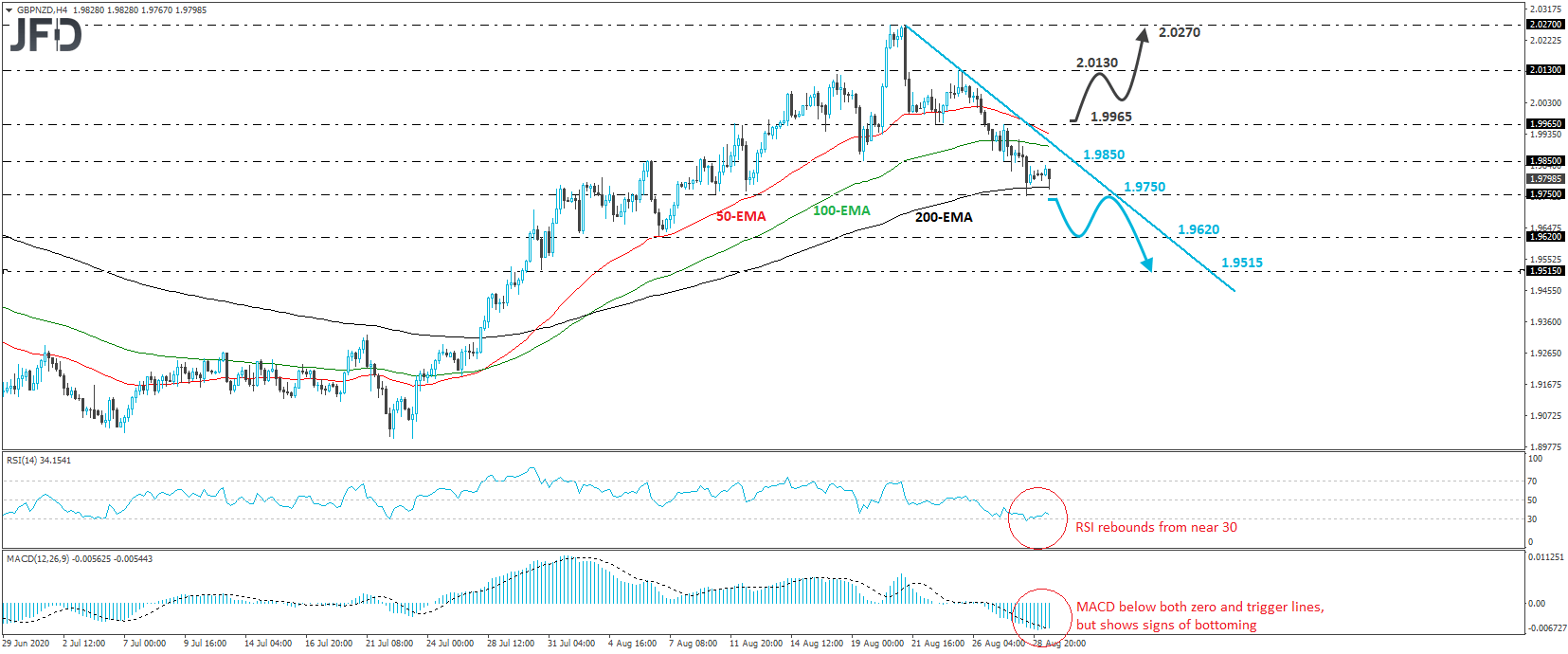
GBP/NZD slid on Friday, breaking below the key support (now turned into resistance) zone of 1.9850, marked by the low of August 19th. In our view, the move has signaled a short-term trend reversal, which can be also marked by a short-term tentative downside resistance line taken from the high of August 21st.

That said, in order to start examining lower areas, we would like to see a strong dip below Friday’s low, at around 1.9750. Such a move would confirm a forthcoming lower low and may encourage the bears to pull the trigger, targeting the 1.9620 obstacle, defined as a support by the low of August 6th. They may decide to take a small break after testing that zone, thereby allowing a corrective bounce, but as long as the rate would be trading below the aforementioned tentative downside line, we would see decent chances for another leg south. If this is the case, and the 1.9620 barrier breaks this time, we may see extensions towards the 1.9515 level, marked by an intraday swing low formed on July 30th.

Shifting attention to our short-term oscillators, we see that the RSI rebounded somewhat after testing its 30 line, while the MACD, although below both its zero and trigger lines, shows signs of bottoming as well. Both indicators detect slowing downside speed and suggest that a minor recovery maybe in the works before the next negative leg, perhaps for the rate to test the 1.9850 from underneath, or even the downside resistance line.

In order to abandon the bearish case and start examining whether the bulls have gained the upper hand, we would like to see a strong break above 1.9965. The rate would already be above the downside resistance line, which may encourage advances towards the 2.0130 obstacle, marked by the high of August 25th. Another break, above 2.0130, could see scope for extensions towards the peaks of August 20th and 21st, at around 2.0270.
GBPNZD

JFDBANK.com - One-stop Multi-asset Experience for Trading and Investment Services


Author

More from JFD Team
Share:

Editor's Picks

EUR/USD holds lower ground near 1.1850 ahead of EU/ US data

EUR/USD remains in the negative territory for the fourth successive session, trading around 1.1850 in European trading on Friday. A broadly cautious market environment paired with modest US Dollar demand undermines the pair ahead of the Eurozone GDP second estimate and the critical US CPI data. 

GBP/USD keeps losses around 1.3600, awaits US CPI for fresh impetus

GBP/USD holds moderate losses at around 1.3600 in the European session on Friday, though it lacks bearish conviction. The US Dollar remains supported amid softer risk tone and ahead of the US consumer inflation figures due later in the NA session on Friday. 

Gold trims intraday gains to $5,000 as US inflation data loom

Gold retreats from the vicinity of the $5,000 psychological mark, though sticks to its modest intraday gains heading into the European session. Traders now look forward to the release of the US consumer inflation figures for more cues about the Fed policy path. The outlook will play a key role in influencing the near-term US Dollar price dynamics and provide some meaningful impetus to the non-yielding bullion.

US CPI data set to show modest inflation cooling as markets price in a more hawkish Fed

The US Bureau of Labor Statistics will publish January’s Consumer Price Index data on Friday, delayed by the brief and partial United States government shutdown. The report is expected to show that inflationary pressures eased modestly but also remained above the Federal Reserve’s 2% target.

A tale of two labour markets: Headline strength masks underlying weakness

Undoubtedly, yesterday’s delayed US January jobs report delivered a strong headline – one that surpassed most estimates. However, optimism quickly faded amid sobering benchmark revisions.

Solana Price Forecast: Mixed market sentiment caps recovery

Solana (SOL) is trading at $79 as of Friday, following a correction of over 9% so far this week. On-chain and derivatives data indicates mixed sentiment among traders, further limiting the chances of a price recovery.