FY 2016: The Deficit Strikes Back


For the first time since the recession, the federal budget deficit rose as a share of the economy. Revenue growth slowed markedly in FY 2016 while outlay growth held steady, resulting in a deficit of $587.4 billion.
Happy Fiscal New Year
Fiscal year 2016, which ran from Oct. 1 2015 to Sept. 30 2016, is officially in the books. September's $33.4 billion surplus brought the full fiscal year (FY) deficit to $587.4 billion, just $12.4 billion larger than the forecast we have maintained since early January (top chart). In FY 2016, the federal budget deficit rose, as a share of the economy, for the first time since 2009.
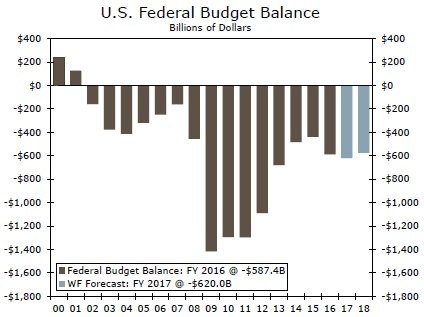
A slowdown in revenue growth and steady outlay growth characterized FY 2016. We have highlighted the significant deceleration in federal tax receipts in previous reports, and this trend was maintained through the end of the fiscal year. As the middle chart illustrates, FY 2016 was the first year since the recession that outlay growth outpaced revenues. Federal revenues totaled $3.3 trillion in FY 2016, just $18 billion (0.6 percent) more than last year. Excluding the one-time $19 billion payment the Federal Reserve made to the Treasury as a result of the FAST Act, which counted toward revenues, receipts were almost perfectly flat relative to last year.
The more volatile sources of federal tax revenue, such as corporate taxes and nonwitheld individual income taxes, accounted for much of the slowdown. Corporate tax collections were particularly weak amid a soft profit environment, declining 12.9 percent in FY 2016. Withheld individual income taxes, which are more reflective of wage & salary changes, were up 2.1 percent in FY 2016–still not especially strong, but a welcome sign given the lackluster trends elsewhere.
On the spending side, the great divide between mandatory and discretionary spending continued. Total net outlays were $3.9 trillion in FY 2016, a 4.5 percent increase from FY 2015. Net interest, the major healthcare programs and Social Security all saw steady growth. These spending categories grew 6.7 percent in FY 2016, while all other spending rose a meager 2.0 percent. Defense spending was largely unchanged in FY 2016 at $595.3 billion, up $4 billion from FY 2015. The strong growth in federal transfer payments, coupled with much more modest growth in federal consumption and investment, continues to constrain the federal government's direct contribution to GDP growth.
New Year's Resolution to Shed Some Debt? Unlikely
As we look to FY 2017, modestly stronger corporate profits, a tighter labor market and faster economic growth should boost federal revenue growth. However, the continued aging of the population, rising medical care costs and higher interest rates will likely offset the moderate acceleration in revenues. These structural drivers of outlay growth will be challenging to deal with from a policymaking perspective. With Congress resorting to stopgap measures to keep the government funded on an annual basis, a fiscal New Year's resolution to cut back and tackle long-term fiscal challenges seems unlikely.
Author
Wells Fargo Research Team
Wells Fargo

















