|

FX alert: Fed hawks, China drags, and a market caught in a late-week gravity well

The late-week gravity well

There are weeks when markets simply misbehave, and then there are weeks like this — where every asset class feels slightly off-kilter, as if someone nudged the global macro machine a few degrees off true north and the bearings haven’t stopped grinding since. What began as a routine post-shutdown recalibration has morphed into a late-week doom loop, the sort of ambient tension traders can feel in their molars before they see it on the screens. And the question cropping up on every desk — from London to Singapore — isn’t philosophical: can equities spill another two or three percent from here? The answer is uncomfortably simple. Yes. Easily.

Momentum didn’t just melt this week; it bled out on the pavement. These long-leg unwind phases have a rhythm—historically around 25 sessions—and we’re sitting at day 21 of this one. Retail remains grotesquely over-their-skis, emboldened by months of one-way AI euphoria, and dealers are swimming in negative gamma. When vol spikes, the machines sell. When they sell, vol spikes. And so the carousel spins until positioning itself burns out or someone turns the lights back on in the rates complex.

But the thing that has every veteran trader rubbing their temples is far simpler: the SPX–MOVE gap has blown wide open, and SPX despises surging bond volatility.
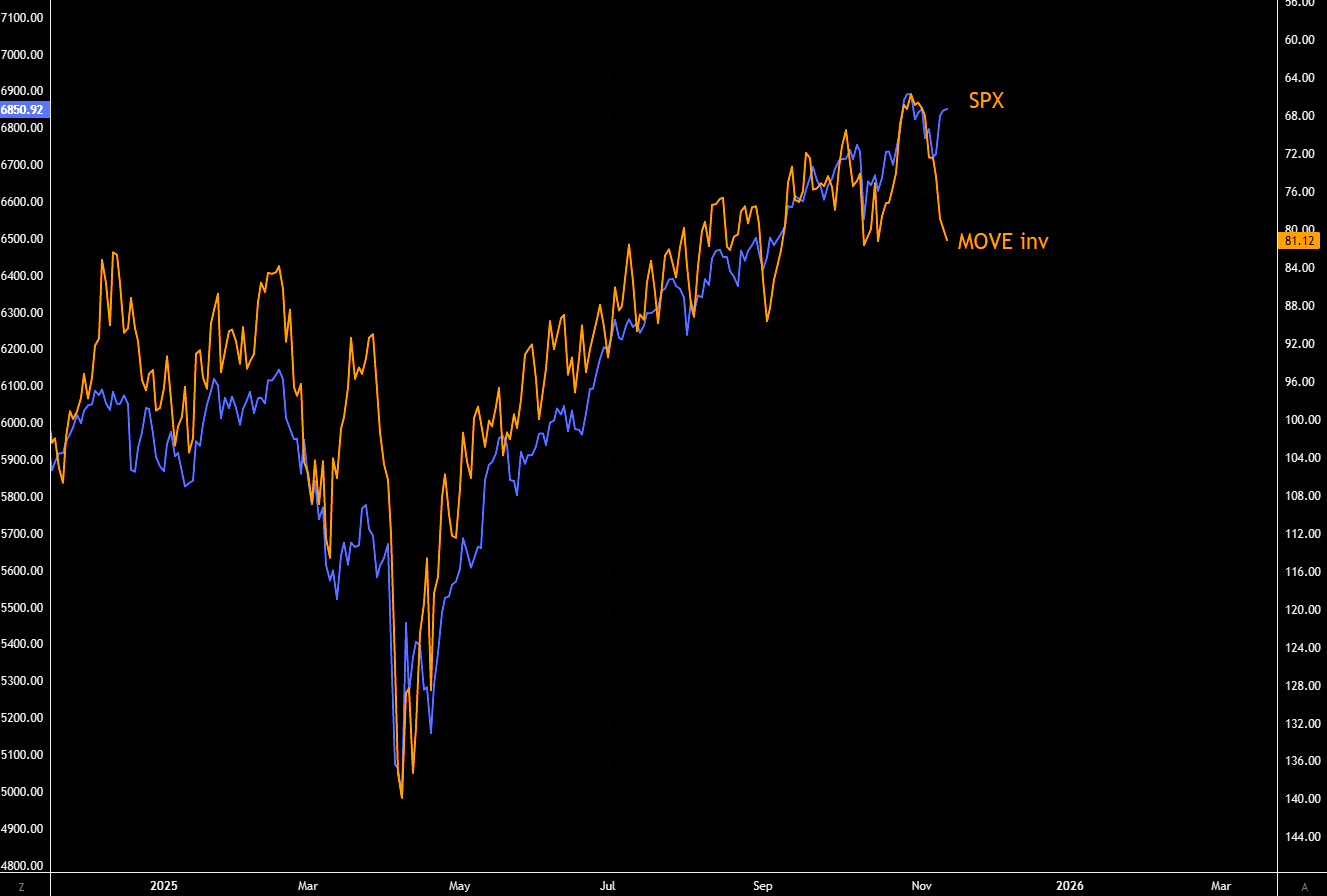
Chart

Chart Via Market Ear

Rates vol is the market’s bad-tempered houseguest — slamming cabinet doors, waking the neighbours, complaining about the plumbing — and equities have been forced into perpetual flinch mode. Until that volatility storm settles, the tape will continue to twitch like an overloaded circuit board.

Author

Stephen Innes

Stephen Innes

SPI Asset Management

With more than 25 years of experience, Stephen has a deep-seated knowledge of G10 and Asian currency markets as well as precious metal and oil markets.


More from Stephen Innes
Share:

Markets move fast. We move first.

Orange Juice Newsletter brings you expert driven insights - not headlines. Every day on your inbox.

By subscribing you agree to our Terms and conditions.

Editor's Picks

EUR/USD rebounds after falling toward 1.1700

EUR/USD gains traction and trades above 1.1730 in the American session, looking to end the week virtually unchanged. The bullish opening in Wall Street makes it difficult for the US Dollar to preserve its recovery momentum and helps the pair rebound heading into the weekend.

GBP/USD steadies below 1.3400 as traders assess BoE policy outlook

Following Thursday's volatile session, GBP/USD moves sideways below 1.3400 on Friday. Investors reassess the Bank of England's policy oıtlook after the MPC decided to cut the interest rate by 25 bps by a slim margin. Meanwhile, the improving risk mood helps the pair hold its ground.

Gold stays below $4,350, looks to post small weekly gains

Gold struggles to gather recovery momentum and stays below $4,350 in the second half of the day on Friday, as the benchmark 10-year US Treasury bond yield edges higher. Nevertheless, the precious metal remains on track to end the week with modest gains as markets gear up for the holiday season.

Crypto Today: Bitcoin, Ethereum, XRP rebound amid bearish market conditions

Bitcoin (BTC) is edging higher, trading above $88,000 at the time of writing on Monday. Altcoins, including Ethereum (ETH) and Ripple (XRP), are following in BTC’s footsteps, experiencing relief rebounds following a volatile week.

How much can one month of soft inflation change the Fed’s mind?

One month of softer inflation data is rarely enough to shift Federal Reserve policy on its own, but in a market highly sensitive to every data point, even a single reading can reshape expectations. November’s inflation report offered a welcome sign of cooling price pressures. 

XRP rebounds amid ETF inflows and declining retail demand demand

XRP rebounds as bulls target a short-term breakout above $2.00 on Friday. XRP ETFs record the highest inflow since December 8, signaling growing institutional appetite.