|

FTSE Tanks Despite Sunak's Blowout Bailout

The bloodbath is resuming on Wednesday. After recording gains of 2.7% in the previous session, the FTSE is plunging lower in early trade as the Chancellor’s blowout bailout has failed to maintain any level of positivity in the markets.

Chancellor Rushi Sunak announced a £330 billion rescue package to help struggling businesses cope with the economic impact of coronavirus. The bailout package aims to keep Britain afloat and offers a lifeline to those businesses that the governments stricter social distancing, isolation and quarantine measures will negatively impact.

Consumption will drop severely as people stay in their homes. Restaurants, shops and pubs will be hard hit so the Government announced a one-year break from business rates, as well as government grants of up to $25,000 will help to alleviate the pain. Banks have also agreed to give struggling customers a mortgage holiday of up to three months. An additional support package for the badly hit airlines will be announced in the coming days.

Yet despite Chancellor Rishi Sunak’s colossal bailout package the markets’ response is very concerning. The fact that the FTSE has failed to hold onto any of the gains quite simply suggests that this is not enough. There needs to be a coordinate global response, which up to now hasn’t happened.  As a result, the markets are vulnerable to further fallout.

What next?

Eyes are now turning to the European Stability Mechanism and what more the White House can bring to the table.

With fear driving the markets and coronavirus numbers escalating, there is a good chance that this overly bearish picture won’t show any signs of improvement until the coronavirus numbers themselves start to improve.

Levels to watch

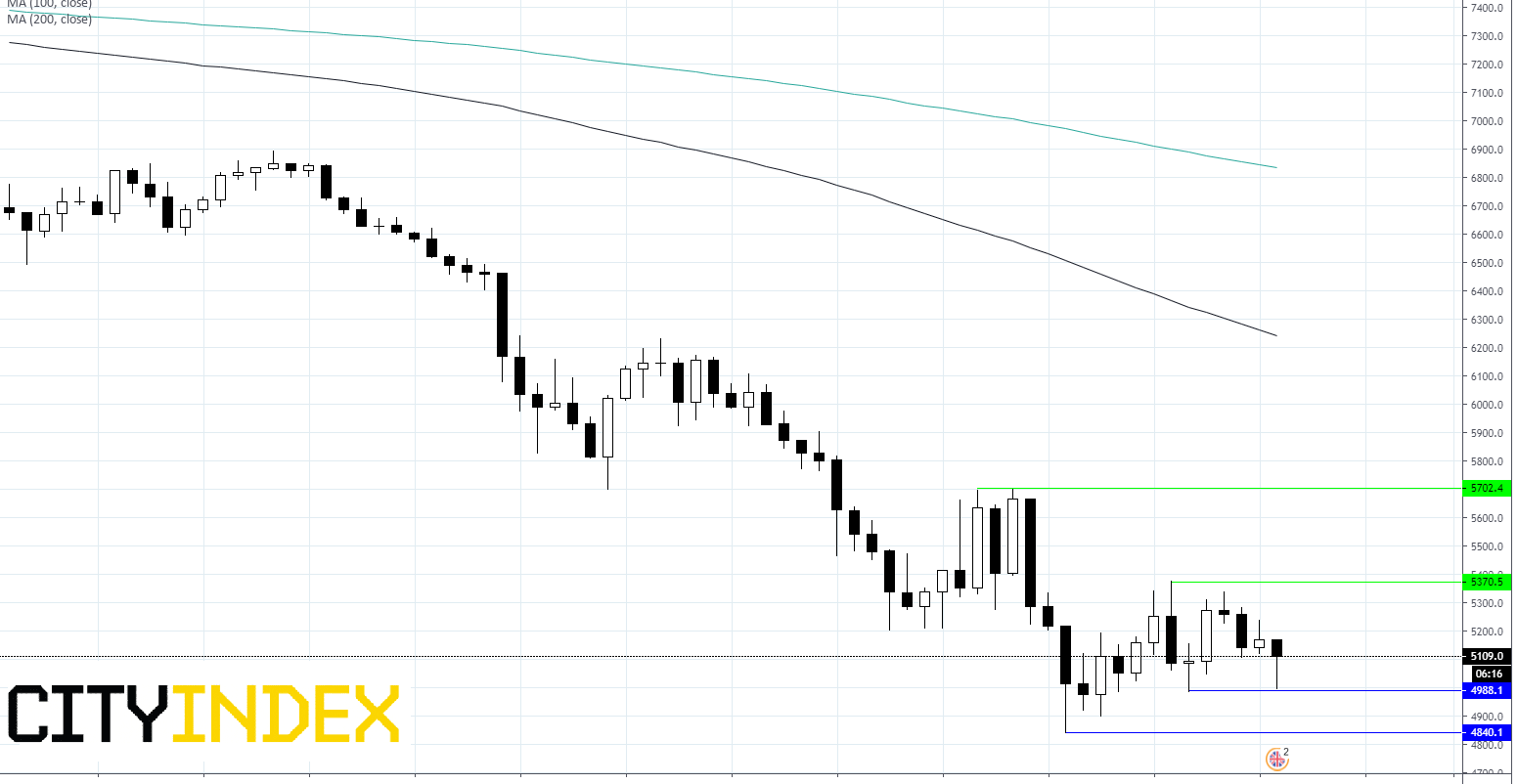
The FTSE is trading down 3.9% at 5088 the time of writing. It trades below 50,100 and 200 sma on 4-hour chart, a bearish chart.

The price found support for a second straight session just shy of 5000. Immediate support is at 4996 (today’s low), prior to 4987 (yesterday’s low) before 4840 (16th March low).

Resistance can be seen at 5370 (yesterday’s high) A break above this level is needed to negate short term bearish trend. Resistance is then seen at 5700 (13th March high).
Chart

Author

More from Fiona Cincotta
Share:

Editor's Picks

AUD/USD leans on a China prop that's quietly buckling

The Australian Dollar spent Monday trying to talk itself into a recovery, and the tape was not buying it. AUD/USD has ridden a China-and-commodities narrative for months, one that conveniently glossed over how shaky both legs of that trade have become, and Friday's Nonfarm Payrolls print finally forced a reckoning. US employers added 172K jobs against a consensus near 85K, with roughly 93K of upward revisions to prior months and the unemployment rate steady at 4.3%.

USD/JPY: Japanese Yen ignores every reason it has to strengthen

There is a strange disconnect running through the Japanese Yen right now, and USD/JPY parked just above 160.00 captures it perfectly. By any domestic reading the Yen should be firming: first-quarter Gross Domestic Product beat expectations over the weekend at 0.5% on the quarter, the Bank of Japan is widely expected to raise rates at its meeting on June 18, and authorities have spent the past week jawboning a currency they clearly want stronger.

Gold faces initial resistance near  $4,350

Gold manages to reclaim the $4,300 mark per troy ounce and above on Monday. The yellow metal’s small uptick comes on the back of modest losses in the US Dollar, while traders continue to follow geopolitical events in the Middle East and the likelihood of a tighter-for-longer Fed.

Strategy resumes BTC accumulation with 1,550 Bitcoin purchase, adjusts STRC dividend schedule

Bitcoin treasury firm Strategy bought 1,550 BTC last week for roughly $101.3 million, according to a Form 8-K filing on Monday. The purchase, made at an average price of $65,332 per Bitcoin, was funded through proceeds from the company's at-the-market equity offering program.

$1.75 trillion: Is SpaceX the most popular IPO in history, or the most engineered?

On June 12, the largest initial public offering (IPO) in history is set to hit the tape, and almost nobody is asking whether the price is right, because almost everybody already wants in.

The US economy defies the rules: 100 days into the Oil shock and the recession signal is still missing

More than three months after the start of the Iran war and the resulting disruption to global energy markets, the US economy continues to display remarkable resilience. The conflict has triggered a sharp rise in Oil prices, reignited inflationary pressures and fueled widespread concerns about a potential economic slowdown.