Fresh tariff threats and mixed messages


Another day, another round of tariff threats
US President Donald Trump once again put pen to paper yesterday, sending a letter to Canada outlining a 35% tariff rate on Canadian imports, set to take effect on 1 August. You will recall that the President recently extended the trade deadline for all countries to 1 August from 9 July.
Canada is America’s second-largest trading partner after Mexico, accounting for 13% of total trade with the US, according to the US Census Bureau. As expected, recent threats weighed on the Canadian dollar (CAD); the Loonie immediately fell by 0.5% against the US dollar (USD) before recovering about half of the decline into the closing bell. In the long term, the USD/CAD currency pair continues to trend upward, although a downward bias has developed in the medium term so far this year.
In an interview with NBC, Trump also announced plans to impose a blanket tariff between 15% and 20% on other trading partners, presumably those who have not received one of his letters, which includes the European Union (EU). This could be a potentially market-influencing story for the euro (EUR), with markets initially betting on a more favourable trade agreement.
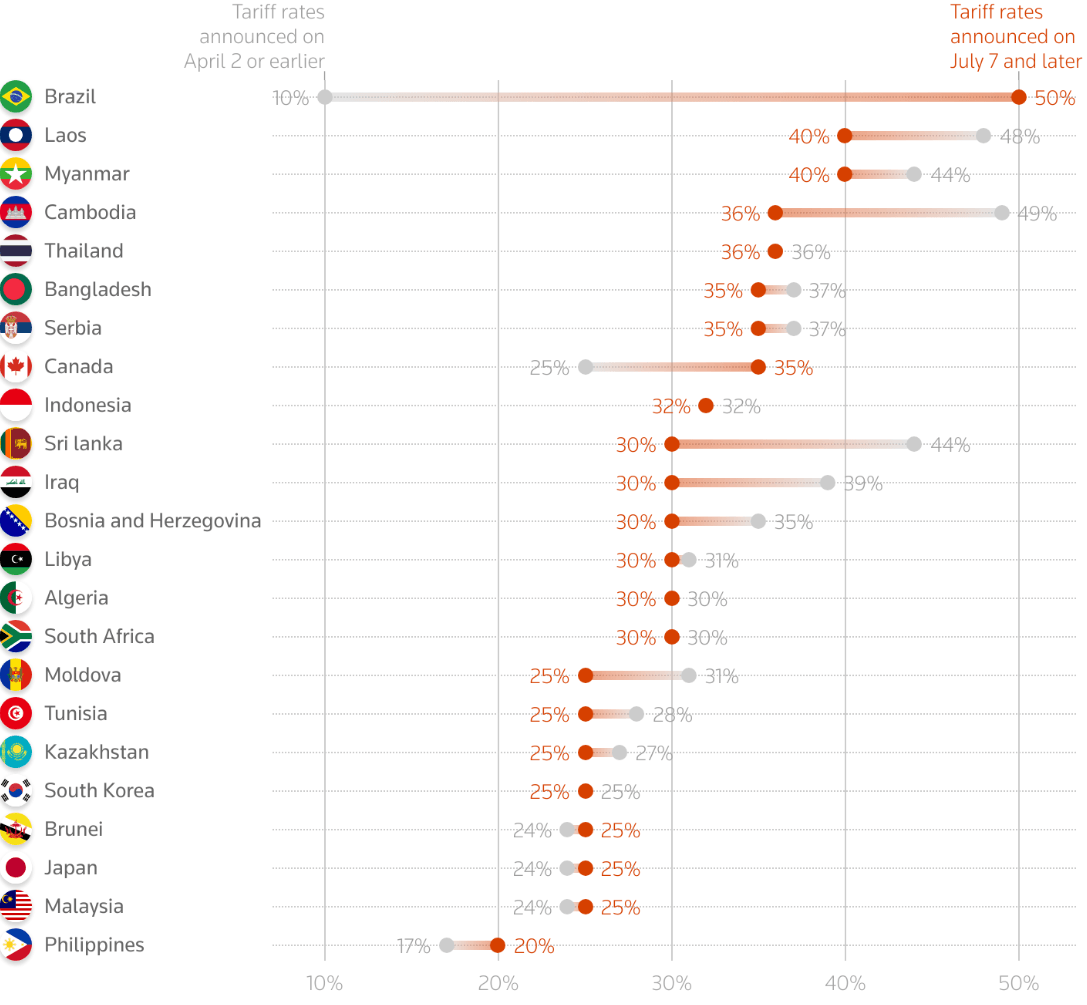
Regarding Brazil, you will note that Trump recently threatened an eye-popping 50% tariff on Brazilian imports due to the legal issues surrounding former President Jair Bolsonaro. Brazilian President Luiz Inácio Lula da Silva stated that his country could survive without US trade and noted that trade with the US accounts for only 1.7% of Brazil’s GDP (Gross Domestic Product).
As you can see, the trade situation remains fluid. However, for those who have become lost in the minutiae of trade tariff threats, the table below provides a clear and concise snapshot of recent events – credit to Reuters here!
Macro space: US jobless claims, UK GDP, Canadian jobs data
In the macro space, US weekly jobless claims eased to 227,000 for the week ending 5 July, down from the previously revised reading of 232,000 in the week prior, and lower than the market’s median estimate of 236,000. However, continuing jobless claims – a person who already filed for unemployment insurance and is applying for a continued claim for that week of unemployment – increased by 10,000 to 1.965 million for the week ending 28 June, which, as depicted in the line chart below, marks the highest level since late 2021.
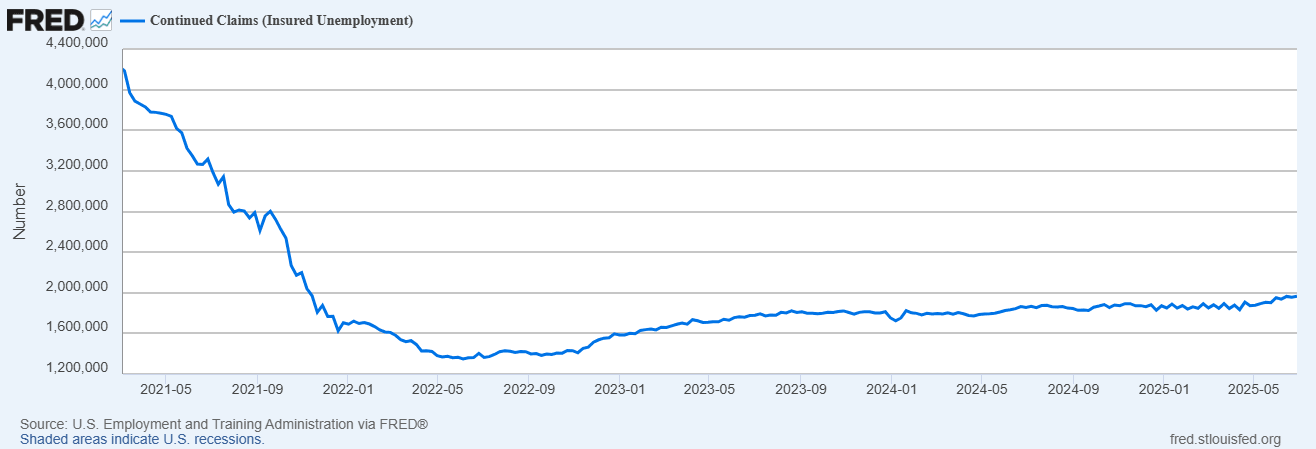
Despite the number of initial claims softening, indicating that companies are retaining employees, the sustained rise in continued claims demonstrates a slowing pace of rehiring; this suggests that those out of work are taking longer to find employment. This, of course, follows unemployment unexpectedly dipping to 4.1% in June, and non-farm payrolls jumping to 147,000, albeit gains in government roles largely underpinned this move.
Earlier this morning, we also received the May UK GDP numbers, which showed that economic activity contracted by 0.1%, defying the market’s median estimate of a 0.1% gain and marking a second consecutive month of contraction. Evidently, this is not great news for UK Chancellor Rachel Reeves, following a rather dire report from the Office for Budget Responsibility (OBR) published earlier this week.
Later today, Canadian jobs data for June will hit the wires. Markets expect the unemployment rate to tick higher to 7.1% from 7.0% in May, with employment expected to show no change, down from the previous reading of 8,800.
Market snapshot in early Europe
The European session opened largely in the red, with the DAX 40 down 0.3% and the STOXX Europe 600 down 0.2%, indicating a risk-off day. US equity index futures are also on the back foot.
Yesterday, the S&P 500 pencilled in another record high of 6,290 (0.3%), while the Dow also saw gains, rising 0.4%. Tech giant Nvidia (NVDA) continued its impressive run, gaining 0.8% and refreshing all-time highs of US$164.50.
In the bond market, US Treasury yields bear flattened, with the 30-year yield largely unchanged, and the 10-year yield capping the session off slightly higher at 4.35%. This follows a solid auction for 30-year bonds and was followed by a robust auction for 10-year notes earlier in the week.
The USD ended yesterday’s session higher by 0.1%. This is a market I have been watching for a while now. While we are at long-term channel support (monthly timeframe), and the buck is considerably overstretched to the downside, I believe there are a number of headwinds that could hinder further buying. First, assuming Trump’s proposed tariffs come into effect, this will likely have a significant impact on global growth and, consequently, could influence demand for the USD. Second, if deals are struck within Trump’s timeline, which he assures us is final, this would likely lower the inflationary impact that elevated tariffs are expected to have, allowing the US Federal Reserve (Fed) Chair Jerome Powell to lower the funds target rate, which would please Trump. Adding to this vibe is the idea of a shadow Fed Chair entering the fold, who is expected to be more dovish than Powell, thus potentially influencing USD action.
Author
Aaron Hill
FP Markets
After completing his Bachelor’s degree in English and Creative Writing in the UK, and subsequently spending a handful of years teaching English as a foreign language teacher around Asia, Aaron was introduced to financial trading,