French political storm: What it means for bonds and the Euro


French bond yields have risen significantly against German bunds and are likely to stay elevated or potentially move higher. The European Central Bank still appears to be a reliable backstop against excessive bond turmoil. Even if OAT-Bund spreads keep widening in the medium term on the back of fiscal woes, the rate of change matters much more for the euro.
Rates impact: French government bond spreads are likely to stay elevated if not widen out more
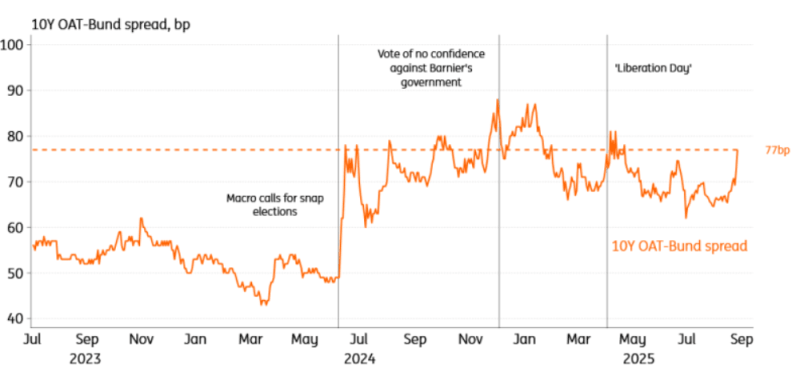
The spread between French government bonds (OATs) and the German equivalent (Bunds) widened materially on the prospect of a confidence vote, and we still see the balance of risk tilted to further widening. The current 10Y spread is at a similar level to that seen in July 2024, when French President Emmanuel Macron called snap elections and OATs sold off significantly in response. However, spreads remain tighter than they were during the political turmoil following the collapse of Prime Minister Michel Barnier’s government last December. A key difference now is that parliamentary elections are allowed again, which in our view adds to the uncertainty from both a political and fiscal perspective.
Furthermore, going forward, the market environment may not remain as accommodative to spreads as it has been over the year. European government bonds have benefited significantly from the ECB’s easing of monetary policy. Markets have increasingly priced out the likelihood of another ECB rate cut, signalling a potential end to the current easing cycle. In addition, quantitative tightening continues to put upward pressure on bond yields globally, with heightened scrutiny on countries facing fiscal challenges.
Current spreads are still below earlier peaks of political turmoil
Source: ING, Macrobond
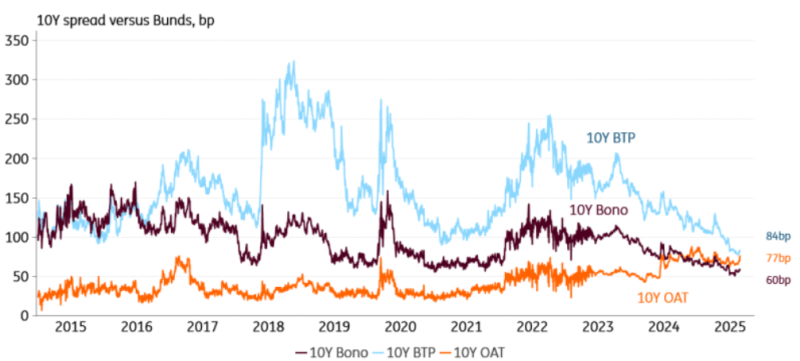
Zooming out, the increase in French spreads is relatively contained, but this also underscores the upside risks should political tensions escalate. Looking at the past decade, the 10Y BTP-Bund spread hit levels of more than 300bp and spreads on Spanish bonds were also well above where France sits today. An improving fiscal outlook for Italy and Spain drastically tightened their spreads. For France, however, we find it difficult to see a clear path towards fiscal reform at the moment.
We do have to keep in mind that the ECB has a lot of firepower to limit excessive widening of EGB spreads, and markets are well aware of this. In theory, the ECB could resort to the Transmission Protection Instrument (TPI) if too-high interest rates on OATs negatively impact the steering of monetary policy. The conditions require a country to comply with EU fiscal rules. At the same time, however, the ECB has the ability to deviate from this requirement, an option it would likely exercise if spillover effects threaten financial stability. As such, the mere existence of this tool may be enough to prevent spreads from spiralling upwards.
French spreads look contained when zooming out, but upside risks are also clear
Source: ING, Macrobond
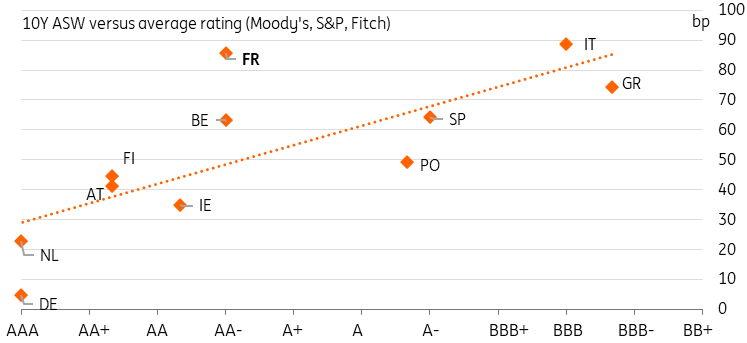
Of course, one of the risks ahead that France will face over the coming months is the possibility of further rating downgrades should fiscal consolidation plans be watered down. Assessing 10yr eurozone government bond spreads over swaps through the lens of relative credit ratings suggests that the discount applied to France largely reflects these adverse dynamics already.
It is a very simplified way of looking at things, though. Spreads do not move entirely independently of each other, and they also reflect more than just credit, including factors like liquidity premia, supply pressures and overall market sentiment. That is to say, wide spreads for France do not preclude further widening should the political situation escalate and sap investor appetite amid rising volatility.
Bond spreads reflect reordering of Eurozone sovereign credit spectrum
Source: Rating agencies, Refinitiv, ING
FX impact: Spreads don’t matter until they explode
The impact on FX markets from French political turmoil has so far been contained, which is not surprising. The correlation between the euro and sovereign eurozone spreads is generally minimal, except for brief spikes during periods of intense bond market stress. For Italian bonds, the “pain point” triggering a substantial euro reaction has typically been around a 200bp BTP-Bund spread, with faster breaches leading to larger EUR-to-spread correlation spikes.
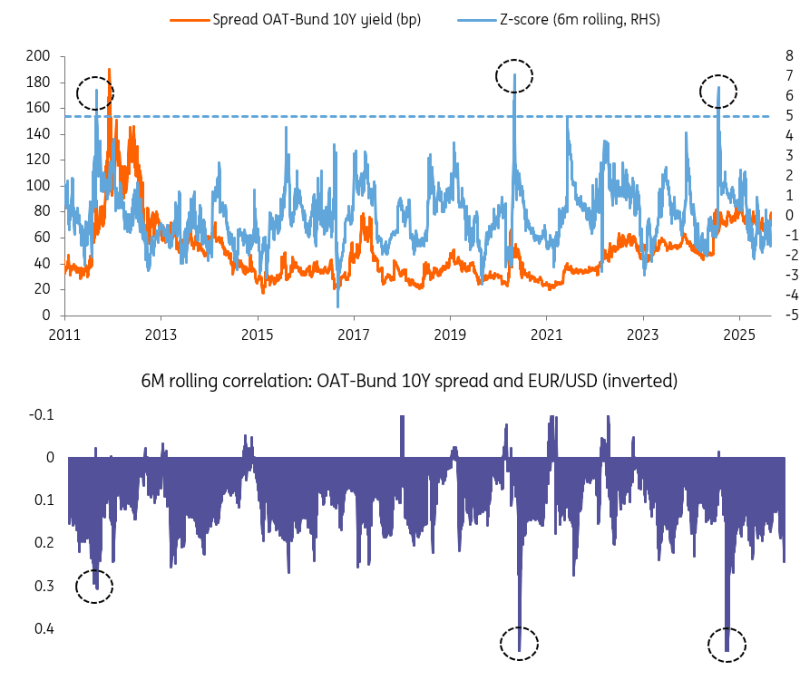
For French bonds, it’s harder to identify such a threshold, mainly because there have been fewer shocks over the past two decades. What we note, as shown in the chart below, is that the correlation between EUR/USD and the OAT-Bund spread becomes materially significant only during abrupt and extreme spread widening - specifically when the spread’s rolling 6-month z-score exceeds +5. This has occurred three times since 2011. In 2011 and 2020, these spikes coincided with broader events (the EU debt crisis and Covid), while in July 2024, the correlation with the EUR/USD spike was due to idiosyncratic French events around the parliamentary elections.
Big spread widening needed to upset the Euro
Source: ING, Refinitiv
Not enough to change our Euro call
We don’t currently see political and fiscal developments in France as a major risk for the euro. While it’s possible that a significant euro reaction could occur even without a 5+ z-score deviation - given the higher starting point of the OAT-Bund spread - past experience (including with BTPs) suggests the speed of change matters more than the level. As noted earlier, it’s difficult to identify a realistic fiscal consolidation path for France, and the risk of continued OAT spread widening remains tangible.
Still, for the euro, this shouldn’t matter much beyond short-lived episodes. The ECB’s TPI backstop is another reason not to materially alter EUR views based on French bond pressures. EUR/USD remains primarily a dollar story, and we expect that to continue, given the Fed’s much wider room to cut rates compared to the ECB and the impact of Trump’s protectionist policies. Developments around potential Ukraine-Russia peace talks pose a much bigger risk to the euro. Our EUR/USD forecast remains unchanged at 1.17 for end-3Q and 1.20 by year-end.
EUR/CHF has historically shown a stronger correlation with eurozone sovereign spreads than EUR/USD, but CHF has not outperformed the dollar following the recent French political news. The recent decline in EUR/USD appears driven mainly by dollar strength amid month-end flows rather than other factors.
Read the original analysis: French political storm: What it means for bonds and the Euro
Author
ING Global Economics Team
ING Economic and Financial Analysis
From Trump to trade, FX to Brexit, ING’s global economists have it covered. Go to ING.com/THINK to stay a step ahead.