France’s 10-year yield hits highest since 2002: This chart shows the market losing faith

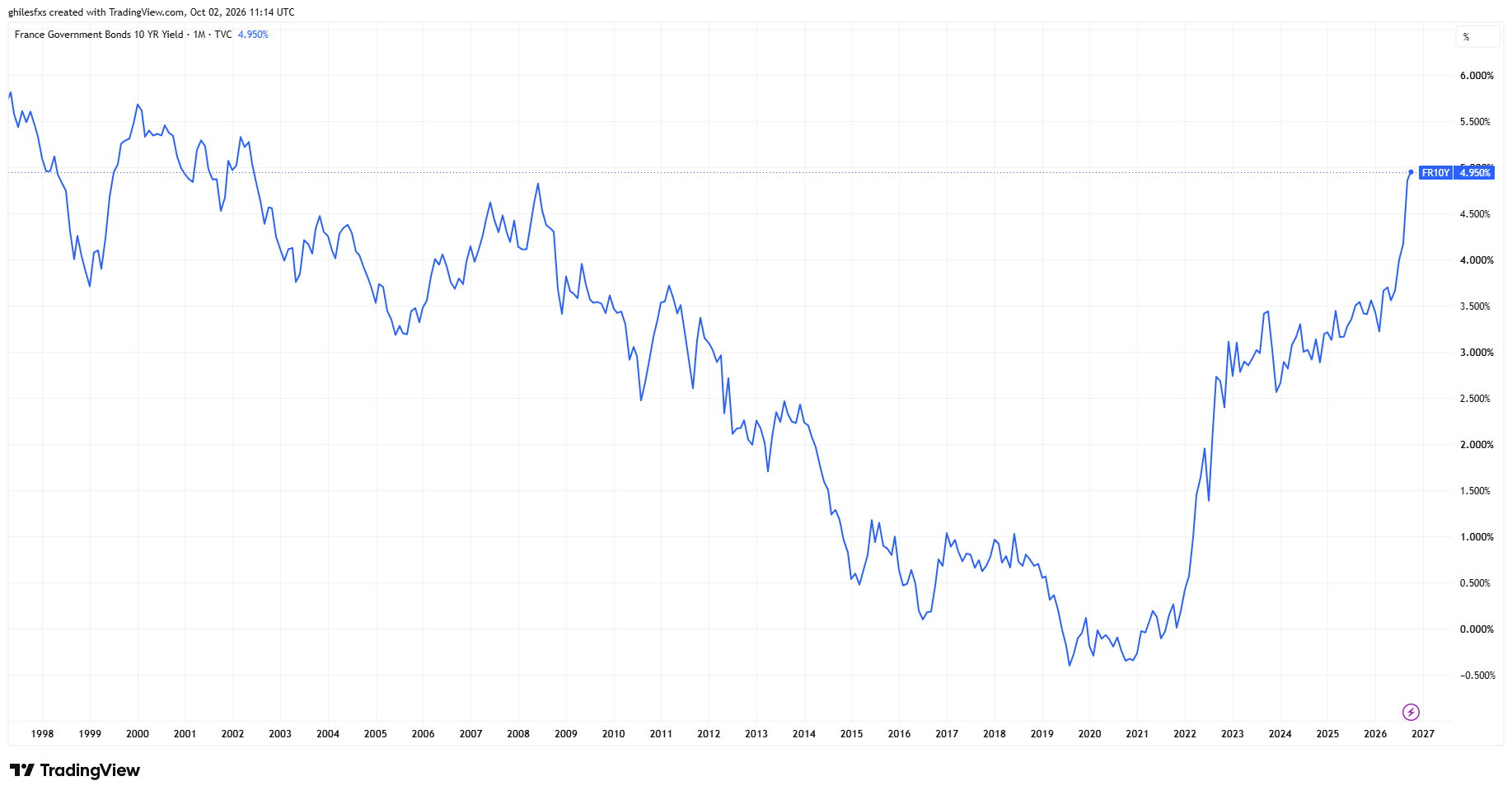
France’s bond market is sending an increasingly uncomfortable message. The country’s 10-year government bond yield climbed as high as 4.96% on Thursday, reaching its highest level since July 2002 and moving within touching distance of the psychologically important 5% threshold.
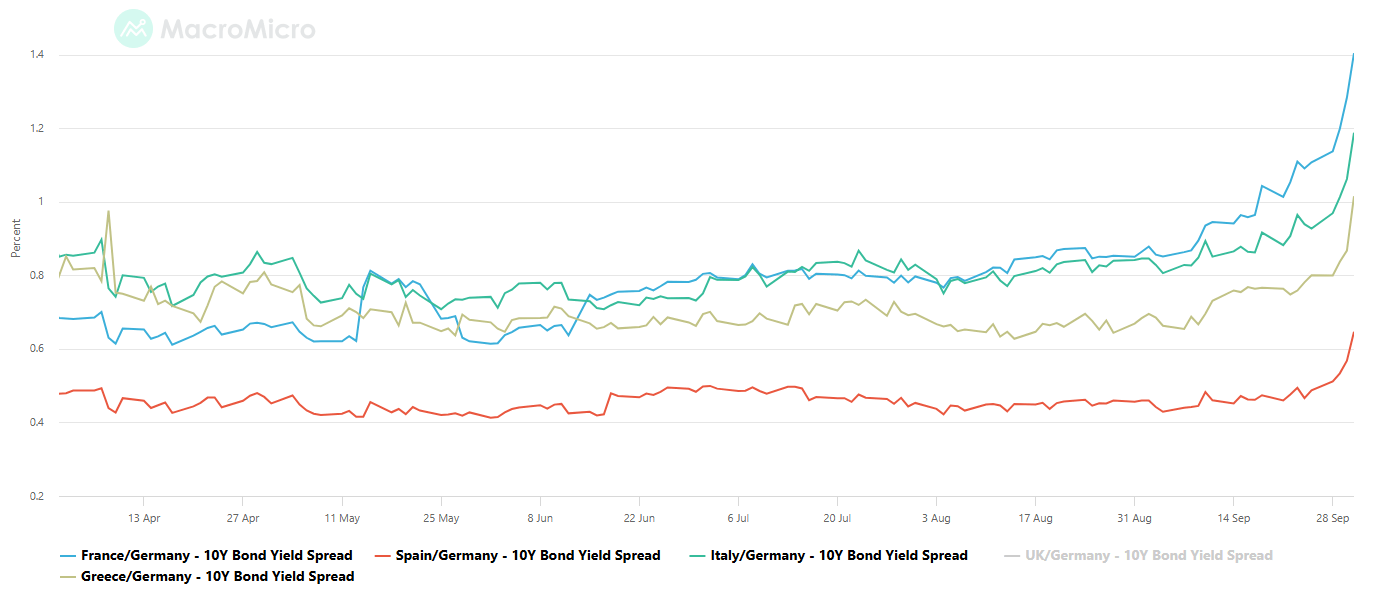
More importantly, the gap between French and German 10-year borrowing costs has widened to around 150 basis points, reaching levels last seen during the Eurozone sovereign debt crisis in 2012.
Part of the move reflects a broader global bond sell-off. Rising energy prices, persistent inflation and expectations that central banks may have to keep interest rates higher for longer have pushed sovereign yields higher across several developed economies.
But France is increasingly standing out. Investors are demanding a substantially higher premium to hold French debt over German government bonds, suggesting that the move is no longer simply about global interest rates. France’s fiscal outlook and political uncertainty are increasingly being priced into the country’s borrowing costs.
That raises a bigger question for currency markets: when does France’s bond problem become a problem for the Euro?
The bond market is sending France a warning
French government bonds have undergone a sharp repricing in recent months. The 10-year French government bond yield has risen by roughly 1.4 percentage points in three months, while the quarter ending in September marked the worst quarterly performance for French sovereign debt since 1987.
Germany has moved in the opposite direction. While German yields have also risen, German government bonds have benefited from safe-haven flows as investors reduce their exposure to riskier parts of the European bond market. The result is a rapidly widening spread between France and Germany.
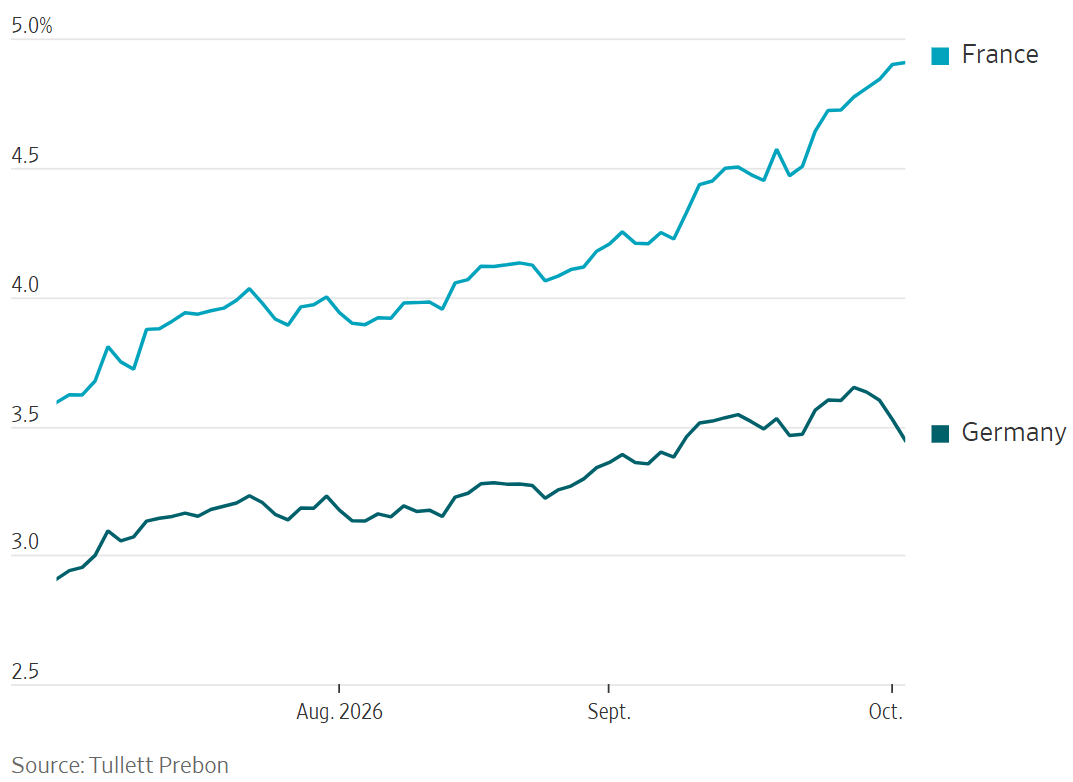
That spread matters because it strips out part of the global move in interest rates. If French and German yields were rising at roughly the same pace, the move could largely be attributed to global inflation, energy prices and monetary policy expectations.
Instead, French yields are rising significantly faster. Mike Riddell, Strategic Bond Fund Manager at Fidelity International, described the shift in unusually stark terms: “France has been slowly but steadily breaking. But today feels like the first day that broader financial markets have noticed,” Riddell said.
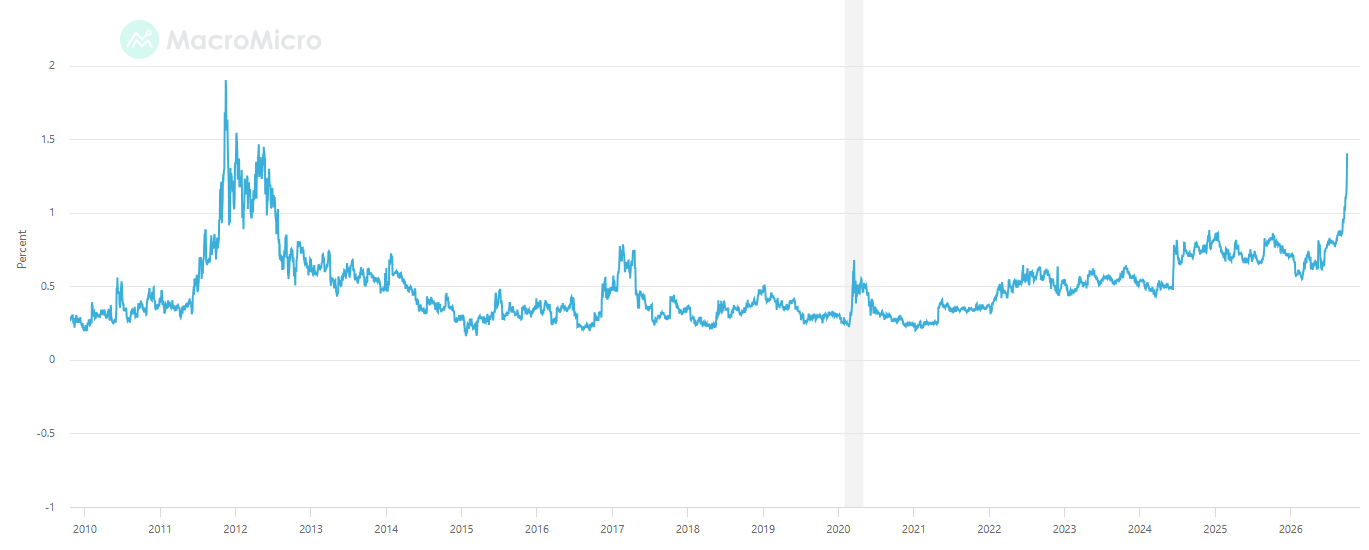
A long-term chart of the France-Germany 10-year spread helps illustrate why the latest move matters. The gap is approaching levels not seen since the European sovereign debt crisis, even though the current macroeconomic and institutional environment remains different from 2011-2012.
The 2027 budget does not answer the market’s main question
The French government’s proposed 2027 budget is intended to demonstrate fiscal discipline, but investors appear unconvinced that it provides a sufficiently credible path toward stabilizing public finances.
The plan targets a reduction in the fiscal deficit to 5% of Gross Domestic Product (GDP) in 2027 from around 5.4% this year. French public debt already stands near 119% of GDP, while the government is expected to borrow a record €340 billion next year.
The problem for bond investors is less the exact size of next year’s adjustment than the credibility of the longer-term trajectory. France’s fiscal watchdog has described the government’s 1% growth assumption as optimistic and considers a return below the European Union’s 3% deficit threshold by 2029 highly unlikely under the current trajectory.
BBH is also skeptical that the proposed budget can pass through parliament without substantial concessions. The bank sees a rollover of the 2026 budget as the most likely scenario if political compromise remains limited ahead of the 2027 presidential election. Under that scenario, BBH estimates that France’s deficit could rise toward 6% of GDP in 2027 rather than decline.
European Central Bank (ECB) President Christine Lagarde has also described France’s debt situation as “serious at 120% of GDP and without a path to lowering it.” Lagarde added: “France needs a credible budget trajectory and reforms to restore confidence.”
Why the France-Germany spread matters more than the 5% threshold
A French 10-year yield above 5% would undoubtedly attract attention. But for markets, the more important signal may be the spread with Germany. The absolute level of French yields reflects both global and domestic factors. The spread against German government bonds provides a clearer indication of the additional premium investors demand specifically for holding French debt. And that premium is rising rapidly.
France successfully issued €12 billion of long-term debt this week, with demand exceeding twice the amount offered. That suggests the country is not facing an immediate problem accessing bond markets. The cost of that access, however, is increasing sharply.
France’s 10-year debt was issued at a yield of 4.93%, compared with an average of 4.32% in September and 3.86% at an auction in early August.
Mabrouk Chetouane, Head of Global Market Strategy at Natixis Investment Managers, summarized the situation succinctly: “It gets through, but it’s expensive.”
That distinction is important. The current situation does not necessarily indicate a sovereign funding crisis. Investors are still willing to buy French debt. Instead, the market is significantly repricing the interest rate required to compensate for France’s fiscal and political risks.
The real risk for the Euro is contagion
For the Euro (EUR), France alone may not be enough to trigger a major currency sell-off. Research from Commerzbank suggests that the single currency tends to react much more aggressively when sovereign stress spreads across several Eurozone countries or into the banking sector.
Michael Pfister and Tatha Ghose at Commerzbank find that when only one country comes under pressure, the impact on the Euro is generally limited. But when several Eurozone countries face simultaneous stress alongside pressure on banks, the median adjusted depreciation in EUR/USD reaches around 0.73% over five trading days.
That distinction could become increasingly important. French government bonds have been at the center of the latest sell-off, but Italian bond spreads have also widened sharply. European banking stocks have simultaneously come under pressure, with the STOXX Europe 600 Banks Index suffering its biggest daily decline since March on Thursday. The three main French bank stocks have all recorded substantial losses as investors reassess the implications of higher sovereign borrowing costs.
For now, the evidence of broader contagion remains limited compared with previous Eurozone debt crises. But the combination of widening sovereign spreads and pressure on banking shares is precisely the type of development currency traders are likely to monitor.
The Euro may not yet reflect the full French risk premium
ING argues that the Euro’s relatively contained reaction could mean that currency markets have not yet priced the full extent of the deterioration in French government bonds. The bank estimates that the Euro currently incorporates a relatively modest risk premium of around 1%. Historically, episodes of much sharper widening in Eurozone sovereign spreads have generated significantly larger deviations in EUR/USD from its short-term fair value.
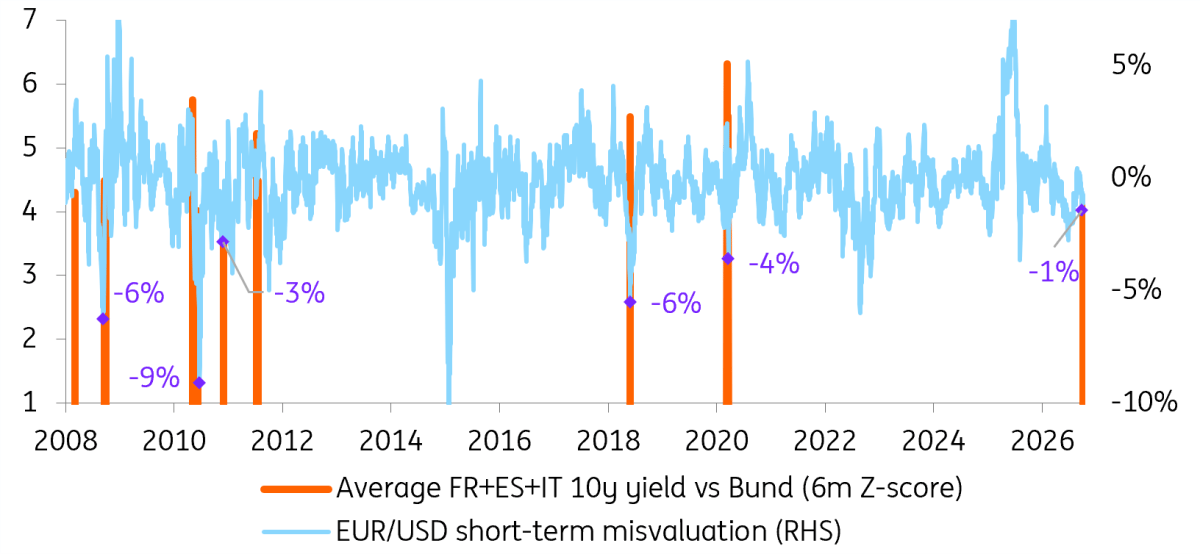
ING estimates that a build-up toward a 3% Euro risk premium would be consistent with previous episodes of severe sovereign spread widening. Under such a scenario, EUR/USD could move toward 1.110. The bank has described the widening of the French-German spread as “quite an alarming move,” arguing that a further deterioration could add a larger risk premium to the Euro.
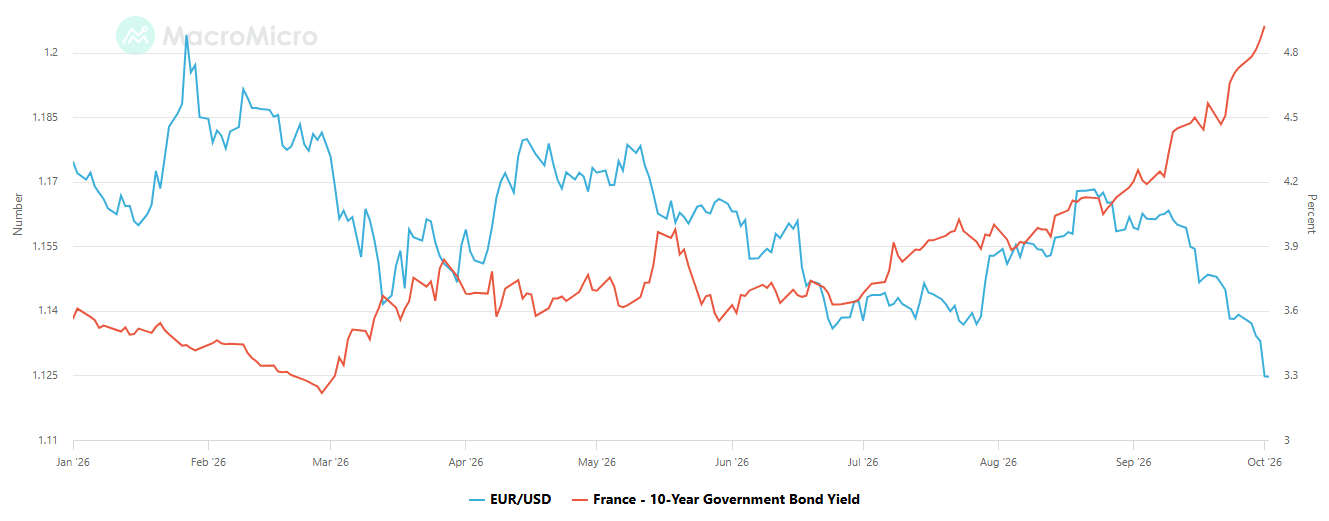
The threshold to watch may no longer be 5%
The French 10-year yield crossing 5% would provide a striking headline, particularly because borrowing costs are already at their highest since 2002. But the France-Germany spread may ultimately be the more important number.
A stabilization in that spread would suggest that investors are becoming more comfortable with France’s fiscal trajectory and that the global bond sell-off remains the dominant force behind higher yields.
A continued widening toward or beyond 150 basis points, particularly if accompanied by rising Italian spreads, further weakness in European banks and pressure on the Euro, would point to a broader repricing of Eurozone sovereign risk.
That does not automatically imply a repeat of the 2011-2012 debt crisis. European financial institutions and the ECB’s policy framework have changed substantially since then, and France continues to access debt markets despite the higher cost of borrowing.
But the market does not need a full-blown sovereign crisis for the Euro to suffer. It only needs investors to demand a larger premium for holding European assets. And with French borrowing costs near 5%, the France-Germany spread around levels last seen during the sovereign debt crisis and fiscal uncertainty likely to persist, that risk premium is becoming increasingly difficult for currency markets to ignore.
Interest rates FAQs
Interest rates are charged by financial institutions on loans to borrowers and are paid as interest to savers and depositors. They are influenced by base lending rates, which are set by central banks in response to changes in the economy. Central banks normally have a mandate to ensure price stability, which in most cases means targeting a core inflation rate of around 2%. If inflation falls below target the central bank may cut base lending rates, with a view to stimulating lending and boosting the economy. If inflation rises substantially above 2% it normally results in the central bank raising base lending rates in an attempt to lower inflation.
Higher interest rates generally help strengthen a country’s currency as they make it a more attractive place for global investors to park their money.
Higher interest rates overall weigh on the price of Gold because they increase the opportunity cost of holding Gold instead of investing in an interest-bearing asset or placing cash in the bank. If interest rates are high that usually pushes up the price of the US Dollar (USD), and since Gold is priced in Dollars, this has the effect of lowering the price of Gold.
The Fed funds rate is the overnight rate at which US banks lend to each other. It is the oft-quoted headline rate set by the Federal Reserve at its FOMC meetings. It is set as a range, for example 4.75%-5.00%, though the upper limit (in that case 5.00%) is the quoted figure. Market expectations for future Fed funds rate are tracked by the CME FedWatch tool, which shapes how many financial markets behave in anticipation of future Federal Reserve monetary policy decisions.
Author

Ghiles Guezout
FXStreet
Ghiles Guezout is a Market Analyst with a strong background in stock market investments, trading, and cryptocurrencies. He combines fundamental and technical analysis skills to identify market opportunities.

















