Gold Weekly Forecast: Precious metal extends slide but safe-haven flows limit losses
- Gold suffered large losses at the beginning of the week as US yields surged higher.
- Investors will keep a close eye on global bond markets.
- The near-term technical outlook suggests that the bearish bias remains intact.

Gold (XAU/USD) started the week under immense bearish pressure but managed to stabilize. Investors will remain focused on the action in global bond markets in the near term. Meanwhile, the precious metal’s technical outlook suggests that sellers are likely to retain control.
Gold attracts safe-haven flows following bearish action
Gold registered large losses on Monday and came in within a touching distance of $4,100 as the US Treasury bond yields continued to push higher, with market participants pricing in an increasing chance of a Federal Reserve (Fed) interest rate hike in October on hawkish comments from policymakers and upbeat macroeconomic data releases to wrap up the previous week.
On Tuesday, US data showed that JOLTS Job Openings declined to 7.079 million in August from 7.335 million in July. Additionally, the Conference Board’s Consumer Confidence Index declined to 81.9 in September from August’s 88.6 (revised from 89.4). As these weak prints limited the US Dollar’s (USD) gains, XAU/USD rose more than 1% on the day and retraced a portion of Monday’s losses.
The US Bureau of Economic Analysis (BEA) reported on Wednesday that annual inflation, as measured by the change in the Personal Consumption Expenditures (PCE) Price Index, held steady at 3.4% in August. In this period, the core PCE Price Index, which excludes volatile food and energy prices, rose 3%, matching July’s increase. These readings came in well below analysts’ estimates, and the BEA revised July prints lower by 0.3%. While the initial reaction to soft inflation readings caused the USD to weaken, the positive revision to the annualized Gross Domestic Product (GDP) growth for the second quarter, from 1.5% to 2.2%, and the 90K increase recorded in private sector employment, compared to the market expectation of 70K, helped the currency limit its losses and capped XAU/USD’s rebound.
The USD continued to gather strength against major currencies on Thursday as the 10-year US T-bond yield hit its highest level since April 2002, above 5.3%. However, Gold attracted safe-haven demand amid a global bond selloff and kept its footing to end the day marginally higher above $4,150. XAU/EUR, XAU/GBP and XAU/JPY pairs rose about 1% on Thursday, reflecting a capital outflow from those currencies into the previous metal.
Analysts at Deutsche Bank reported that markets stumbled “as we began Q4, with mounting signs of financial stress focused on Europe.” They highlight that the pressure “cascaded across different asset classes,” with the Euro on Thursday “(-0.76%) posting its worst day against the Dollar since June,” while the STOXX Banks index “(-3.90%) had its worst day since March,” underscoring how quickly concerns around European financial conditions have intensified.
Meanwhile, some cautious comments from Fed policymakers on further policy tightening helped Gold hold its ground in the second half of the week.
Fed Vice Chair for Supervision Michelle Bowman said that she sees no urgent need for more rate moves this year, while Minneapolis Fed President Neel Kashkari argued that if they keep raising rates, they will put different pressure on different parts of the economy.
The US Bureau of Labor Statistics (BLS) reported on Friday that Nonfarm Payrolls (NFP) rose by 29K in September. This print followed the 133K increase recorded in August (revised from 162K) and came in well below the market expectation of 90K. Other details of the report showed that the Unemployment Rate edged higher to 4.2%, while the Labor Force Participation Rate increased to 61.8% from 61.6%. Finally, annual wage inflation, as measured by the change in the Average Hourly Earnings, softened to 3% from 3.1% and came in below analysts' estimate of 3.2%. The odds of an October Fed rate hike diminished further following the employment report and helped Gold keep its footing heading into the weekend.
Gold could continue to react to bond market action
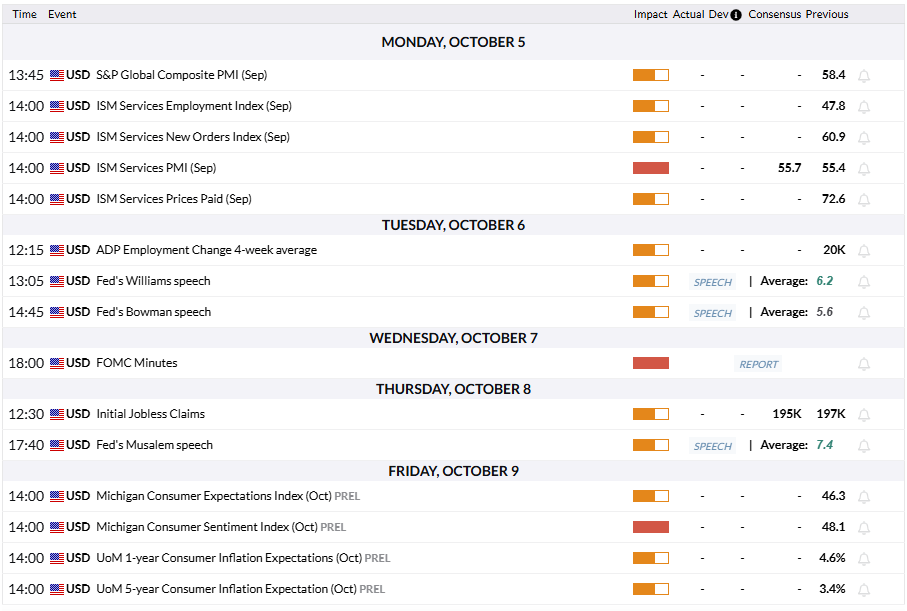
The US economic calendar will feature the Institute for Supply Management’s (ISM) Services Purchasing Managers’ Index (PMI) report for September. If the headline PMI holds near August’s 55.4 and the Prices Paid Index, the inflation component of the survey, rises further, the immediate reaction could help the USD preserve its strength and make it difficult for XAU/USD to gather bullish momentum.
On Wednesday, the Fed will publish the minutes of the September policy meeting. Discussions surrounding the possibility of a policy action in October could ramp up Gold’s volatility. If the publication highlights that policymakers argued against consecutive rate increases, Gold could gain traction with US Treasury bond yields correcting lower.
Investors will continue to pay close attention to the situation in global bond markets. Even if the USD continues to outperform its major rivals, Gold could hold its ground in case bond selloff in major economies persists.
Meanwhile, the ongoing decline in crude Oil prices seems to have been overlooked recently, with market participants focusing on global bond markets. The barrel of West Texas Intermediate (WTI) fell more than 3% for the third consecutive week as reports highlighted a noticeable improvement in Oil supply passing through the Strait of Hormuz. Even if the US and Iran fail to reach an agreement to end the conflict, an extended decline in Oil prices could be supportive for Gold in the short term.
Gold technical analysis: Sellers look to retain control
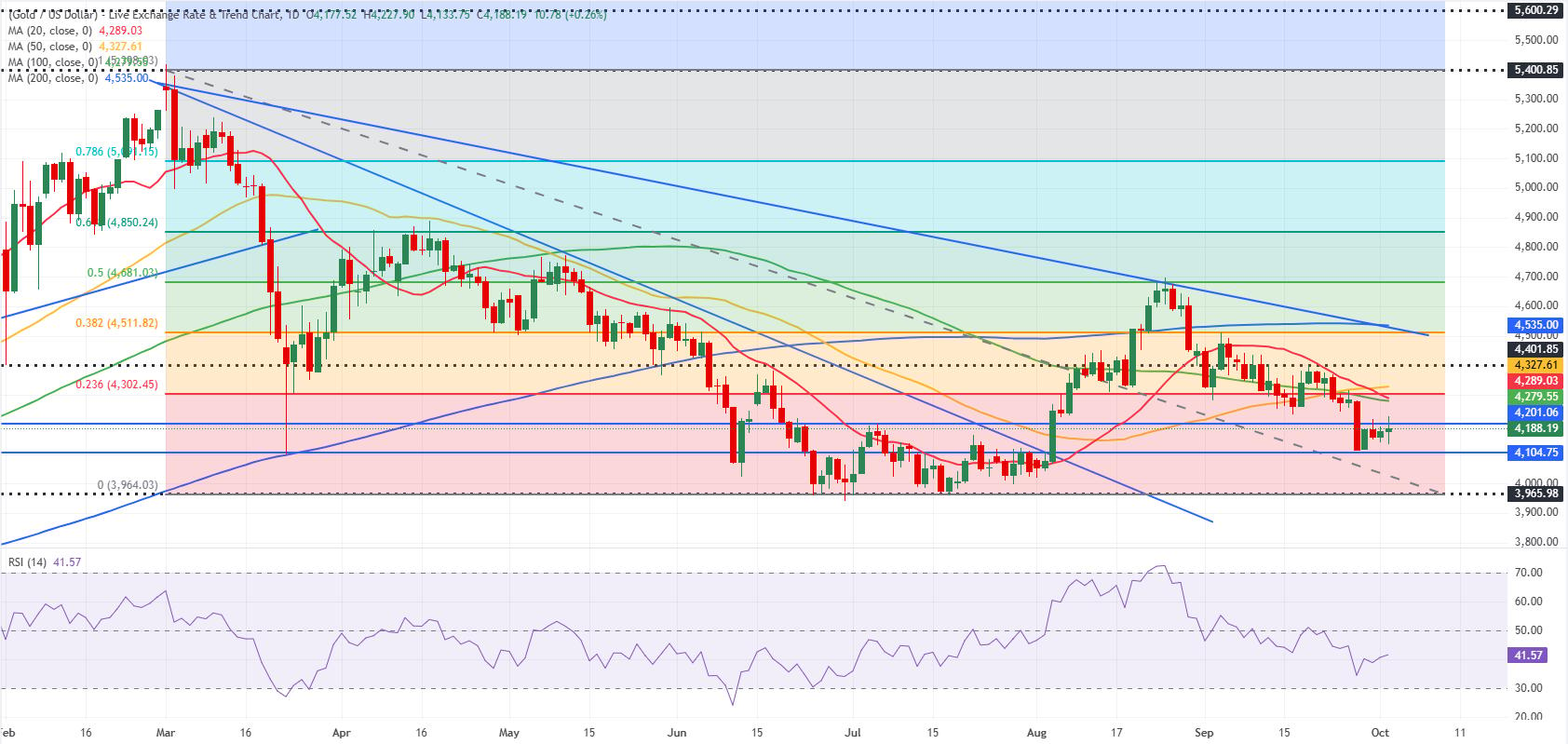
The Relative Strength Index (RSI) indicator on the daily chart stays near 40, while Gold continues to trade well below all the key moving averages, highlighting a bearish stance.
On the downside, an interim support level seems to have formed at $4,100 (static level). If this support fails, $4,000-$3,970 (static level, round level, end-point of March-August downtrend) could be the next bearish target.
Looking north, a cluster of resistances aligns in the $4,280-$4,330 region (100-day Simple Moving Average (SMA), 50-day SMA, 20-day SMA, Fibonacci 23.6% retracement of the March-August downtrend). If Gold clears this area and starts using it as support, $4,400 (static level) could be seen as the next resistance level before $4,510-$4,535 (Fibonacci 38.2% retracement, 200-day SMA).
Analysts at Societe Generale note that Gold has "struggled to establish itself above the 200-DMA during its recent rebound attempt," a pattern that "highlight[s] the persistence of downward momentum." They caution that "if Gold fails to reclaim the recent pivot high near $4,315, the decline may extend," leaving the focus on downside levels. In that scenario, Societe Generale points to "the next supports" around "the projection of $4,095 and the June/July troughs at 3,960/3,940, which is a crucial zone" for the metal.
Gold FAQs
Gold has played a key role in human’s history as it has been widely used as a store of value and medium of exchange. Currently, apart from its shine and usage for jewelry, the precious metal is widely seen as a safe-haven asset, meaning that it is considered a good investment during turbulent times. Gold is also widely seen as a hedge against inflation and against depreciating currencies as it doesn’t rely on any specific issuer or government.
Central banks are the biggest Gold holders. In their aim to support their currencies in turbulent times, central banks tend to diversify their reserves and buy Gold to improve the perceived strength of the economy and the currency. High Gold reserves can be a source of trust for a country’s solvency. Central banks added 1,136 tonnes of Gold worth around $70 billion to their reserves in 2022, according to data from the World Gold Council. This is the highest yearly purchase since records began. Central banks from emerging economies such as China, India and Turkey are quickly increasing their Gold reserves.
Gold has an inverse correlation with the US Dollar and US Treasuries, which are both major reserve and safe-haven assets. When the Dollar depreciates, Gold tends to rise, enabling investors and central banks to diversify their assets in turbulent times. Gold is also inversely correlated with risk assets. A rally in the stock market tends to weaken Gold price, while sell-offs in riskier markets tend to favor the precious metal.
The price can move due to a wide range of factors. Geopolitical instability or fears of a deep recession can quickly make Gold price escalate due to its safe-haven status. As a yield-less asset, Gold tends to rise with lower interest rates, while higher cost of money usually weighs down on the yellow metal. Still, most moves depend on how the US Dollar (USD) behaves as the asset is priced in dollars (XAU/USD). A strong Dollar tends to keep the price of Gold controlled, whereas a weaker Dollar is likely to push Gold prices up.
Author

Eren Sengezer
FXStreet
As an economist at heart, Eren Sengezer specializes in the assessment of the short-term and long-term impacts of macroeconomic data, central bank policies and political developments on financial assets.

















