|

Four factors moving oil prices

Oil was on the front foot at the start of the New Year buoyed by the prospect of a signed US – China trade deal and rising tensions in the middle east, in addition to shrinking stockpiles and the start of deeper OPEC plus production cuts. However, the push higher has been short lived.

1. Middle Eastern tensions. An Iran back Iraqi militia withdrew from the US embassy in Baghdad after storming it in protest over airstrikes. Elevated tensions involving Iranian backed forces has increased geopolitical risk in the region. However, there is no immediate threat to Iraq’s oil supply so the move higher could be short lived.

2. Trade deal. The US – China trade deal is expected to be signed on 15th January. Strong indications that the first phase trade deal will be signed and formally entered into within the coming weeks is boosting sentiment towards the global economic outlook and to a degree lifting expectations for future oil demand.

Realistically though, traders will want to see this optimism reflected in stronger data before we see a meaningful advance in oil prices.

3. Production cuts. This month also sees the start of deeper production cuts agreed by the OPEC plus group at the end of last year. This move has already been priced in. Of more concern was data showing that Russian output reached a post-Soviet high last year. Despite curbing production under the OPEC plus agreement and being one of the architects, Russia has a poor record of fulfilling its pledge.

4. Fall US Inventories. A decline in US inventories last week lifted the price of oil. API report showed that US crude stocks fells 7.8 million barrels week ending 27 December, significantly greater than the 3.2 million forecast. Investors are now awaiting Friday’s EIA crude stock data for fresh direction

Levels to watch:

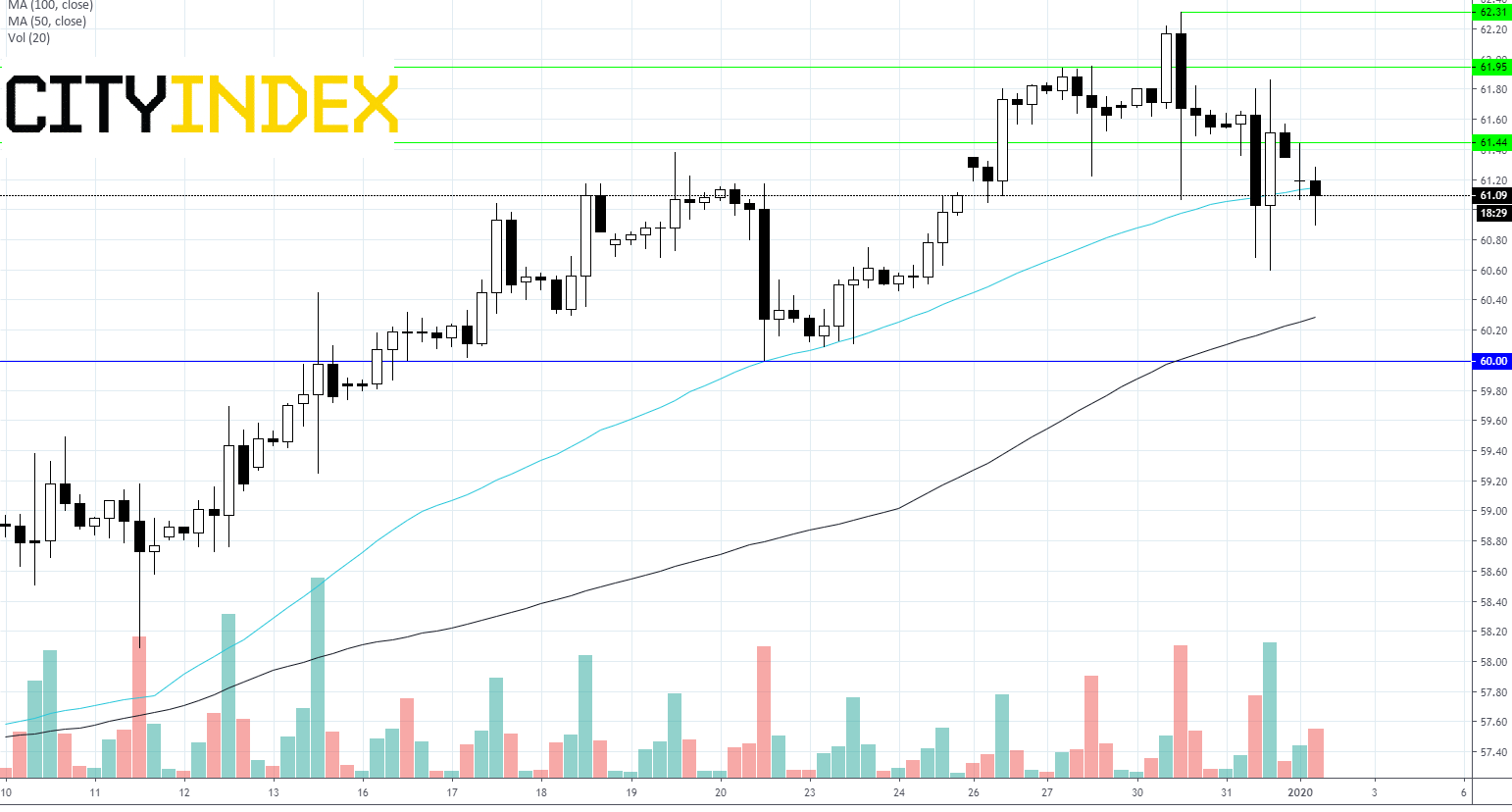
After starting 2020 on the front foot WTI is showing evidence of weakness. Falling volumes raise doubts over bull’s strength going forwards. After failing to break through resistance close to $61.50, the bulls have lost momentum and WTI has seen heavy selling over the past hour. WTI has fallen below 50 SMA although remains firmly above 100 SMA and 200 SMA. Oil bulls need to push through $61.50 to open the door to $61.95 and $62.31. A breakthrough support at $60 could negate the uptrend.
CityIndex

Author

More from Fiona Cincotta
Share:

Editor's Picks

EUR/USD holds firm near 1.1850 amid USD weakness

EUR/USD remains strongly bid around 1.1850 in European trading on Monday. The USD/JPY slide-led broad US Dollar weakness helps the pair build on Friday's recovery ahead of the Eurozone Sentix Investor Confidence data for February. 

GBP/USD hovers near 1.3600 as UK government crisis weighs on Pound Sterling

GBP/USD moves sideways after registering modest gains in the previous session, trading around 1.3610 during the European hours on Monday. The pair could come under pressure as the Pound Sterling may weaken amid a fresh government crisis in the United Kingdom.

Gold remains supported by China's buying and USD weakness as traders eye US data

Gold struggles to capitalize on its intraday move up and remains below the $5,100 mark heading into the European session amid mixed cues. Data released over the weekend showed that the People's Bank of China extended its buying spree for a 15th month in January. Moreover, dovish US Fed expectations and concerns about the central bank's independence drag the US Dollar lower for the second straight day, providing an additional boost to the non-yielding yellow metal.

Cardano steadies as whale selling caps recovery

Cardano (ADA) steadies at $0.27 at the time of writing on Monday after slipping more than 5% in the previous week. On-chain data indicate a bearish trend, with certain whales offloading ADA. However, the technical outlook suggests bearish momentum is weakening, raising the possibility of a short-term relief rebound if buying interest picks up.

Japanese PM Takaichi nabs unprecedented victory – US data eyed this week

I do not think I would be exaggerating to say that Japanese Prime Minister Sanae Takaichi’s snap general election gamble paid off over the weekend – and then some. This secured the Liberal Democratic Party (LDP) an unprecedented mandate just three months into her tenure.

Bitcoin, Ethereum and Ripple consolidate after massive sell-off

Bitcoin, Ethereum, and Ripple prices consolidated on Monday after correcting by nearly 9%, 8%, and 10% in the previous week, respectively. BTC is hovering around $70,000, while ETH and XRP are facing rejection at key levels. Traders should be cautious: despite recent stabilization, upside recovery for these top three cryptocurrencies is capped as the broader trend remains bearish.