Forex Strength And Comparison for March 2017


In the Currency Strength table the AUD was the strongest currency while the EUR was the weakest. The JPY and AUD gained 2 points last month. All the other Currencies remained around the level of the previous week with a maximum difference of just 1 point.
______________________________________
12 Months Currency Score Strength
The 12 Months Currency Strength and the 12 Months Average are provided here below. This data and the "12 months Currency Classification" are considered for deciding on the preferred range. Because it is not ideal nor desired to change the range for a currency every single month, we perform several checks to avoid this.
- First of all the strength over a period of 12 months. See each row for more information.
- Then the 12 months average, see the last row called "Avg. 12 M."
- The number of months that a currency is stronger than another currency can also be evaluated.
- The TA Charts for each Time Frame can also be consulted.
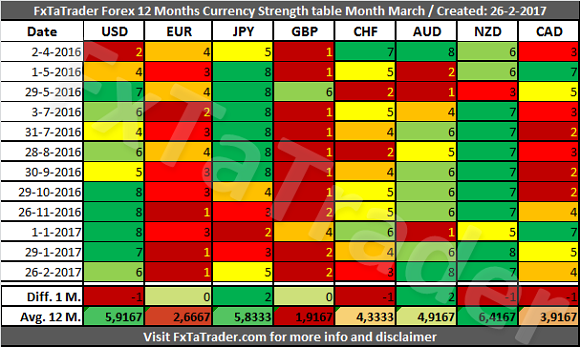
For analyzing the best pairs to trade looking from a longer term perspective the last 12 months Currency Classification can be used in support.
This was updated on 29 January 2017 and is provided here for reference purposes:
Strong: USD, JPY, NZD. The preferred range is from 6 to 8.
Neutral: AUD, CAD, CHF. The preferred range is from 3 to 5.
Weak: EUR, GBP. The preferred range is from 1 to 2.
When looking at the Average 12 M. Score the NZD remains the strongest of all while the GBP remains the weakest. The currencies are grouped together around a level which makes clear to what classification they fit best.
For some currencies this may not be very clear, a good example at the moment is the AUD being a Neutral currency but having an Average 12 M. score of 4,9167 being between the Strong and Neutral currencies.
This currency is gaining a lot of strength in the last 2 months and is clearly the strongest of the Neutral currencies, which are the CHF, CAD and AUD.
_____________________________________
Classification review
The USD and NZD are remaining strong while the JPY had a dip in the last months. This currency is getting stronger again in the last few months and the Avg. 12 M. is still at a high level. It means that this currency can remain strong if it continues to recover from the dip.
The AUD is a Neutral currency but remained in the last months many times in the range of Strong currencies (6 to 8). This month it is the strongest currency and if the strength remains the Avg. 12 M. can get closer to the Strong currencies.
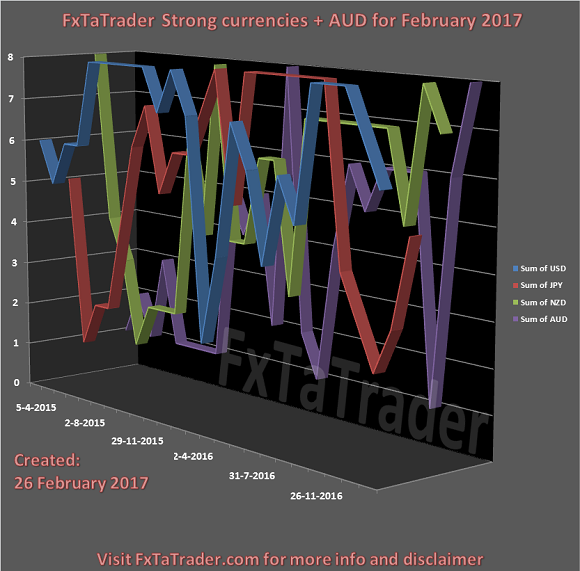
Here below you can see the Monthly Currency Score Chart with 24 months data as a reference.
_____________________________________
Currency Score Comparison
"Comparison table" and the "Ranking and Rating list"
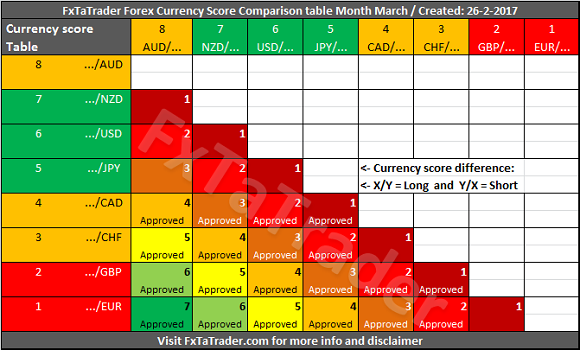
The Forex Currency Comparison Table compares each currency with its counterpart based on the Currency Score. For more information about the currency Score of this month you can read the article "Forex Ranking, Rating and Score" which is published every month together with this article.
By using the comparison table directly below you can get a view without the volatility and statistics as opposed to the "Ranking and Rating list". Only the strength of each currency against the counterparts is analyzed by using the Technical analysis charts of the 3 Time Frames that are also used for the "Ranking and Rating List".
The information from the Comparison Table is the source for calculating the "Ranking and Rating List" where this list additionally uses the volatility and statistics for creating the best and worst performer in the list from number 1 to 28.
"Comparison table" and the "Currency Score Chart"
The additional value of this table compared to the Currency Score table is that the Comparison Table compares the strength between the currencies of each pair. By subtracting the strength of the weaker currency from the stronger currency we have a way to compare each pair combination.
The comparison table provides a way to compare currencies from a longer term perspective of 12 months and also simultaneously taking the current trend into account. By coloring the currencies in the X and Y axis according to their Classification we can show what the best combinations are. In doing this we apply 2 rules to make it clearer.
- First of all only better classified currencies in combination with weaker classified currencies are "Approved" when there is a Currency Score difference of at least 1 in the current month.
- The only exception is when 2 currencies are similarly classified but the Currency Score difference is equal to or more than 4.
- It means that each currency should be as far apart from each other as possible in the range from 1 to 8. The classification of the currencies in question may change in the longer term. By using the difference of 4 which is exact the half of the range it seems a safe approach for trading 2 currencies which are similarly classified.
- Even though currencies may be in the same classification a currency may be in a weaker/stronger period and may even change its classification in the future. See the current classification for the coming period at the beginning of this article.
______________________________________
Putting the pieces together
Based on the last "12 Months currency classification" and the "Currency Comparison Table" the most interesting currencies for going long seem to be the:
AUD, NZD, USD and JPY.
These are Strong or Neutral currencies from a longer term perspective when looking at the last "12 Months currency classification".
For going short the same analysis can be done and the following currencies seem to fit best:
EUR, GBP and CHF.
These are Weak or Neutral currencies from a longer term perspective.
Currencies with a high deviation seem less interesting to trade because they are less predictable. A good example at the moment is e.g. the:
AUD.
Some of the pairs in the "Currency Comparison Table" comply for a longer term trade based on the Technical Analysis (TA) of the Daily and Monthly chart. For the coming month these seem to be: GBP/AUD, EUR/AUD, EUR/NZD, GBP/JPY, GBP/NZD, EUR/USD, EUR/JPY, EUR/CAD, AUD/CAD, GBP/CAD and USD/CHF
Author
Frank Oznar
FxTaTrader
Technical Analysis of the trading markets has fascinated me since the early 1990's. I was then about 25 years old. During the years my studies and work made it possible to look into Technical analysis from an economic and a scientific point of view.

















