Forex alert: Circle February 1 – Macro factors to steer the FX market until then


This past week has seen a notable shift in the dollar's dynamics. The dollar has significantly weakened as traders scale back their bullish bets, reacting to President Trump’s less confrontational posture toward President Xi. However, as highlighted in our "Weekender," ( Go long USDCNH & Short EURUSD at today’s open), my skepticism lingers regarding the sustainability of this dollar's softness and the corresponding strength in Asian currencies. It appears that Trump’s second term could use tariffs strategically to press for swift concessions, using Colombia as the latest tariff blueprint for broader global immigration, national security and trade strategies.
However, despite the initial market unease, this iteration of the Trump administration seems more calculated and politically astute, influenced by tech innovators and market tacticians. While partly stirred by tariff apprehensions, today's S&P 500 swoon reflects a pushback in US tech stocks due to the groundbreaking DeepSeek AI model we covered earlier today.
Still, in his view, the ultimate gauge for his Presidential performance will likely be the level of the S&P 500. This perspective could shape his administration's approach, suggesting a measured application of tariffs with major trading partners. Hence, while expecting a more tempered approach to tariffs, maintaining a long US dollar hedge seems prudent against the possibility of Trump decisively wielding the tariff hammer if concessions are not forthcoming.
No foreign exchange trader would argue that tariffs, to some extent, won't be dollar-positive. The currency markets naturally adjust to such maneuvers; that's a given. However, the extent of that impact and whether the potential tariffs are already factored into the current prices remains a hotbed for intense debate, especially in such a crowded trade.
As the FX market prepares for a possible February 1st tariff deadline involving Mexico, Canada, and China, the dollar is not expected to experience a significant sell-off due to the compression of the tariff risk premium; therefore, trading this week is likely to focus more on macroeconomic indicators. The upcoming US PCE data will considerably impact the bond and currency markets. Another crucial factor is whether the Fed's board aligns with Chris Waller's dovish view on inflation, which could suggest a more lenient approach to Fed policy.
In a surprising twist, the latest official PMI surveys for January revealed a sharp downturn in China's economic activity just before the Lunar New Year—traditionally a period marked by an economic uptick. The manufacturing PMI plummeted to 49.1, its nadir since August, while the services sector took an even steeper dive, dropping 2.0 points to 50.2. This unexpected slump, straying from the typical seasonal boost in service-related demand, paints a bleak picture of China's annual economic kickoff.
This downturn is stirring a heightened urgency among Chinese policymakers, compelling them to ramp up fiscal and monetary interventions to revive growth. The need for a robust policy response could intensify if President Trump decides to implement his proposed tariff hikes. Anticipating the need for economic stabilization, plans are already in place to deploy additional stimulus measures promptly after the Lunar New Year break, which runs from January 28th to February 4th.
Considering China's languishing growth momentum, the possibility of further rate cuts by the People's Bank of China (PBoC), and the shadow of increased tariffs, our outlook on the renminbi remains decidedly bearish. We project a movement in the USD/CNY pair towards 7.6000 over the year, suggesting a challenging economic landscape ahead for China amidst global trade tensions.
The EUR/USD briefly surged above the 1.05 mark on Friday, fueled by indications that Washington might adopt a less aggressive stance on China tariffs than initially anticipated. This news prompted a rise in short-dated swap rates in the Euro, reflecting expectations that the European Central Bank might not need to implement deep cuts. Concurrently, U.S. short-dated swap rates declined amid prospects that tariffs might not drive inflation as previously feared, suggesting the Federal Reserve might have more room to ease.
As a result, the two-year EUR/USD swap differential tightened to around 165 basis points—the narrowest it has been since early November. This metric remains crucial to monitor, especially if tariff threats continue to diminish. Nevertheless, superior economic performance in the U.S could sustain the dollar's strength.
While the recent movement in EUR/USD could be seen merely as a correction, I maintain the view that EUR/USD could trend towards parity by year-end. This outlook assumes the rate differential will widen to about 200 basis points. Time will tell if this scenario unfolds as anticipated. In the meantime, enjoy the carry.
View
The narrative weaving through hedge fund circles suggests a potent mix of robust U.S. job growth since the election is muddying the waters for the Federal Reserve's rate cut agenda, even in light of last year's inflation slowdown. Adding to the intrigue, President Trump's hardline stance on immigration could send wage inflation soaring due to a looming migrant labour shortage, bound to further stir the Fed’s inflation anxieties.
Amid these market machinations, the echoes of Chris Waller’s astute observations resonate with me deeply. His perspectives are invaluable, and while a rate cut in March isn’t the expected norm, it's not off the table if you follow his guidance. This potential pivot poses the most significant downside risk for the U.S. dollar this week, hinging mainly on any forthcoming hints from the Fed itself.
I genuinely despise holding a long dollar position that aligns with the majority. My usual FX trading strategy revolves around staying ahead of the crowd—getting in early and selling when everyone else catches up. That's precisely why I haven't fully committed yet or "backed up the Mack Truck," so to speak. I prefer to navigate ahead of the consensus, not within it.
The Dollar smile
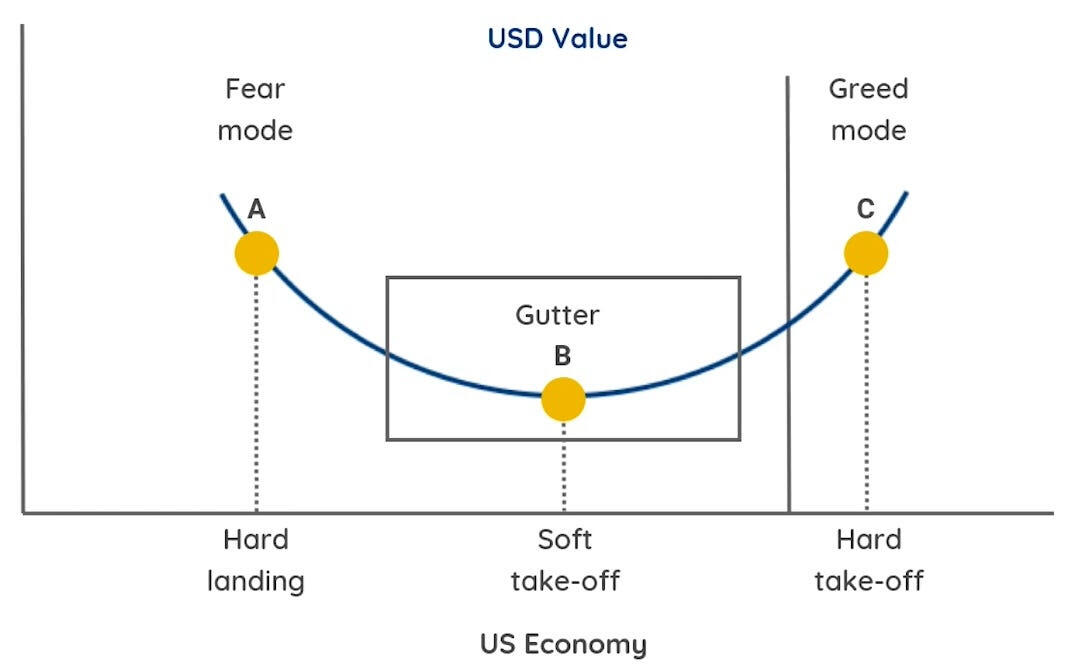
Stephen Li Jen's "Dollar Smile" theory is a fascinating concept that I find particularly insightful when looking at the behaviour of the US dollar in various economic climates. The idea is that the dollar strengthens during times of either US economic prosperity or during extreme global economic distress but tends to weaken during moderate US economic conditions. It's like the dollar smiles at both ends of the economic spectrum—when things are fantastic and when they're dire—but not so much in between. This phenomenon occurs because the dollar serves as a safe haven during global crises and benefits from significant capital inflows when the US economy is on an upswing.
Author
Stephen Innes
SPI Asset Management
With more than 25 years of experience, Stephen has a deep-seated knowledge of G10 and Asian currency markets as well as precious metal and oil markets.