Forecasting the upcoming week: Global markets set to kick off the new year with a light data docket


The US Dollar Index (DXY) is trading tepid through the year-end holiday season but still holding onto territory near the high end of 2024’s chart action. Market flows are set to take it easy next week with a midweek blackout period slated to roll through the global market sessions for the rollover into 2025. US ISM manufacturing Purchasing managers Index (PMI) survey results are due late next week on Friday, where investors are broadly anticipating another tick down in aggregated business expectations. The Federal Reserve (Fed) broadcasted a lower-than-expected pace of rate cuts likely in 2025, taking down market-wide expectations of steeper rate trims through the year.
EUR/USD is holding near the 1.0400 handle to wrap up the Christmas holiday week, grinding out a rough sideways pattern in the near-term as Euro traders grapple with the new year’s upcoming outlook. The European Central Bank (ECB) is widely expected to continue slashing interest rates through 2025 in an effort to bolster the European economy in the face of lopsided growth figures, as well as mounting headwinds looming ahead in the form of continued uneven demand developments and an overly cautious global trade outlook. With the ECB’s policy rate strategy set to continue lowering reference rates, EUR/USD is likely to continue falling as the Euro’s interest rate diverges from the Greenback’s.
GBP/USD is marching along in rough lockstep with its geographic neighbor, churning into a middling price action pattern as 2024 draws to a close. Meaningful UK economic data is entirely absent from the data docket for next week, leading the Pound Sterling to kick off 2025 on a decidedly quiet note. The Bank of England (BoE) is widely expected to take a cautious approach to interest rates as the UK’s central bank tries to keep the UK domestic economy and its inflation rate roughly on-balance, which could provide some near-term support for the GBP/USD technical stance.
AUD/USD is similarly facing a thin data docket next week, though a fresh round of key Chinese economic data could have some knock-on effects for the Aussie. Chinese NBS PMI figures for December are due early Tuesday next week, followed by Caixin PMI results for the same period slated for Thursday.
USD/JPY is set to continue breaching into multi-month highs as the calendar rolls over into 2025. Japanese key data remains light next week, but the US Dollar’s long, slow grind back into the high end has pared away much of the Bank of Japan’s (BoJ) expensive efforts to prop up the batter Yen during the middle months of 2024.
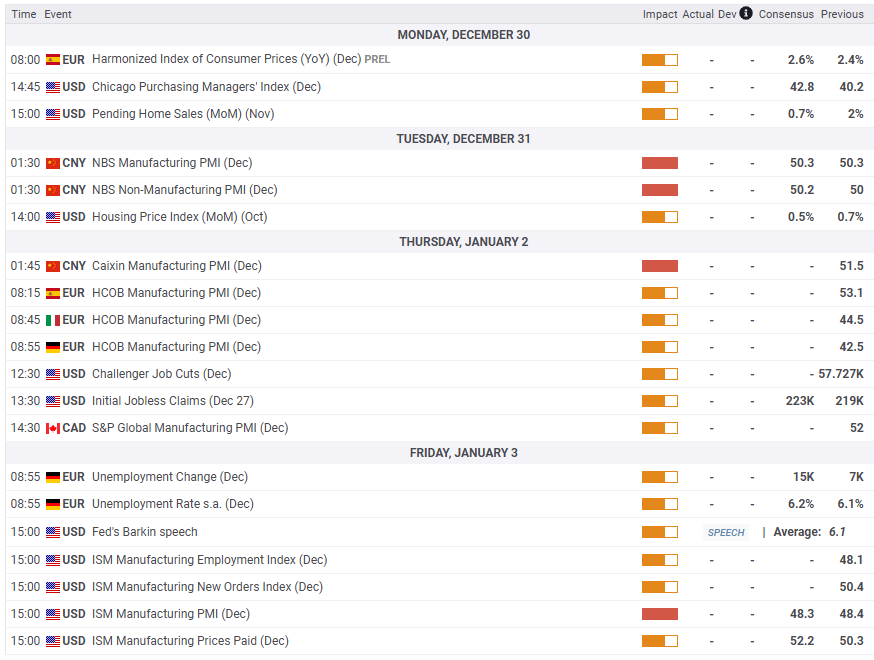
Key events to watch next week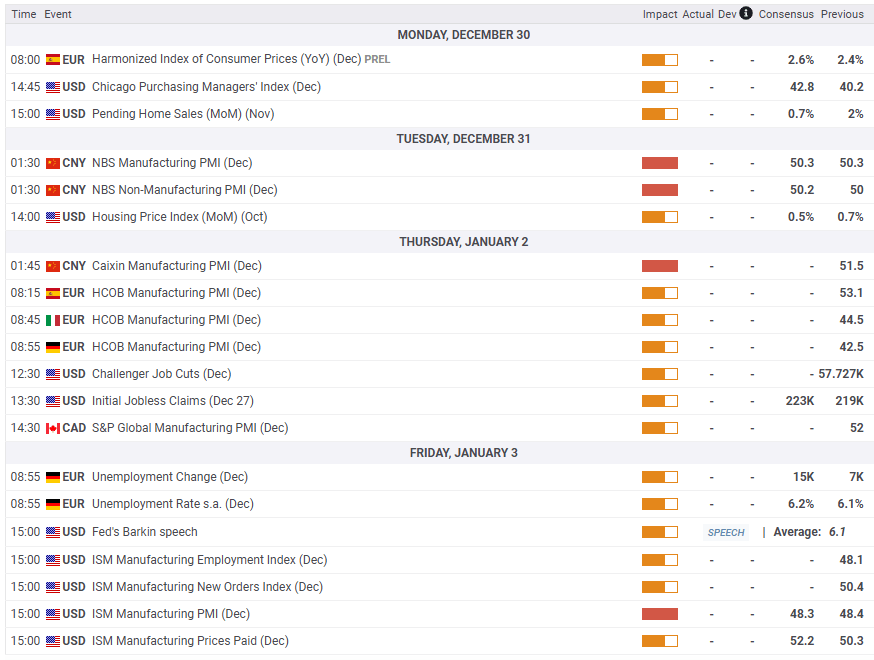
Fed FAQs
Monetary policy in the US is shaped by the Federal Reserve (Fed). The Fed has two mandates: to achieve price stability and foster full employment. Its primary tool to achieve these goals is by adjusting interest rates. When prices are rising too quickly and inflation is above the Fed’s 2% target, it raises interest rates, increasing borrowing costs throughout the economy. This results in a stronger US Dollar (USD) as it makes the US a more attractive place for international investors to park their money. When inflation falls below 2% or the Unemployment Rate is too high, the Fed may lower interest rates to encourage borrowing, which weighs on the Greenback.
The Federal Reserve (Fed) holds eight policy meetings a year, where the Federal Open Market Committee (FOMC) assesses economic conditions and makes monetary policy decisions. The FOMC is attended by twelve Fed officials – the seven members of the Board of Governors, the president of the Federal Reserve Bank of New York, and four of the remaining eleven regional Reserve Bank presidents, who serve one-year terms on a rotating basis.
In extreme situations, the Federal Reserve may resort to a policy named Quantitative Easing (QE). QE is the process by which the Fed substantially increases the flow of credit in a stuck financial system. It is a non-standard policy measure used during crises or when inflation is extremely low. It was the Fed’s weapon of choice during the Great Financial Crisis in 2008. It involves the Fed printing more Dollars and using them to buy high grade bonds from financial institutions. QE usually weakens the US Dollar.
Quantitative tightening (QT) is the reverse process of QE, whereby the Federal Reserve stops buying bonds from financial institutions and does not reinvest the principal from the bonds it holds maturing, to purchase new bonds. It is usually positive for the value of the US Dollar.
Author
Joshua Gibson
FXStreet
Joshua joins the FXStreet team as an Economics and Finance double major from Vancouver Island University with twelve years' experience as an independent trader focusing on technical analysis.