FOMC Preview: don't get over excited, probably there won't be much to see here
- Fed's statement may be less relevant than Trump's tweets this Wednesday.
- Focus on updates on possible trade war effects on the economy.

The inappropriate and historically unusual comments from US President Trump, criticizing the Fed's policy, and their possible effects on policymakers, are the only risk the market faces from the upcoming Federal Reserve decision. One day ahead of the event, chances of a September hike stand at 80%, while the fourth yearly hike remains on the table for December, with odds at 60%. For this "non-live" meetings, odds are at less than 2.0%. The market "knows" what will happen, and has already priced it in.
The likelihood of Trump's words denting Fed officers' conviction at this point, is pretty much null. Powell & Co. won't deviate from "keep gradually raising the federal funds rate", as Powell affirmed in its testimony before the Senate unless the mandate is dictated by the economy. The central bank bases its decisions on two main legs: employment and inflation. The jobs´ market has been strong for years now, while inflation has been hovering around the 2.0% target. Even more, the central bank had to clarify that is willing to allow inflation to run above it. Just this Tuesday we knew that US employment cost index, which measures wages and benefits, grew 2.8% in the 12 months to June, the largest yearly increase in almost a decade, another encouraging sign. The economy grew 4.1% according to preliminary Q2 GDP, while macroeconomic data release day after day fluctuates at healthy levels.
With that in mind, little could be expected for this meeting, although being a central bank announcement, it always has the ability to surprise investors and rock the boat. One of the main issues the US economy is facing is a trade war with China and its potential effects on the economy. Powell has already acknowledged it in his prepared testimony before the Congress, as he said that policymakers expect the economy to remain strong, but added that " it is difficult to predict the ultimate outcome of current discussions over trade policy," adding that escalating tariffs could be bad for the US economy. Anyway, he avoided getting in too deep into the issue.
Surprises are what trigger market moves, so if the Fed signals that officers are more concerned about the trade war effects on the economy, a reaction is possible. A huge surprise will be a change in the "gradual path" stance, but chances of any of these happening are quite limited. US Trump tweeting is the loose wire that can trigger the most action this Wednesday.
At the end of the day, worth remembering that the US Federal Reserve is pretty much alone in the tightening path, with the only central bank with chances of raising rates being the BOE, something that market players will know next Thursday. It could well happen that with an on-hold BOE, the USD enjoys renewed demand across the board, as it will highlight the distance between the Fed and its counterparts.
EUR/USD technical outlook, levels to watch
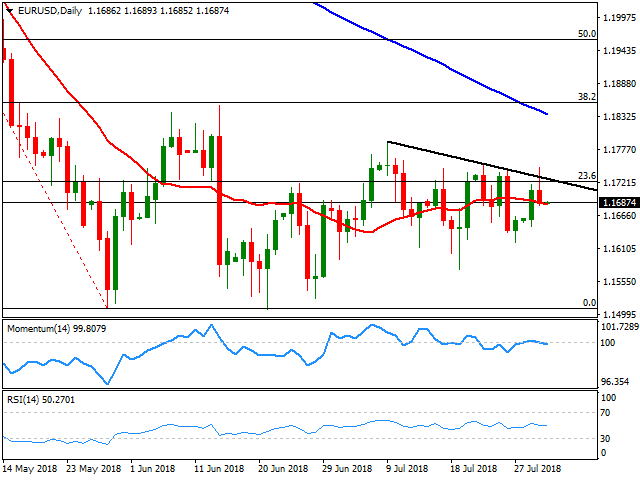
The EUR/USD pair has been steadily rejected on attempts to run beyond the 1.1720 level, the 23.8% retracement of the April/May decline ever since June ECB's meeting, something quite significant ahead of Fed's decision, as the dovish tapering from the European Central Bank highlighted the divergences between the two financial institutions. The daily chart shows that the pair also failed to surpass a daily descendant trend line coming from July high, although Tuesday's high interrupted the cycle of lower highs. Buyers, on the other hand, had lifted the bar from 1.1500 to 1.1600 in the last couple of weeks. In the mentioned chart, the price is hovering around a horizontal 20 DMA, and below the larger ones, with the 100 DMA maintaining its strong bearish slope, while technical indicators head nowhere around their mid-lines. The picture should be completed with the decreased volume typical of the northern hemisphere's summer. Seems unlikely that the Fed could trigger a sustainable directional breakout. Supports, from here are located at 1.1660, 1.1620 and 1.1590, with a break below this last leaning the scale toward the downside. To the upside, 1.1720, 1.750 and 1.1790, this last July high, are the intraday resistances that the pair will need to surpass in its way to turn bullish.
Author

Valeria Bednarik
FXStreet
Valeria Bednarik was born and lives in Buenos Aires, Argentina. Her passion for math and numbers pushed her into studying economics in her younger years.

















