FOMC meeting preview: big noise, little substance?
- A rate hike will be much less relevant than any clue on what will come next.
- US CPI data ahead of the Fed's announcement to influence market's reaction to the latest.

US policymakers begin a two-day monetary policy meeting today with an announcement expected on Wednesday, and there are multiple reasons to believe it will be one of "those" meeting, although maybe not as big as next February one. Firstly, a rate hike has been largely anticipated and the market is taking it for granted. Secondly, is one of those known as "live-meeting" which includes a new dot plot and a Yellen's speech, her last one, as on February, Jerome Powell will become the Federal Reserve's head.
The Federal Reserve began shrinking its $4.5 trillion balance sheet last October, and despite sluggish inflation, policymakers continued to forecast one more interest-rate hike for this year from the current range of 1% to 1.25% to 1.25% to 1.50%. That's why this time, a rate hike will be much less relevant than any clue on what will come next.
The latest dot plot continued signaling the likelihood of three rate hikes for 2018, although the market is not quite convinced about it, particularly as head's Yellen keeps saying that she has no clue why inflation remains below their 2% target. Hopes that the upcoming tax reform could boost the economy, and therefore help the US Federal Reserve to keep on normalizing monetary policy are a positive factor that the market has also priced in. The fact that Mr. Powell will pretty much follow Yellen's path also counts as an up for the Fed.
Given that the FX board usually presents larger reactions to the unknown, which are then, the loose ends this time, the ones that could rock the board?
A positive surprise will be the removal of the word "gradual" when referring to normalization, something that the Fed has repeated ad exhaustion, although chances of this happening are null. Another shock will be a change in the number of hikes foresee for 2018. If somehow policymakers dare to cut their forecast and anticipate just two hikes, the greenback will plunge. Four hikes would be a joke, also with no chances of happening, and the most likely scenario is that it will remain at the current three.
An unknown factor that could add some chilly to tomorrow's announcement would be inflation figures, to be released earlier on the day. If inflation comes better-than-expected, will reinforce a hawkish stance from policymakers later in the day. A soft reading, on the other hand, will offset any encouraging line the statement may have.
EUR/USD technical outlook, levels to watch
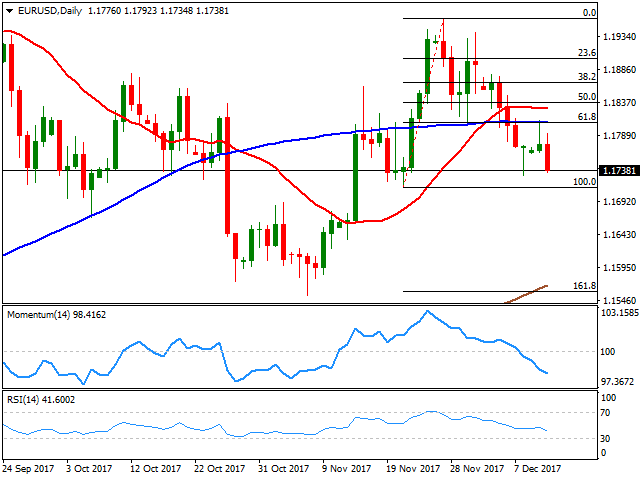
The EUR/USD pair trades not far from its November low at 1.1712, with the dollar gaining ground as the Fed's decision looms. Technical readings in the daily chart favor a bearish extension ahead, although the Fed is one of those events that could mess up big with technical readings. Anyway, the key support is now 1.1712, November 21st low, ahead of the 1.1660 level, a major static support. A break below this last should lead to a continued decline towards 1.1620, leaving the pair exposed to a steeper decline in the following sessions.
To the upside, the immediate resistance is 1.1800, wherein the daily chart the pair has the 61.8% retracement of its latest bullish run converging with a horizontal 100 DMA. Beyond it, selling interest has been surging in the 1.1870 level, these last two weeks, being then, the key level to surpass so the pair has a minimum chance of changing the current negative stance.
Author

Valeria Bednarik
FXStreet
Valeria Bednarik was born and lives in Buenos Aires, Argentina. Her passion for math and numbers pushed her into studying economics in her younger years.

















