FOMC Minutes Preview January 29-30 Meeting: The pause that refreshes
- FOMC voted to keep the Fed Funds rate at 2.25% to 2.5% at the January 29-30 meeting
- Fed debuts 'patience' as a policy quality
- Markets looking for clues whether the rate cycle is finished or only paused

FOMC Policy Analysis
The change incorporated in the December Projection Materials and elaborated through the January FOMC statement, Chairman's Powell's news conferences and appearances by him and other Fed officials was not based on developments in the US economy.
As noted in the January 30th FOMC statement, the “labor market has continued to strengthen, and that economic activity has been rising at a solid rate. Job gains have been strong....and the unemployment rate has remained low. Household spending has continued to grow strongly, while business fixed investment has moderated from its rapid pace earlier in the year. ...Overall inflation and inflation for items other than food and energy remain near 2 percent.”
This description was little changed from the December statement. The pause implied by the reduction of projected Fed Funds increases in 2019 from three to two was prompted by global concerns. As elucidated by Chairman these include a slowdown in the global economy and specific risks from the British exit from the European Union, the US-China trade dispute and political unrest in France and elsewhere.
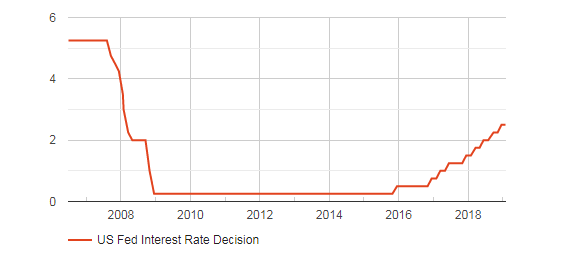
The outstanding question is whether the Fed has moved to a neutral policy? The aggressive tightening moves of 2018, four Fed Funds increases, were the climax of a three year old rate normalization campaign. The rationale for this was not economic, except in the twin senses that the governors wanted a rate cushion for the next recession and they kept a wary eye to see if higher rates were curbing economic growth. The tightening policy was not based on rising inflation or an overheating US economy.
Fed Funds Rate Upper Target
FXStreet
Patient is as patient does
The January statement said, “In light of global economic and financial developments and muted inflation pressures, the Committee will be patient as it determines what future adjustments to the target range for the federal funds rate may be appropriate…”
As written ‘patient’ is not a policy prescription. It favors no conclusion as to the next rate move though it clearly implies a pause. Markets have interpreted it as meaning there will be no rate increases at least until the second half of the year.
The specific threats to global economic growth from the UK exit and the trans-Pacific trade dispute are amenable to positive solutions. The UK and the EU could agree on an amicable departure, the United States and China may negotiate an operational agreement that boosts trade between the world’s two largest economies. Such agreements would go a long way to easing tensions about a global economic slowdown.
Is there any internal economic logic to the Fed’s current pause? The Fed’s own growth projections show the US economy slowing this year to 2.3%. That estimate was 2.5% in the September Projection Materials. The solution probabilities of the two issues above must be incorporated into the growth estimates, as such they must be partial, that is, they must take into account the chances of a breakdown in both negotiations, a no-deal Brexit and a full blow US-China trade war. How will a positive outcome to Brexit and US-China affect the Fed’s economic estimates and policy projections? Will US economic growth ebb or accelerate if global growth levels off or improves?
Whether the FOMC minutes will provide answers is questionable and historically unlikely but they will be scoured nonetheless.
Author

Joseph Trevisani
FXStreet
Joseph Trevisani began his thirty-year career in the financial markets at Credit Suisse in New York and Singapore where he worked for 12 years as an interbank currency trader and trading desk manager.