FOMC meeting: How could Trump's protectionism affect FED´s decisions?

It is not big news that the FED has flipped from "data-dependent" to "Trump-dependent". Ever since rising rates for a second time in a decade last December, Yellen & Co. have made it clear that uncertainty under the new administration is becoming the new normal. In fact, for those that love to scrutinize FOMC's statement to the last comma, the Central Bank mentioned the word "uncertainty" around fifteen times in its latest statement. The press conference showed a cautious stance as Yellen said it was “too early to know what changes in these policies would be implemented and how such changes might alter the economic outlook.”
The FED is not characterized for changing much the wording of its statements and given that this January meeting is one of the ones that don't include a press conference or forecasts revision, little changes are to be expected, as the new US President has shed no light over upcoming fiscal policies. Hopes of faster growth and rising inflation have receded after Trump's first week at the office, with his first measures focused on trading protectionism and immigrant policies. While is too early to say, that's how the financial world feels these days.
The market welcomed the three rate hikes in the December's dot plot, an improvement from previous two. Making a little history, however, made it irrelevant, as the dot plot suggested four hikes per year back in December 2014 and 2015, with the FED delivering just one per year in 2015 and 2016.
Back mid January and in a speech titled "The goals of monetary policy and how we pursue them," FED's Yellen said that the FOMC expects to raise interest rates "a few times" per year, until achieving a 3% rate by 2019, boosting the greenback temporarily, as the effect of her hawkish comments diluted in a non-so-hawkish speech a few days afterwards.
In the meantime, Mr. Trump keeps signing trade-protectionism executive orders. These kind of measures could affect growth, as imposing import tariffs won't go unnoticed by other world´s major powers. And Wall Street's decline is clearly reflecting fears of such happening. The biggest risk is that this kind of policy will backfire in the inner market.
Another point of conflict comes from Trump's infrastructure promises. Such policies would need low rates to guarantee a competitive exchange rate and attractive borrowing costs, opposing to FED's latest policy that suggests an acceleration in the pace of rate hikes.
It won't be until June, when Trump will reach his 100 days as President, that the picture will be clearer for the FED and for the markets. It's still to be seen if Yellen will remain as the chief on the Central Bank then. A great deal of water will flow under the bridge until then, and therefore it seems unlikely that the FED will be able to do something.
EUR/USD technical outlook, levels to watch
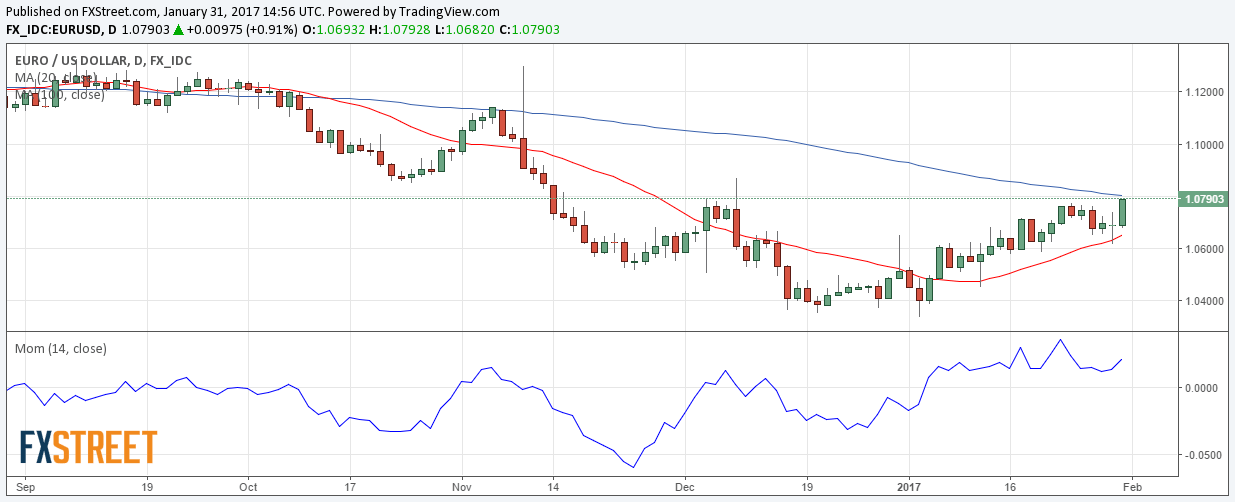
The EUR/USD pair is trading at its highest for this 2017 ahead of the meeting, with the dollar weighed by Trump's executive orders, and latest comments from Peter Navarro, the new head of the US National Trade Council who said that Germany is taking advantage of the US and its EU counterparts by using a “grossly undervalued” euro. Challenging its 100 DMA for the first time since early November, the daily chart shows that technical indicators have gained upward momentum within positive territory, whilst the price is well above a bullish 20 SMA, all of which supports some further advances.
The 1.0800/40 region is the immediate resistance, as the area has offered a major static support all through 2015 and 2016, while the 50% retracement of the November/January decline stands at 1.0820. A dovish FED can push the pair through this area, favoring then an advance up to 1.0930, the 61.8% retracement of the mentioned slide. Beyond this last, the key 1.1000 figure comes next.
The downside seems now well limited, with 1.0700/10 being the first support. It would take a break below 1.0650, however, to consider some further slides towards the 1.0600/20 region, where buying interest will likely contain the decline.
Author

Valeria Bednarik
FXStreet
Valeria Bednarik was born and lives in Buenos Aires, Argentina. Her passion for math and numbers pushed her into studying economics in her younger years.