Five fundamentals for the week: Global sell-off has a life of its own, Middle East may spiral out of control
- Markets are in a "sell-everything" mode, with speculation of an emergency rate cut hanging in the air.
- Tensions between Israel and Iran are nearing a boiling point that could trigger further price action.
- Two significant US releases and the RBA decision are also of high interest.


Panic – no better word to describe a fall of over 12% in the Nikkei stock index and plunges in almost all assets. Will it continue? The sell-off has a life, but the factors triggering it matter.
1) Sell-everything mode seems like a call for a Powell Put
Is the Federal Reserve (Fed) behind the curve? It took investors less than a day to change their minds from optimism about a rate cut in September – that the bank hinted to – to concerns the central bank should have already cut.
Another two trading days and one disappointing Nonfarm Payrolls report, and markets already began pricing an emergency rate cut coming in the next few days. This may have gone too far.
First, while the Nonfarm Payrolls triggered the Sahm Rule – an acceleration in unemployment that has historically indicated a recession is in the works – that increase in the jobless rate came on top of a higher participation rate. Having more people engaged in the labor market is a good sign.
Second, the reason for the magnitude of the drop, which included a crash of 10-year yields to below 3.80% from above 4.10%, is also triggered by low liquidity in markets. It is August, when many traders are on vacation. Marktes could swing in the other direction at the same pace.
Third, AI-driven stocks reached dizzying heights and suffered altitude sickness – but the rest of the market has not experienced such "irrational exuberance."
All in all, I expect a pullback in the other direction and some stability. But, the panic now has a life of its own, and low liquidity may amplify any move. Markets want some help from the Federal Reserve but may bounce even without any dramatic action from the central bank.
Will the Fed cut rates now? I do not expect that, as it would show that the bank surrenders to markets and would only add more to panic. Opening the door to a 50 bps cut in September would be a good compromise between promising to act but without hysteria.
2) Middle East risks are priced in only in some assets
Will the war in the Middle East spiral out of control? Fears of a broader clash between Iran and its proxies on one side and Israel and others on the other side have been intensifying. According to reports, an Iranian response to the killing of a Hamas leader in Tehran could come as early as Monday or Tuesday. Israel does not rule out preventive action, and Lebanon is bracing itself for war.
Back in April, Israel intercepted an Iranian attack with help from the US and others, allowing markets to calm. If recent history repeats itself, I expect weakness in the Swiss Franc (CHF), which is pricing worsening conditions. The US Dollar (USD) and the Japanese Yen (JPY) would fall from their highs, but only marginally, while Gold is set to respond to other factors.
However, this time, it looks different and more dangerous. If the war significantly widens, there is room for Gold to rise and Oil to surge. Crude prices are on the back foot in the "sell-everything" mode, and there is room for a jump if supplies from the Persian Gulf are in danger. Safe-haven currencies would extend their gains, and market stocks would further fall.
While it is hard to project what will happen in the volatile region, it is somewhat easier to say that the Franc mostly reflects an escalation, the US Dollar and the Japanese Yen to a lesser extent, while Oil and Gold are ignoring the tensions.
3) ISM Services PMI may soothe panic mode – if it is not a total disaster
Monday, 14:00 GMT. The poor ISM Manufacturing Purchasing Managers Index (PMI), released on Thursday, was one of the catalysts for the sell-off, later exacerbated by the Nonfarm Payrolls. That raises the stakes for the larger services sector report.
The economic calendar points to a bounce to 51 in July from 48.8 in June. That would be excellent news for investors who are panicking about growth and the labor market, triggering a turnaround in the current rout.
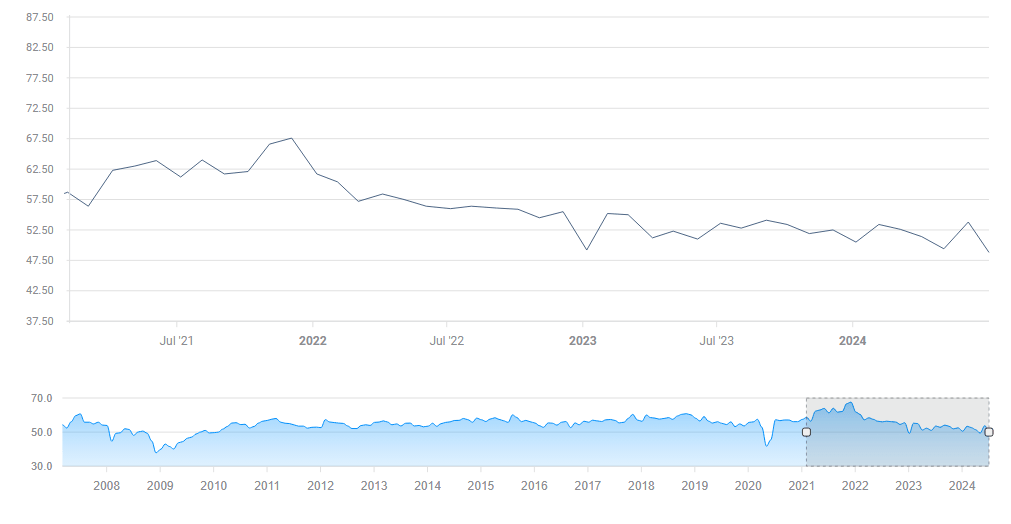
ISM Services PMI. Source: FXStreet
I believe markets are expecting a worse result following recent data, and merely hitting 50 — the threshold that separates expansion and contraction — would provide a sigh of relief.
4) RBA decision serves as a test of the central bank 's reaction
Tuesday, 4:30 GMT. The Reserve Bank of Australia (RBA) is expected to leave rates unchanged at 4.35%. However, there is room for a rate cut, given the softer Trimmed Mean Consumer Price Index (CPI) in the second quarter.
More importantly, there is a small chance that the recent market rout may push the RBA to soothe markets. That would raise expectations for an emergency move by the Federal Reserve, providing hope to markets.
I expect RBA Governor Michelle Bullock and her colleagues to keep borrowing costs unchanged, trying to convey a message of business as usual. While remaining calm may be the right policy for Australia, I expect it to cause more jitters in broader markets, giving a sense that central bankers are disconnected.
5) US Jobless Claims stand out after last week's jump
Thursday, 12:30 GMT. The ISM Manufacturing PMI was one catalyst for stock-market sales, and the rise of weekly Unemployment Claims to 249,000 last week also added to worries. With no top-tier releases left in the week, jobless claims will have a substantial impact on markets.
Jobless claims are creeping up
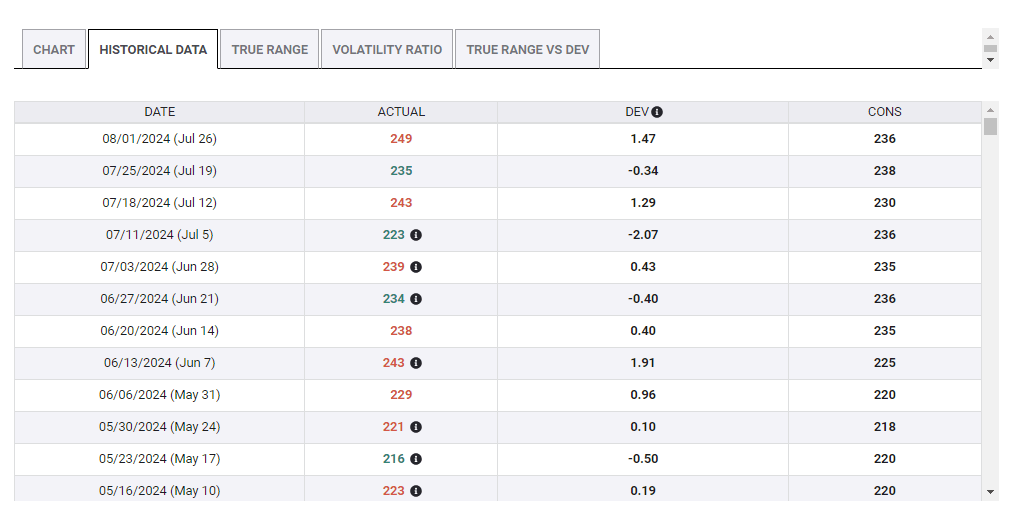
US jobless claims. Source: FXStreet
Economists expect a similar read of 250,000, pointing to stabilization at higher levels but not raising any alarms. Any upside surprise would trigger fresh market fears, while any decline would soothe investors.
The current focus on jobless claims is similar to the one in March 2020, when investors were eager to receive high-frequency data about the impact of COVID-19. Once again, low liquidity also adds to the outsized responses.
Final thoughts
Volatility has surged recently, and even if markets turn back up, extreme movements are here to stay. I recommend trading with care or plainly going on vacation instead of trading in such extreme conditions.
Premium
You have reached your limit of 3 free articles for this month.
Start your subscription and get access to all our original articles.
Author
Yohay Elam
FXStreet
Yohay is in Forex since 2008 when he founded Forex Crunch, a blog crafted in his free time that turned into a fully-fledged currency website later sold to Finixio.