Fed’s FOMC still sees two rate cuts in 2025
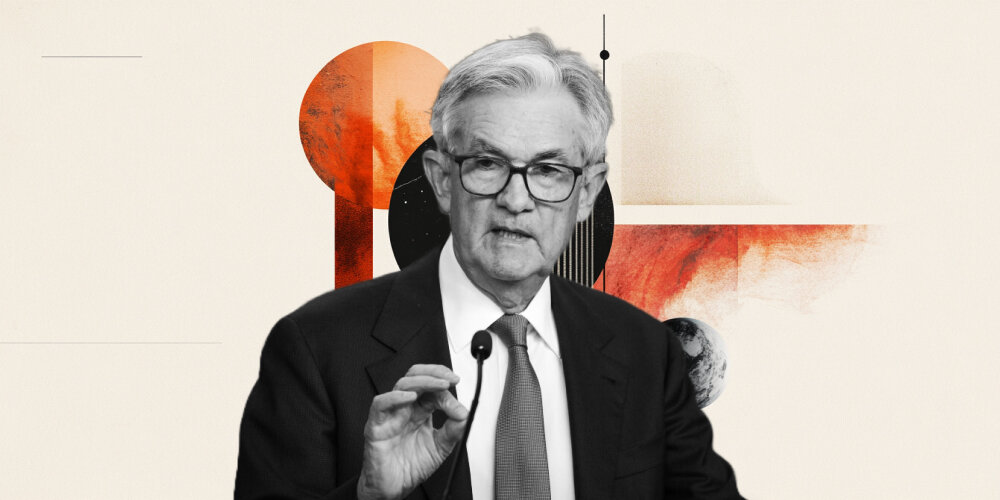

But there were no cuts at the March FOMC meeting.
Stocks were rising on Wednesday afternoon following the Federal Open Market Committee’s (FOMC’s) meeting on the federal funds rate.
The FOMC did not make any changes to rates, holding them at the 4.25% to 4.50% range for the second straight meeting. That was widely expected.
But the reason for the slight uptick in markets after the FOMC’s statement was released may have had to do with the committee’s quarterly summary of projections.
The FOMC’s summary, or dotplot, calls for two rate cuts in 2025, and a median federal funds rate of 3.9%. While just a projection by the committee members, and subject to change, the fact that the majority maintain a two-rate-cut scenario this year was likely encouraging for investors, given inflation and economic concerns.
The committee anticipates two more cuts in 2026 to 3.4% and one cut in 2027 to 3.1% — same as December’s projections.
However, the FOMC has a more pessimistic view on economic growth, lowering the GDP projection to 1.7% at the end of 2025, down from 2.1% in December. But considering there have been talks of recession following trade wars and tariffs, perhaps the 1.7% growth, while lower, was somewhat reassuring.
GDP growth is targeted at 1.8% for both 2026 and 2027, which is also down from December.
In addition, the summary anticipates PCE inflation to end the year at 2.7%. PCE inflation in January was at 2.5%, so it would be up from that. Core PCE inflation is pegged at 2.8% by year’s end, up from 2.6% in January. The FOMC does see PCE inflation falling to 2.2% in 2026 and to its 2.0% target by the end of 2027.
Uncertainty has increased
The FOMC’s statement contains the typical boilerplate language, but with a few exceptions. Most notably, the statement said, “Uncertainty around the economic outlook has increased. The committee is attentive to the risks to both sides of its dual mandate.”
In a press conference, Powell was asked about the impact of tariffs on inflation. He acknowledged that a “good part” of the Fed’s expectations of higher inflation was due to tariffs, but he added that the impact remains to be seen.
“Everybody is forecasting some inflation effect from tariffs,” Powell said, reported NPR. “We’re at a stage where we’re still very uncertain about what will be tariffed, for how long, at what level. We’re going to have to wait and see all of that.”
Slowing pace of balance sheet reduction
It was also notable that the FOMC said that, starting in April, “the committee will slow the pace of decline of its securities holdings by reducing the monthly redemption cap on Treasury securities from $25 billion to $5 billion.”
In layman’s terms, that means it will sell $5 billion worth of Treasuries per month instead of the usual $25 billion. This is a sign that the Fed is concerned about the economy and is looking to give it a boost. This move is effectively designed to encourage consumers to borrow and businesses to spend and invest.
“This dovish move is likely to provide the market with the reassurance it has been seeking,” wrote analyst Charles Hayes for AI Invest. “By slowing the pace of QT, the Fed is effectively reducing the pressure on long-term interest rates, which could lead to a decrease in these rates.”
The FOMC added that it is prepared to adjust the stance of monetary policy as appropriate if risks emerge.
“The Committee’s assessments will take into account a wide range of information, including readings on labor market conditions, inflation pressures and inflation expectations, and financial and international developments,” the statement read.
The vote to hold rates at 4.25% to 4.50% was unanimous. However, FOMC member Christopher Waller voted against reducing the pace of decline of its securities holdings.
Author
Jacob Wolinsky
ValueWalk
Jacob Wolinsky is the founder of ValueWalk, a popular investment site. Prior to founding ValueWalk, Jacob worked as an equity analyst for value research firm and as a freelance writer. He lives in Passaic New Jersey with his wife and four children.