Federal Reserve preview: Fed to hold the line, but cuts are coming


The jobs market continues to hold up despite concerns about a cooling economy, while officials remain nervous about the effect of tariff-induced price hikes on inflation. We see no interest rate cut this month, but the Fed is expected to start laying the groundwork for a move, most likely in December.
Fed set to hold on firm jobs and inflation uncertainty
The market is currently pricing virtually zero chance of a rate cut on 30 July, despite President Trump pushing the Fed to lower interest rates immediately and two of his appointees to the Federal Reserve, Chris Waller and Michelle Bowman, saying they could support such action. However, the rest of the committee feels they have time to wait, especially in light of the recent firmer-than-expected June jobs report and ongoing uncertainty about how inflationary the president’s tariffs will be.
Inflation has been well behaved recently, posting 0.1% and 0.2% month-on-month readings between February and May, but we always suspected it would be three months from April/May before the tariffs showed in the data. That means the July, August and September CPI reports are where we see the potential for 0.4% MoM or even 0.5% prints. The Fed was stung by criticism after suggesting the post-pandemic supply shock price hikes would be “transitory”, only for inflation to hit 9% in 2022. It will not want to cut rates on a hunch and only have to backtrack again if inflation becomes more persistent.
As such, we believe this meeting will be a non-event with rates left on hold and quantitative tightening likely left unchanged.
But the groundwork for cuts will be laid
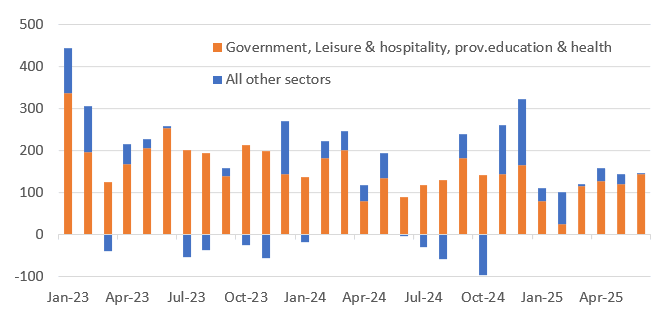
Nonetheless, interest rates are likely to be cut before the end of this year. Consumer confidence has weakened and spending is stalling on fears over squeezed household spending power, volatility in wealth and concerns about a cooling jobs market. In that regard, nearly 90% of all jobs added over the past two-and-a-half years have been in just three sectors: government, leisure & hospitality and private education & healthcare services. All other sectors, which are the key drivers of the US economy growth cycle – technology, business services, manufacturing, construction, and so on – have added an average of only 23,200 per month over that period.
As for inflation, we believe that tariffs are a one-off price adjustment and the month-on-month inflation rates will swiftly drop back to more benign readings later this year. Energy costs are contained, and the weaker jobs market means that wage growth, which contributed to the acceleration in inflation in 2021/22, is not strong enough to do so this time round. Moreover, the shifting dynamics of the housing market will mean housing costs, which have been a major driver of inflation in recent years, will increasingly become a source of disinflationary pressure as rents moderate.
Contribution to monthly changes in Nonfarm Payrolls (000s)
Source: Macrobond, ING
December versus September rate cuts
Right now, the market thinks that the Fed could be in a position to cut rates in September with 16bp of a potential 25bp cut priced. We are not so sure. With inflation likely to be pushed higher by tariffs over the next few months, we are unlikely to get confirmation of more benign MoM inflation prints until the October and November reports. Obviously, this comes after the September FOMC and October FOMC meetings so we would need to see significant weakness in jobs to trigger a rate cut by then. There is little sign of that happening right now. This suggests President Trump’s frustrations with Jerome Powell will intensify and incentivise him to seek a more dovish replacement for when Powell's term as Fed Chair ends early next year.
Consequently, we think December will be the likely starting point, but that it may be a 50bp cut, if the evidence on weaker jobs and GDP growth becomes more apparent as we anticipate. This would be a similar playbook to the Federal Reserve’s actions in 2024, where it waited until it was completely comfortable to commit to a lower interest rate environment. Then it made a 50bp move in September, followed by 25bp cuts in November and December.
Fed could provide some Dollar support in a busy week
It has been unclear how much the threat of Trump firing Powell has weighed on the dollar this month. Certainly, there have been moments when the dollar came under broad-based pressure when reports of a move were imminent. Yet short-dated US rates look to be ending the month a little firmer, helping to provide the dollar a little support in an otherwise pervasively bearish environment.
Unless the FOMC statement, the voting pattern or Chair Powell in his press conference surprises us by incorporating some of the dovish ideas espoused by the likes of Christopher Waller, we suspect the dollar will stay supported. This is especially so since the day after we receive the release of the June core PCE data, which should start to show the pick up in inflation we expect this summer.
The dollar is also facing a major event risk on Friday, with the deadline for tariff agreements and, perhaps more significantly, the release of the July jobs report. As long as the jobs picture holds up, firmer inflation may well delay the restart of the Fed easing cycle and provide the dollar with a lift this summer. If the dollar is to get that lift, it may be more against the low-yielding Japanese yen and Swiss franc. This is because the market is pricing August as a low volatility month after the 1 August event risk is out of the way, and the carry trade (yen and franc bearish) looks set to remain popular. This also assumes that the momentum towards US trade deals continues through EU and Chinese discussions, and that the commodity currencies remain in demand due to improved global growth prospects. And in theory, trade deals should mean less support for the low-yielding safe-haven currencies which did so well during the tariff stress in early April.
In all, we think there's a chance USD/JPY trades up to 150 over the coming weeks, especially if Japanese Prime Minister Shigeru Ishiba resigns. EUR/USD could correct back to 1.15/16 if we're right with the Fed/resilient labour market story. USD/CHF could trade back to 0.81. And the undervalued commodity currencies both in the G10 and EM world could continue to outperform should the threat of tariffs continue to erode.
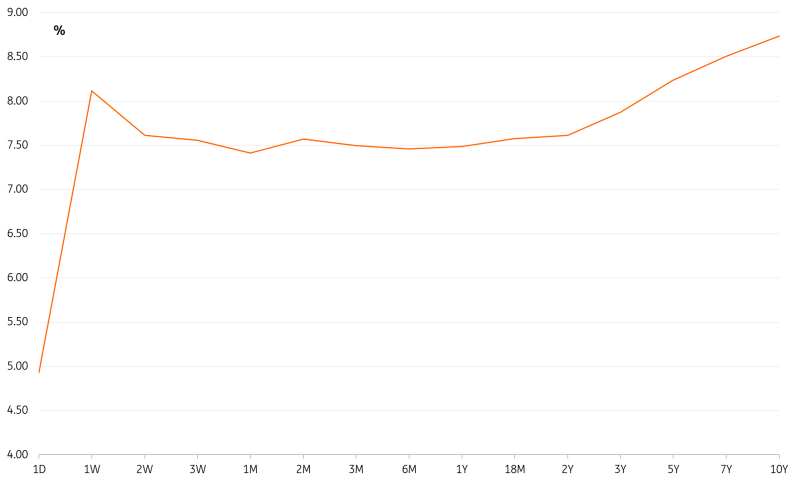
EUR/USD traded volatility curve (ATM strikes, %)
Source: Refinitiv, ING
Read the original analysis: Federal Reserve preview: Fed to hold the line, but cuts are coming
Author
ING Global Economics Team
ING Economic and Financial Analysis
From Trump to trade, FX to Brexit, ING’s global economists have it covered. Go to ING.com/THINK to stay a step ahead.