Federal Reserve Preview: Dots before our eyes
- Fed Funds 2.25%-2.5% target range not in contention at this FOMC
- Market focus will be on the Projection Materials
- December listed GDP 2.3% in 2019, 2.0% in 2020; PCE inflation 1.9% and 2.1%; Fed Funds 2.9% and 3.1%; unemployment rate 3.5% and 3.6%.

The Federal Reserve will conclude its two day policy setting Federal Open Market Committee (FOMC) meeting on Wednesday March 20th. It will issue its rate decision, FOMC statement and Projection Materials at 2:00 pm EDT, 18:00 GMT. Chairman Jerome Powell will hold a news conference beginning at 2:30 pm EDT, 18:30 GMT.
US Economy
By most measures the US was doing well at the end of last year.
The American economy is expected to have expanded at a quarterly average of 3.05% in 2018 when the final revision of fourth quarter GDP is released on March 29th (forecast 2.4%). This would be the first 3% growth since 2004.
In December the 12-month moving average for non-farm payrolls of 223,250 was the highest in 33 months. In January payrolls soared to 311,000.
The unemployment rate declined in 2018 from 4.1% to 3.8%, a level that in prior decades would have been considered full employment and sent the Fed queuing rates hikes to forestall an overheating economy and wage inflation. Increases in average annual earnings had been at 3.3% for the final quarter of last year the best since before the recession.
Business and consumer sentiment while down from their highs in the summer and fall were at eminently respectable levels of economic activity in December. Even the ISM manufacturing PMI which had the largest year end drop to 54.3 was still firmly in growth.
Projection Materials
Yet despite the seemingly buoyant US economic news the Fed surprised markets by reducing its economic projections for the first time in two years. Estimated growth in 2019 dropped from 2.5%, where it had been since September 2018 when it was upgraded from 2.4%, to 2.3% its lowest estimate since 2.1% in the December 2017 projections. Headline PCE inflation dropped to 2.0% from 2.1%. The core PCE inflation forecast for 2129 slid to 2.0% from 2.1%.

Reuters
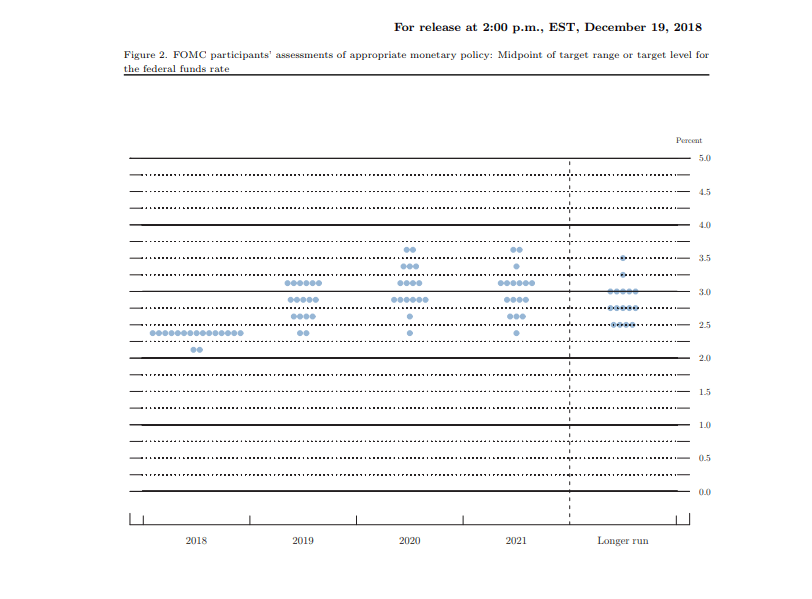
Most importantly the Fed Funds projection for the end of 2019 decreased to 2.9% from 3.1%. The number of rate increases anticipated by the governors in 2019 fell from three to two.
In September 2018 the median projection for the Fed Funds rate two years hence at the end of 2020 had been 3.4%. In the December materials than had fallen to 3.1%, cutting the increases in 2020 from two to one.
The FOMC mid-point rate projections for each of the years covered in the materials are displayed as graphically plotted dots, rates against year. This is the origin of the term ‘dot plot’ and all its witty derivatives.
Federal Reserve
FOMC Statement
The December FOMC statement did not address the changed projections. Chairman Powell in his written statement before his press conference and in response to questions cited several issues external to the US economy including, the trade dispute with China, slowing global growth and the British exit from the European Union as reasons for the Fed’s curtailed expectations. Mr. Powell and other Fed officials elaborated this logic in the following weeks
The January 30th FOMC statement incorporated the new economic outlook. “In light of global economic and financial developments and muted inflation pressures, the Committee will be patient as it determines what future adjustments to the target range for the federal funds rate may be appropriate to support these outcomes.” Mr. Powell again enumerated the governors concerns in his press conference.
The lowered expectations for the US economy in the Fed December projections, the January FOMC statement, particularly the use of the word “patient” and the cautious tone of Fed officials since the December meeting has convinced markets that the Fed is in a prolonged pause in its three year old rate normalization campaign.
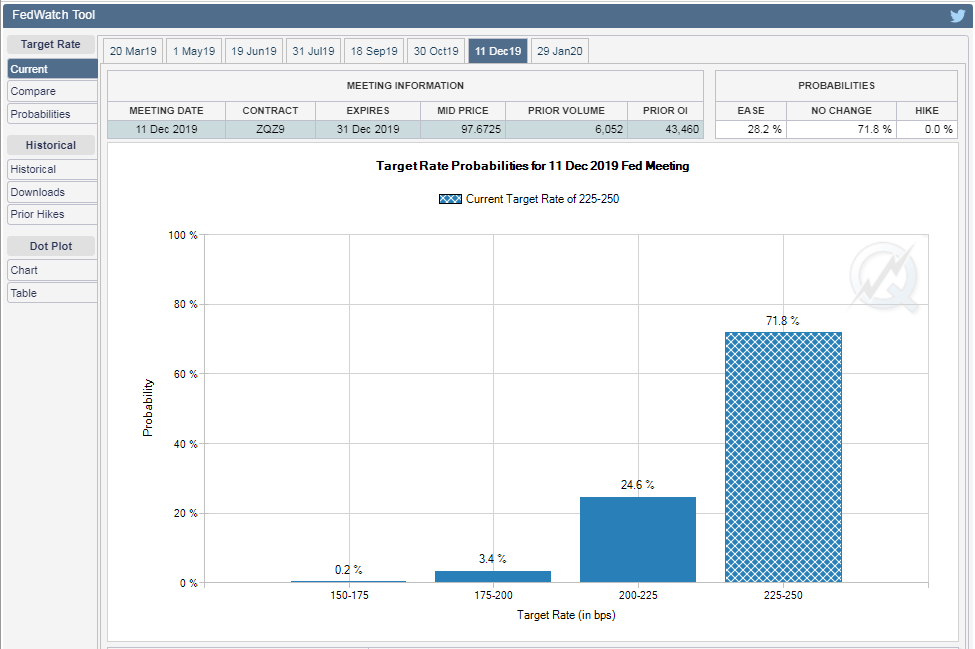
Fed funds futures have a 71.8% probability that there will be no change from the current fed funds rate by the end of the December 11th 2019 FOMC meeting. The probability that there will a reduction is 28.2%.
CME Group
The Fed began holding press conferences after each FOMC meeting in January this year. In prior years there were press conferences and questions for the Chairman only four times a year at the meetings in January, March September and December when new Projection Materials were released.
Market Rates, the Dollar and the Fed Projections
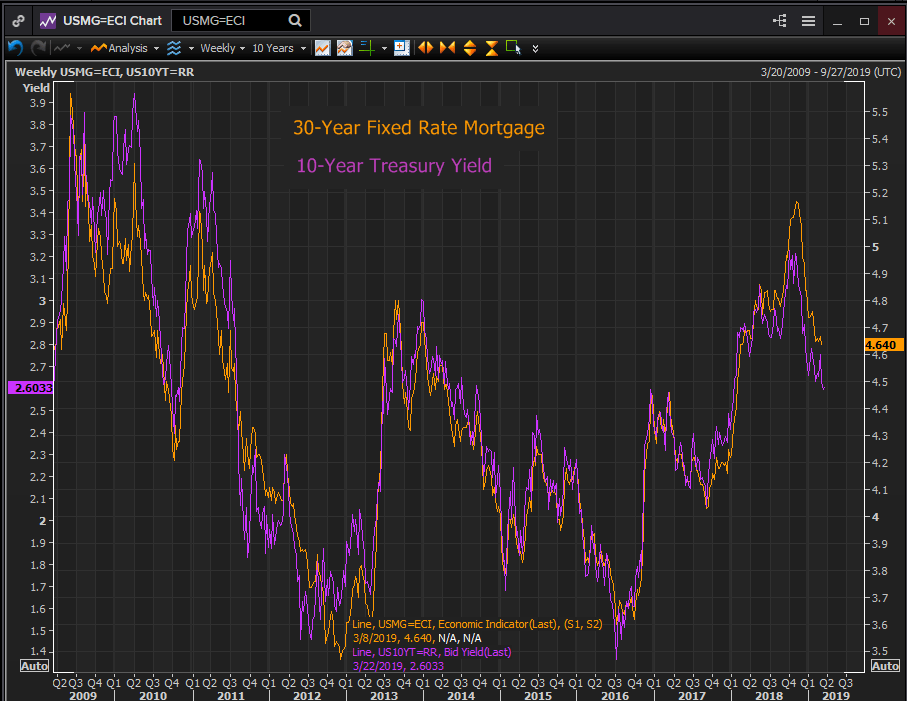
The yield on the 10-year Treasury, on which many commercial market rates are based, peaked at 3.23% on November 8th 2018. By the Fed meeting that began on December 18th it had already fallen 41 basis points to 2.82%. On January 3rd it traded down to 2.55%, then recovered to 2.78% by January 18th and has trended lower since closing at 2.60% on March 18th.
Mortgage rates have declined with Treasury yields. The 30-year fixed rate loan closed at 4.65% on March 22nd, 48 basis points lower than its eight year top at 5.17% on November 9th 2018.
Reuters
The dollar has been in a narrow trading range for almost five months as concerns over changing circumstances in the US economy and the Fed’s rate pause have blunted the American currency’s rate and economic growth advantage. The Atlanta Fed’s latest GDPNow first quarter estimate is just 0.4%.
Even the recent European Central Bank restart of its commercial loan program just months after ending its bond purchases has not moved the currency markets waiting for the ends of the Brexit and US-China trade dramas.
In this environment any change in the Fed’s economic and rate projections takes on an unusual importance. If there are new economic estimates Chairman Powell’s explanations will likely come as an afterthought to the market judgement.
Author

Joseph Trevisani
FXStreet
Joseph Trevisani began his thirty-year career in the financial markets at Credit Suisse in New York and Singapore where he worked for 12 years as an interbank currency trader and trading desk manager.

















