Fed Emergency Cut Falls Flat, BoC Next

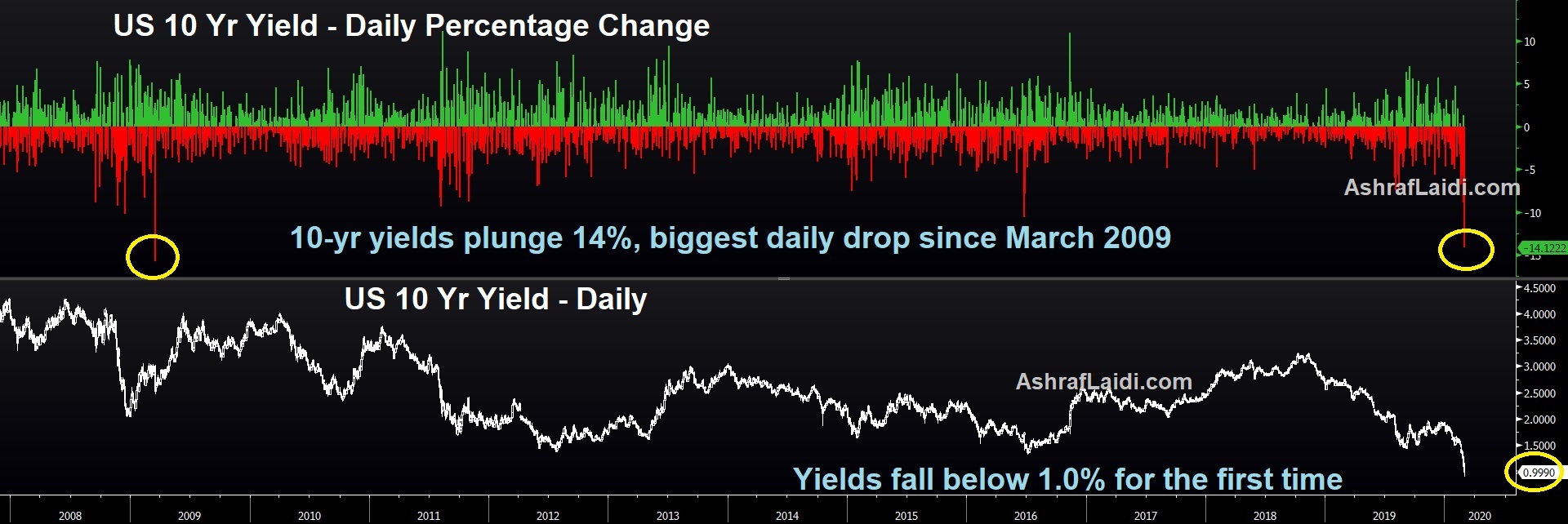
The Federal Reserved has delivered its first intermeeting rate cut since Oct 2008, one week after stocks posted its biggest weekly decline since ...Oct 2008. The Global central banks failed to deliver a coordinated cut after a bland G7 statement but the Federal Reserve did with a 50 bps move. Yields on the US 10-year govt bond fell below 1.0% for the 1st time. Oil and US stocks initially spiked higher on the news but the reaction lasted only minutes as a 'sell the fact' trade hit hard. A consistent reaction throughout the day was weakness in USD/JPY and jumps in bonds and gold. Also keep an eye on the US Democratic presidential primaries in 14 US states and Bernie Sanders' road expandinhg his lead over Joe Biden. Friday's Premium short in EURUSD is currently in a 220-pip gain.
The problem with the Fed surprise cut is that it was framed – unfairly or not – as an 'emergency' measure and to companies and Main Street all that does is underscore that coronavirus is an emergency. The S&P 500 jumped 80 points in seconds on the initial headlines but quickly gave it all back and closed down 86 points, or 2.8%.
As we warned yesterday, “Even if cuts are delivered the effect could be fleeting as investors continue to grapple with an seemingly endless stream of headlines about the virus.”
This isn't a financial crisis and it won't be solved by financial measures. Undoubtedly, lower rates will help in a rebound but that won't come until there is some visibility towards an end to the pandemic. Once again on Tuesday there was an endless stream of bad news about infections and deaths. The WHO revised its estimate of fatality rates higher to 3.4%, which is certainly a scary number to ponder with little chance now that the virus can be contained.
The Bank of Canada is the next central bank on deck with a decision coming Wednesday at 1500 GMT. A 25 bps cut is fully priced in and 50 bps is a 65% probability in the OIS market. The BOC has said recently that it doesn't want to fall behind the Fed so 50 bps is far more likely and 75 bps is a real possibility because Poloz may want to get ahead of a further March 18 Fed cut.
In any case, the bond market is way ahead of both of them. US 2-year yields hit 0.62% at the lows Tuesday and 10-year yields hit at record low of 0.90%. In a world where the Fed's mandate is to get inflation to 2% that looks like an overreaction but it also seems reasonable in a world where the Fed will seemingly do whatever it can to keep equity valuations high.
Author

Adam Button
AshrafLaidi.com
Adam Button has been a currency analyst at Intermarket Strategy since 2012. He is also the CEO and a currency analyst at ForexLive.