Export Prices Down 4th Time in 5 Months


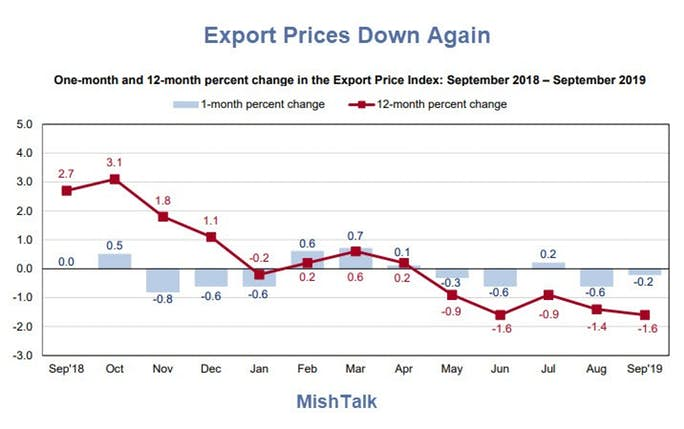
Export prices fell for the fourth time in five months while import prices rose slightly.
This morning the BLS released its US Import and Export Price Indexes. Let's take a look.
Exports
All Exports: The price index for U.S. exports declined 0.2 percent in September following a 0.6-percent drop in August and a 0.2-percent advance in July. Price declines for agricultural and nonagricultural exports each contributed to the September decrease. U.S. export prices fell 1.6 percent from September 2018 to September 2019.
Agricultural Exports: Agricultural export prices declined 1.8 percent in September, after falling 2.3 percent in August. Lower prices for corn, meat, wheat, and soybeans each contributed to the decline, more than offsetting higher fruit prices. Despite the decrease in September, agricultural export prices advanced 0.2 percent over the past year.
All Exports Excluding Agriculture: Prices for nonagricultural exports edged down 0.1 percent in September following a 0.3-percent drop the previous month. Price declines for nonagricultural industrial supplies and materials, consumer goods, and automotive vehicles drove the September decrease. Capital goods prices were unchanged in September. The price index for nonagricultural exports decreased 1.9 percent from September 2018 to September 2019. Lower nonagricultural industrial supplies and materials prices more than offset price increases for capital goods, consumer goods, and automotive vehicles over the past year.
Imports
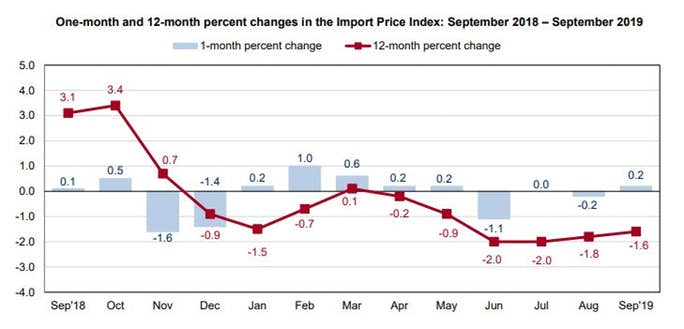
All Imports: Prices for U.S. imports advanced 0.2 percent in September, after decreasing 0.2 percent in August and unchanged in July. The price index for U.S. imports has not recorded an increase larger than 0.2 percent since the index rose 0.6 percent in March. U.S. import prices declined 1.6 percent from September 2018 to September 2019.
Fuel Imports: Import fuel prices rose 2.1 percent in September following a 1.9-percent decline in August. Higher prices for petroleum drove the September increase, more than offsetting lower natural gas prices. The price index for import petroleum advanced 2.3 percent in September, after declining 2.3 percent the previous month. In September, natural gas prices fell 3.7 percent, resuming a downward trend after the rise in August. Fuel prices decreased 5.1 percent over the past year. Prices for import petroleum fell 5.8 percent from September 2018 to September 2019. Natural gas prices declined 10.4 percent over the same period.
All Imports Excluding Fuel: Prices for nonfuel imports edged down 0.1 percent in September following two consecutive months unchanged. Foods, feeds, and beverages prices declined 0.8 percent; in contrast, nonfuel industrial supplies and materials prices rose 0.5 percent. The price index for nonfuel imports declined 1.1 percent over the past 12 months, led by price decreases for capital goods and nonfuel industrial supplies and materials.
Nonfuel Industrial Supplies and Materials: Prices for nonfuel industrial supplies and materials increased 0.5 percent in September, after falling 0.3 percent in August and rising 0.2 percent in July. The increase in September was driven by higher prices for nonferrous metals and lumber, which more than offset price decreases for chemicals.
Finished Goods: Prices for imported finished goods were unchanged in September. Consumer goods prices were unchanged following a 0.1-percent increase in August. Lower prices for household goods were offset by price increases for coins, gems, jewelry, and collectibles. The price index for automotive vehicles was unchanged for the second consecutive month, after decreasing 0.2 percent in July. Prices for capital goods were unchanged in September, after edging down 0.1 percent the previous month.
Foods, Feeds, and Beverages: The price index for import foods, feeds, and beverages fell 0.8 percent in September following a 0.5-percent drop in August. A 7.6-percent decrease in fruit prices, which more than offset higher coffee prices, drove the September decline.
Author
Mike “Mish” Shedlock's
Sitka Pacific Capital Management,Llc

















