Exploring the widening gap between GDP and GDI

Summary
While it is generally something of an anomaly, it is not unprecedented for growth in income to fall behind growth in expenditures. This can happen for any number of reasons from labor market challenges to corporate profitability concerns to external trade dynamics. This report looks at why it is happening now and what it says about the likelihood of recession.
Q2 GDP growth held steady, but movement under the hood
The third estimate of real GDP growth released last week included benchmark revisions going back 10 years. The data showed the U.S. economy expanding at a 2.1% annualized rate during the second quarter. While unchanged from the second estimate, there was some substantial movement in the underlying components. Growth in real personal consumption expenditures (PCE) was revised down 0.9 percentage points (pp) to just a 0.8% annualized rate, while the growth rate in gross private investment was revised up 1.9pp to a sturdy 5.2% annualized rate.
The marked deceleration in PCE appears to be mostly driven by benchmark revisions, but the reduction in PCE’s contribution to Q2 GDP growth (0.55pp from 1.14pp previously) signals less momentum in consumer spending than previously thought. Elsewhere, the revisions showed a 4.9pp boost to growth in non-residential construction, which helped lift growth in total business fixed investment to a 7.4% annualized rate, and an upwardly revised $14.9B inventory build translated into a neutral force on topline GDP growth. All these adjustments left real GDP up 2.4% on a year-over-year basis, in line with the second estimate and its 2019 average.
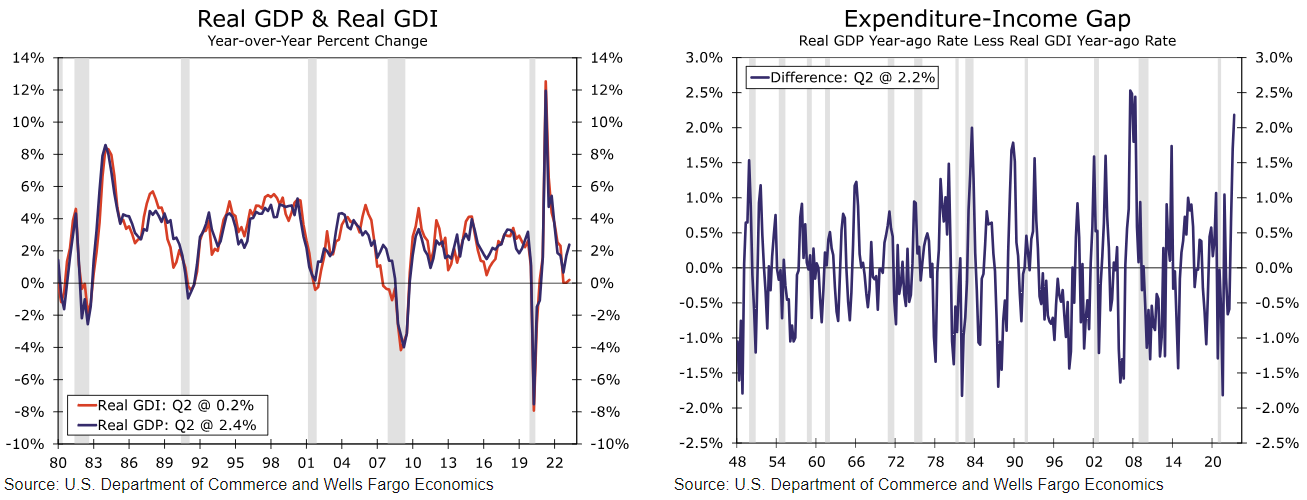
What is most interesting to us is that the gap between real GDP and real gross domestic income (GDI) remains unusually wide in this updated Q2 data. As seen in Figures 1 and 2, real GDI was up just 0.2% on a year-ago basis in Q2, leading to the widest gap (2.18pp) between real GDP and real GDI since 2008. In theory, the two measures should be the same, though in practice they can differ because they are constructed using independent source data. In the parlance of the BEA, this difference is called the statistical discrepancy. GDP looks at the expenditure side of the economy, while GDI tallies the income side.
Author
Wells Fargo Research Team
Wells Fargo

















