Expectations and Evolution Along the Yield Curve

Financial markets have moved in anticipation of Trump administration policy actions. Will interest rates evolve along the patterns represented by these expectations? We suspect the fundamentals are in line.
Yield Curve as a Benchmark for Expectations
As illustrated in the top graph, the yield curve has shifted upward following Donald Trump's election. We view this shift as a product of an increase in expectations for growth and inflation as well as Federal Reserve policy actions. For growth, financial markets appear to be discounting some combination of additional federal spending (infrastructure/defense), income tax cuts (both corporate and individual) as well as a turn in federal regulatory actions toward some deregulation. These actions all hint at higher real economic growth.
Yet, in the context of current fiscal trends, additional federal spending along with tax cuts would signal rising federal deficits. These deficits may represent a problem in a closed economy with a fixed trend growth rate. For now, additional capital inflows, signaled by a stronger dollar, would take up some of the deficit financing as global capital inflows seek higher interest rate returns as well as an expectation of greater real returns in equities as the economy improves.
Rising Inflation as a Driving Force
Inflation trends represent an interesting reversal of risk and reward compared to the Trump election. While the prior years of the expansion highlighted deflation risks, the outlook now is for a steady rise in the inflation rate towards the Fed's two percent target (middle graph). In fact, inflation, as measured by the benchmark PCE deflator, had already started to rise in the second half of 2016 as labor costs began to rise and non-labor costs picked up as well. A tighter labor market is the most visible source of rising inflation with a resulting increase in unit labor costs.
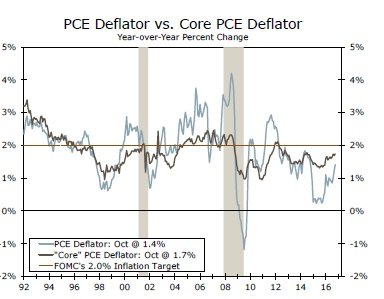
As a market proxy, we note that five-year five years forward rates on Treasury securities have shifted upward, providing support for the expectation of rising inflation and an upward shift in the yield curve.
Inflation Validates the Dot Plot
Rising inflation provides the Fed with the opportunity to raise the funds rate in a way that appears to simply validate prior financial market movements and the Fed's own dot plot (bottom graph). The fundamentals of continued economic growth, rising inflation and significant capital inflows provide a basis for our expectation that the recent rise in benchmark two- and ten-year rates will be sustained and will increase in the year ahead. We expect that the yield curve spread between ten- and two-year Treasury yields will flatten as the year progresses.
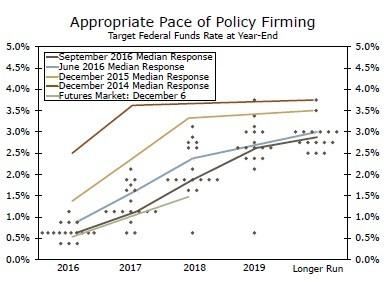
We have not raised the pace of FOMC actions in 2017 as we see the pace of inflation to be consistent with the Fed's dot plot and thereby not requiring more aggressive action. In addition, the strength of the dollar will moderate imported goods inflation and increase the import drag on real GDP growth.
Author
Wells Fargo Research Team
Wells Fargo

















