Existing Home Sales Unexpectedly Decline

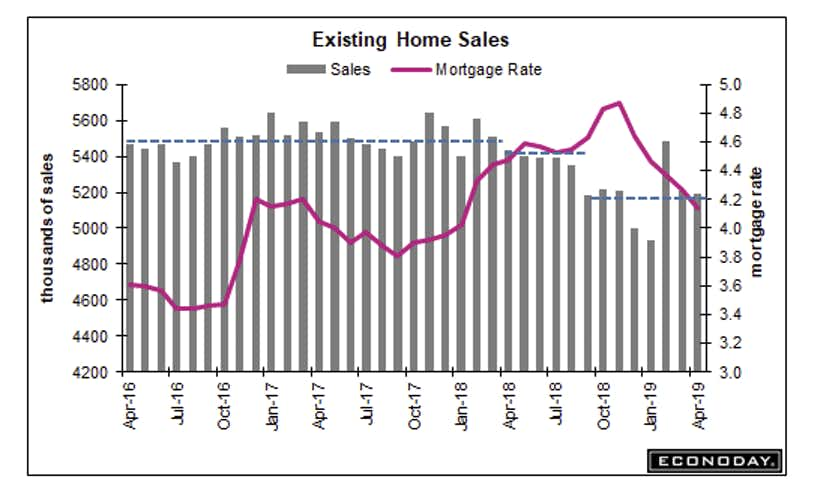
Existing homes sales fell 0.4% in April. The Consensus expected a rise.
The National Association of Realtors (NAR) reports Existing-Home Sales Inch Back 0.4% in April.
Existing-home sales saw a minor decline in April, continuing March’s drop in sales, according to the National Association of Realtors®. Two of the four major U.S. regions saw a slight dip in sales, while the West saw growth and the Midwest essentially bore no changes last month.
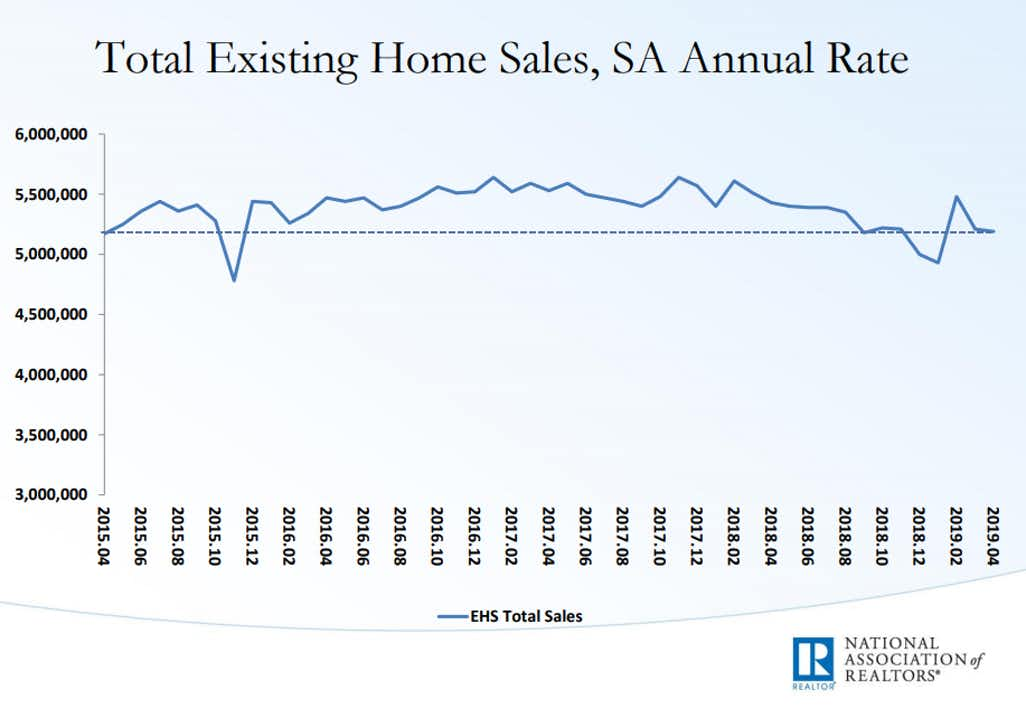
Total existing-home sales, completed transactions that include single-family homes, townhomes, condominiums and co-ops, fell 0.4% from March to a seasonally adjusted annual rate of 5.19 million in April. Total sales are down 4.4% from a year ago (5.43 million in April 2018).
Nobody Concerned
- Lawrence Yun, NAR’s chief economist, said he is not overly concerned about the 0.4% dip in sales and expects moderate growth very soon. “First, we are seeing historically low mortgage rates combined with a pent-up demand to buy, so buyers will look to take advantage of these conditions,” he said. “Also, job creation is improving, causing wage growth to align with home price growth, which helps affordability and will help spur more home sales.”
- “I think the market had a bit of a slow start in the Fall, but Realtors® all over the country have been telling me that April was a nice rebound. We’re hopeful and expect that this will continue heading into the summer,” said NAR President John Smaby, a second-generation Realtor® from Edina, Minnesota and broker at Edina Realty.
Cheery Note by Econoday
Econoday was also in on the cheerleading.
Trends are still improving though existing home sales in April came in below Econoday's consensus range, at a 5.190 million annual pace for a 0.4 percent decline from March. There are no revisions in today's report.
Housing data are often volatile and 3-month averages can offer a more balanced view, and on this basis April's results are still favorable at a 5.293 million rate for the best showing since September last year. Sales of single-family homes, the key component in this report, did fall 1.1 percent in the month to a 4.620 million rate but here too the 3-month average is positive, at 4.733 million for the best showing since August last year. Condo sales, the second and much smaller component in the report, were a big positive in April, up 5.6 percent to a 570,000 rate.
Supply is a key positive in April's results with a 9.6 percent jump in total resales on the market, at 1.830 million that lifts supply relative to sales to 4.2 months from 3.8 months in March. The movement here likely reflects this year's pick up in the new home market as buyers put their existing home sales on the market to move up to a new home.
Three-Month Average
A three-month average depends on a unsustainable surge in April. The last of the three sets of dotted lines on the above chart show approximately what the 4-, 5-, and 6-month average would look like.
There is no indication of a trend change yet.
Existing Home Sales 2015-Present
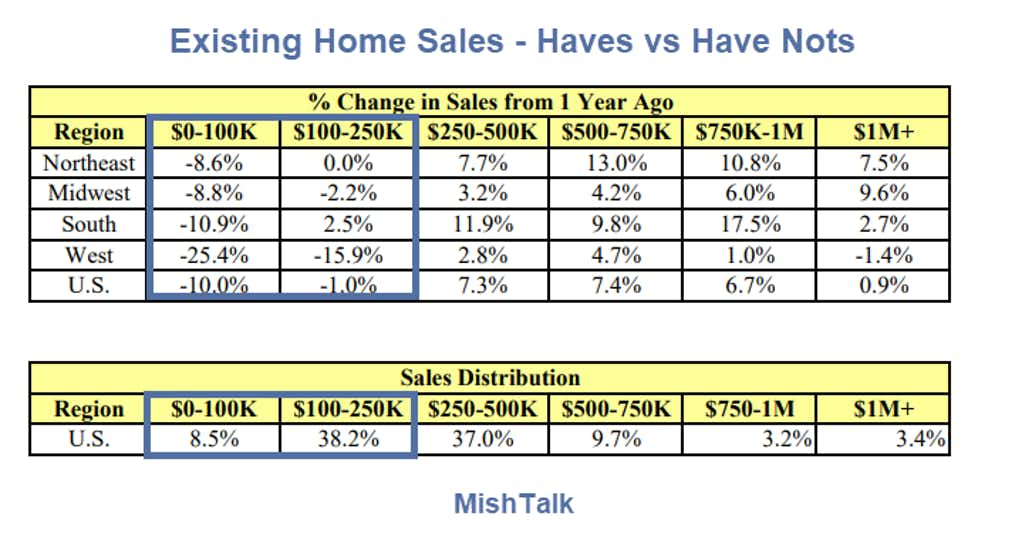
Existing Home Sales by Price
Trends
Homes prices in the $100,000 to $250,000 constitute the largest percentage of sales at 38.2%. Sales are down year-over-year.
Homes priced $100,000 or less are down 10% year-over-year.
If the economy falters (and it will), don't expect the key $250,000 to $500,000 range (all ranges in fact) to do much of anything but sink.
Housing Bubble - What's Next?
Some claim the economy is in a bigger bubble now than in 2008.
I agree with that overall assessment, but the dynamics today are far different.
This bubble was fueled by junk bonds, QE, and zombie IPOs, not mortgages. The next bust will be radically different than the last.
Author
Mike “Mish” Shedlock's
Sitka Pacific Capital Management,Llc

















