Existing Home Sales Preview: Revived by falling rates?
-
Existing home sales expected to recover In January after a sharp fall in December
-
Home purchases have been falling for a year
-
Mortgage rates rose more than 1% from September 2017 to November 2018

The National Association of Realtors will release Existing Homes Sales for January at 10:00 am EST, 15:00 GMT on Thursday February 21st.
Forecast
Existing home sales are expected to rise 0.8% to a 5.0 million annualized rate in January following a 6.4% drop to 4.99 million in December.
US housing market and mortgage rates
Existing home sales which are also know as previously occupied homes are the largest segment of the US housing market, comprising about 90% of all purchases. The balance is newly constructed homes that are yet to be sold for the first time.
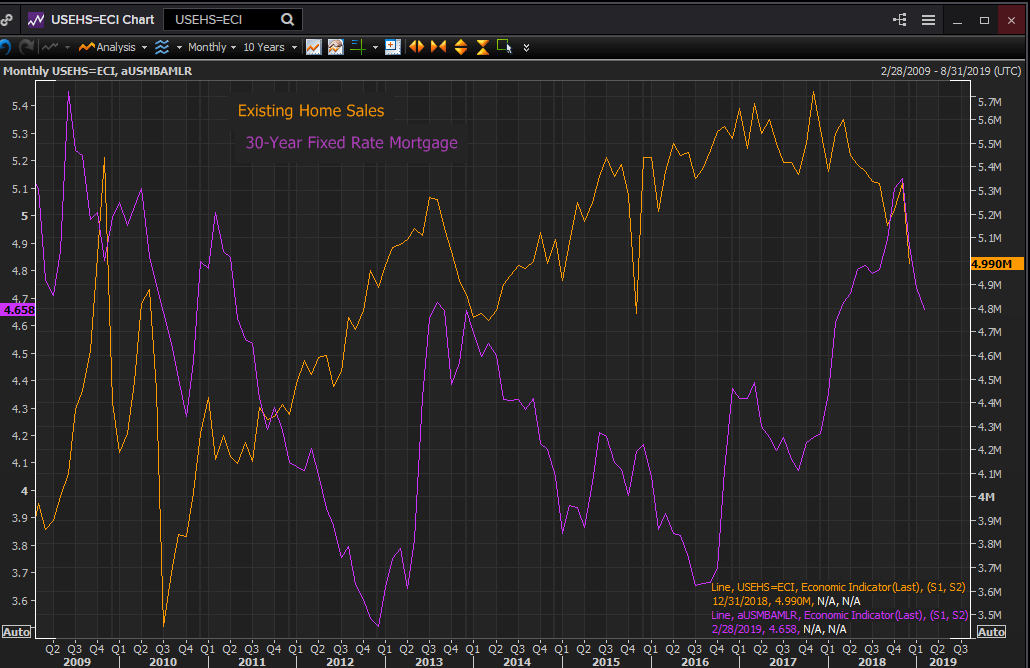
The recovery from the housing crash of the last decade took almost ten years. The post-recession peak of 5.72 million annualized units came a little over year ago in November 2017. December’s 4.99 million purchases represents a 12.8% decline.
The peak in home sales in November 2017 came two months after mortgage rates turned conclusively higher. From 4.074% for a 30-year fixed rate mortgage in early September 2017, rates followed the 10-year Treasury higher reaching 4.69% in March 2018; home sales declined to 5.60 million. By the next peak in rates at 4.86% that May, home sales were down to 5.41 million. September’s 4.96% rate brought sales down again to 5.15 million. The highest post-crash rate of 5.17% in the first week of November 2018 saw sales of 5.33 million and was followed by Decembers 6.4% fall to 4.99 million, the lowest total since November 2015.
Mortgage rates have declined quickly from the November peak as the market followed the Fed’s changing policy in December lower. By the third week in February the 30-year fixed rate mortgage was down to 4.658% more than half a point lower in four months.
Reuters
US Housing and the labor market
With the US labor market operating at full tilt prospective home buyers have excellent prospects for maintaining and improving their employment and wages, normally the two most important criteria for buying a home.
Home buyers may have become spoiled by the extremely low mortgage rates of the past five years which by historical standards are quite inexpensive.
Will the small recent reduction in mortgage costs convince buyers to return? Or will it take time until the realization that only a recession will bring mortgage rates back to their lows of the last five years?
Author

Joseph Trevisani
FXStreet
Joseph Trevisani began his thirty-year career in the financial markets at Credit Suisse in New York and Singapore where he worked for 12 years as an interbank currency trader and trading desk manager.